
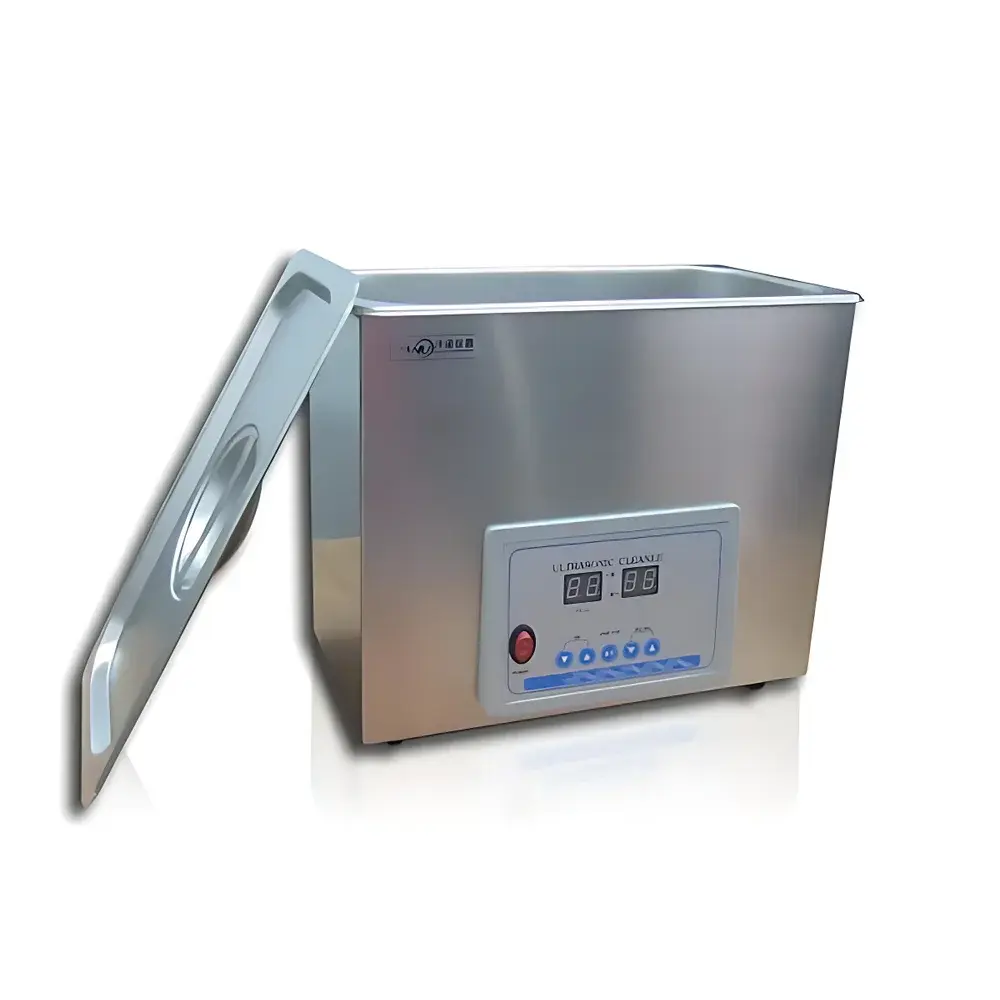
Hannuo HN22-500C Ultrasonic Cleaner
| Brand | Hannuo |
|---|---|
| Origin | Shanghai, China |
| Model | HN22-500C |
| Chamber Volume | 22.5 L |
| Heating Power | 500 W |
| Temperature Range | Ambient to 80 °C |
| Cleaning Medium | Aqueous Solutions |
| External Dimensions (L×W×D) | 500 × 300 × 150 mm |
| Frequency Options | 25 kHz / 45 kHz (switchable) |
| Ultrasonic Power Output | 0–100% adjustable |
| Display | LCD with timer memory and real-time temperature monitoring |
| Timer Range | 1–99 min |
| Cumulative Operating Hours Counter | up to 99,999 h |
| Construction | Stainless steel tank and housing |
Overview
The Hannuo HN22-500C Ultrasonic Cleaner is a benchtop laboratory-grade cleaning system engineered for precision, repeatability, and multi-functional utility in research, quality control, and production environments. It operates on the principle of ultrasonic cavitation—high-frequency sound waves (25 or 45 kHz) generate microscopic vacuum bubbles in aqueous cleaning solutions; their rapid collapse produces localized high-pressure shockwaves that dislodge particulate contaminants, biofilms, and residual organics from surfaces without mechanical abrasion. Unlike simple immersion baths, this unit integrates programmable digital control, dual-frequency transduction, adjustable power output, and precise thermostatic regulation—enabling optimized cleaning protocols across diverse sample geometries and soiling profiles. Its 22.5-liter capacity accommodates large-volume glassware, multi-well plates, surgical instruments, optical components, and industrial parts, while maintaining compliance with standard laboratory safety and operational workflows.
Key Features
- Dual-frequency operation (25 kHz for robust macro-cleaning; 45 kHz for delicate, high-resolution surface decontamination)
- 0–100% continuously adjustable ultrasonic power output, enabling method development and process validation
- Programmable digital timer (1–99 minutes) with non-volatile memory and cumulative operating hour counter (up to 99,999 h)
- Precise temperature control (ambient to 80 °C) with real-time LCD display and integrated 500 W heating element
- Stainless steel (304 grade) tank and exterior housing—corrosion-resistant, easy to sanitize, and compliant with ISO 13485 cleanroom-compatible material specifications
- Integrated drain valve and sound-dampening lid for safe, quiet, and ergonomic operation
- Microcontroller-based firmware architecture ensures stable performance, reproducible cycle execution, and low failure rate under continuous use
Sample Compatibility & Compliance
The HN22-500C supports a broad range of substrates including borosilicate glassware (vials, flasks, pipettes), stainless steel surgical tools, aluminum and titanium aerospace components, silicone tubing, ceramic filters, and polymer-based microfluidic devices. It is routinely employed in pre-analytical sample preparation workflows compliant with CLSI GP26-A4, ASTM D2603 (ultrasonic cleaning validation), and ISO 15883-1 (washer-disinfectors). While not classified as a medical device per FDA 21 CFR Part 820, its construction and thermal stability meet baseline requirements for GLP/GMP ancillary equipment used in pharmaceutical QC labs. All aqueous cleaning formulations—including alkaline detergents, enzymatic solutions, and low-foaming surfactants—can be safely deployed within its specified temperature envelope.
Software & Data Management
This model operates via embedded microcontroller firmware with no external PC dependency. All operational parameters—including time, temperature, frequency selection, and power level—are stored in non-volatile memory and recalled upon power-up. The LCD interface provides immediate visual feedback of setpoints and real-time values, supporting audit-ready manual log entries. For laboratories requiring electronic records, optional RS-232 or USB-to-serial adapters (sold separately) enable integration with LIMS or custom data acquisition scripts. Though not natively 21 CFR Part 11 compliant, the device’s deterministic behavior, consistent parameter retention, and absence of user-modifiable firmware make it suitable for environments where procedural traceability is enforced through SOP-controlled documentation practices.
Applications
- Pre-sterilization cleaning of reusable surgical instruments and endoscopes in hospital central supply departments
- Removal of flux residues, solder paste, and oxide films from PCBs and semiconductor wafers prior to metrology
- De-gassing of mobile phase solvents and HPLC columns prior to chromatographic analysis
- Cleaning of NMR tubes, cuvettes, and quartz optical cells to eliminate spectral interference from organic carryover
- Extraction of metabolites from plant tissues or microbial pellets using sonication-assisted solvent extraction
- Dispersion of nanomaterials (e.g., graphene oxide, metal oxides) in aqueous suspensions for TEM/SEM sample prep
FAQ
What cleaning solutions are compatible with the HN22-500C?
Aqueous-based detergents, enzymatic cleaners, and low-foaming alkaline solutions are recommended. Avoid halogenated solvents, strong acids (pH < 2), or oxidizers unless validated for stainless steel compatibility.
Is the unit suitable for cleaning delicate optics or MEMS devices?
Yes—when operated at 45 kHz with reduced power (30–50%) and controlled temperature (≤40 °C), it achieves gentle yet effective contaminant removal without surface pitting or coating delamination.
Does the HN22-500C support automated batch processing?
No built-in automation interface is provided; however, external relay control (via dry-contact signal) can be implemented for integration into larger lab automation systems.
How often should the ultrasonic tank be descaled?
In hard-water regions, descaling with 5% citric acid solution is advised every 200–300 operating hours to maintain transducer efficiency and temperature uniformity.
Can the unit be used for cell lysis or DNA shearing?
While capable of generating acoustic energy, this model is not calibrated or validated for biological homogenization applications; dedicated sonicators with pulse-mode control and microtip probes are recommended for such tasks.
Related Products



