
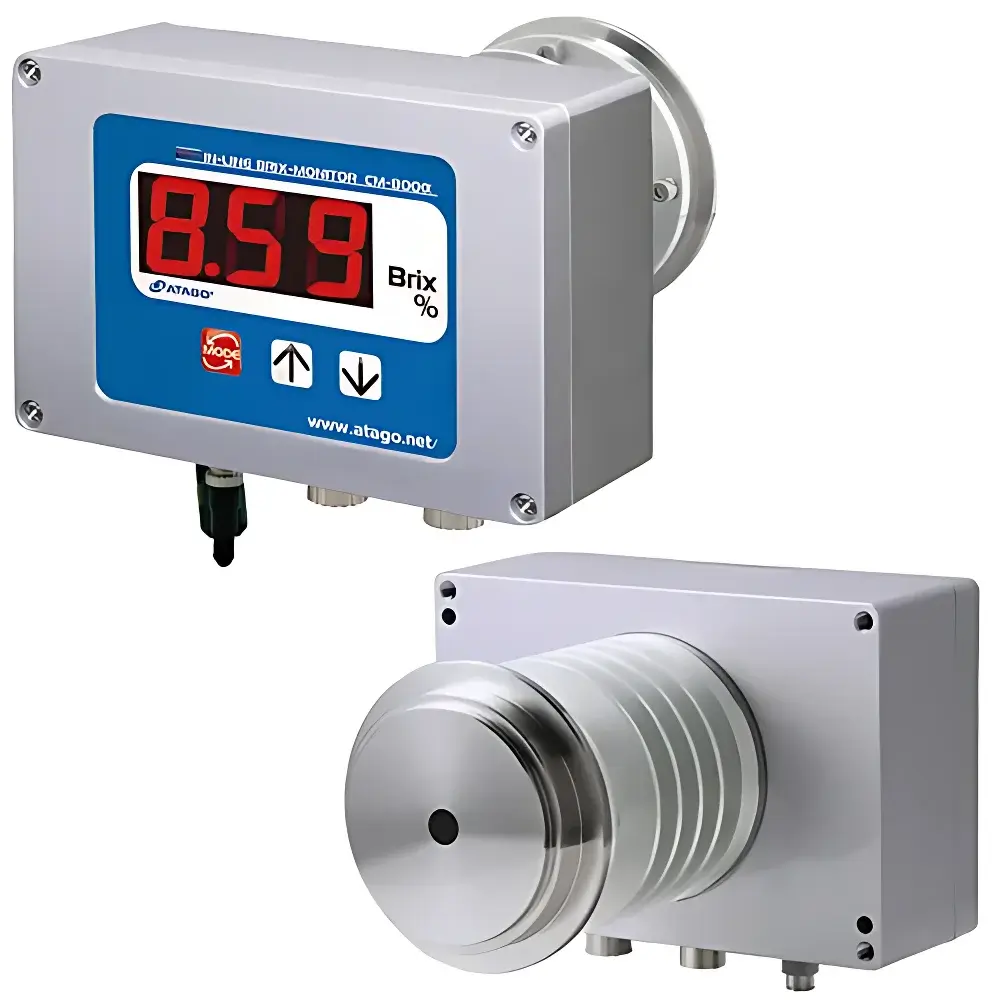
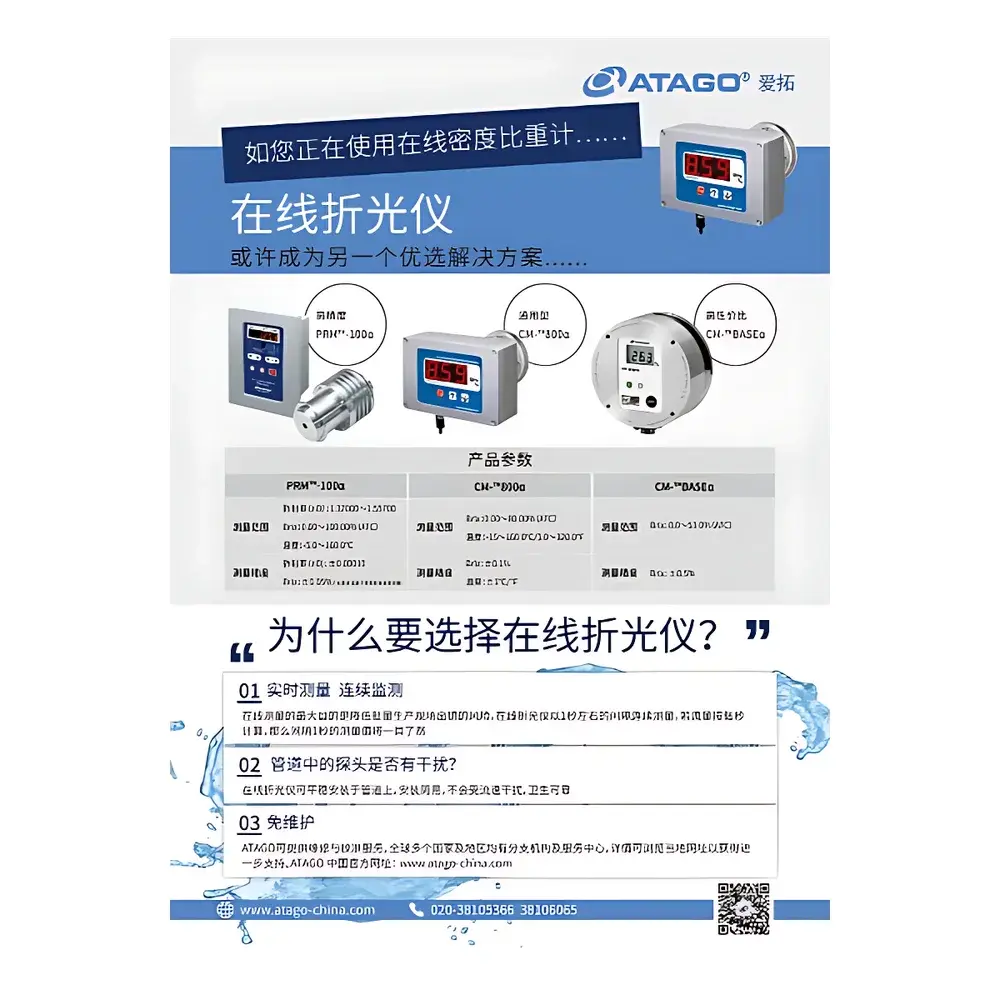
ATAGO CM-800α Online Refractometer for Real-Time Brix Measurement in Juice and Beverage Production
| Brand | ATAGO |
|---|---|
| Origin | Japan |
| Model | CM-800α |
| Measurement Principle | LED-based Abbe Refractometry (D-line equivalent) |
| Measured Parameter | Brix (% w/w, ATC) & Temperature (°C/°F) |
| Accuracy | ±0.1% Brix, ±1°C/°F |
| Range | 0.00–80.00% Brix (ATC), −15–160.0°C |
| ATC Range | 5–100°C |
| Resolution | 0.01% or 0.1% Brix (user-selectable), 1°C/°F |
| Output | DC 4–20 mA, RS-232C (refractive index or Brix data selectable via host interface) |
| Sampling Interval | ~1 s (default) |
| IP Rating | IP67 |
| Light Source | High-stability LED (D-line equivalent, 589 nm) |
| Prism Material | Synthetic Sapphire |
| Body Material | SUS316L Stainless Steel |
| Dimensions | 160 × 167 × 110 mm |
| Weight | 2.4 kg |
| Power Supply | DC 24 V (AC 100 V optional with AD-32 adapter) |
Overview
The ATAGO CM-800α is an industrial-grade online refractometer engineered for continuous, real-time measurement of soluble solids content—expressed as Brix (% w/w)—in liquid process streams. It operates on the principle of Abbe refractometry using a temperature-stabilized LED light source approximating the sodium D-line (589 nm), enabling precise determination of refractive index, which is then converted to Brix values via built-in calibration curves compliant with ISO 2173 and AOAC Official Method 932.12. The instrument integrates automatic temperature compensation (ATC) across 5–100°C, ensuring metrological traceability under dynamic thermal conditions typical of juice concentration, pasteurization, blending, and fermentation lines. Unlike benchtop or handheld refractometers, the CM-800α is designed for permanent installation in sanitary or industrial piping systems (e.g., tri-clamp or flanged configurations), delivering high reproducibility without manual sampling or operator intervention.
Key Features
- Robust optical architecture with synthetic sapphire prism and SUS316L wetted parts, resistant to corrosion from acidic fruit juices, organic solvents, and cleaning-in-place (CIP) agents.
- True inline measurement with <1-second response time and user-configurable sampling intervals (five preset options), supporting closed-loop control integration with PLCs or DCS systems.
- Dual-output capability: simultaneous analog (4–20 mA) and digital (RS-232C) signals; output mode (Brix or refractive index) configurable via local interface or remote command.
- IP67-rated enclosure ensures reliable operation in humid, washdown-intensive environments common in food & beverage manufacturing facilities.
- Compliance-ready firmware architecture supports audit trails and configuration logging—essential for facilities operating under FDA 21 CFR Part 11, ISO 22000, or HACCP-aligned quality management systems.
Sample Compatibility & Compliance
The CM-800α is validated for use with homogeneous, low-turbidity liquids including clarified fruit juices (orange, apple, grape), soft drinks, syrups, dairy-based beverages, vinegar, soy sauce, and malt extracts. It is not intended for slurries, particulate-laden fluids, or highly viscous media (>500 mPa·s) without prior filtration or dilution. Its measurement methodology aligns with multiple international standards: NY/T 2637–2014 (China), ISO 2173:2003 (fruit and vegetable products), AOAC 932.12 (refractometric sugar analysis), and ASTM D1074–20 (refractive index of liquid chemicals). For regulated environments, the device supports documentation of calibration history, sensor drift verification, and temperature-compensation validation—key elements for GLP/GMP audits.
Software & Data Management
While the CM-800α operates autonomously as a field instrument, its RS-232C interface enables seamless integration with SCADA, MES, or LIMS platforms. Raw refractive index data can be captured alongside timestamped Brix and temperature readings for statistical process control (SPC) charting. Optional ATAGO-supplied PC software (RefractoLink™) allows remote parameter configuration, real-time trend visualization, and export of CSV-formatted logs compatible with JMP, Minitab, or Python-based analytics pipelines. All configuration changes are logged with date/time stamps and user ID fields—meeting baseline requirements for electronic record integrity per FDA 21 CFR Part 11 when deployed with appropriate system controls.
Applications
- Continuous Brix monitoring during juice evaporation, blending, and standardization to maintain consistent sweetness and osmotic stability.
- Real-time concentration control in tomato paste, jam, and syrup production lines to optimize energy use and endpoint detection.
- Fermentation process supervision in cider, wine, and plant-based beverage manufacturing—tracking sugar depletion kinetics without offline sampling delays.
- Concentration verification in CIP rinse water recovery loops and effluent streams to support sustainability KPIs and wastewater compliance reporting.
- In-line monitoring of alkaline solutions in textile sizing baths or polyvinyl alcohol (PVA) spinning dopes where viscosity correlates strongly with refractive index.
FAQ
Does the CM-800α require periodic recalibration? Why or why not?
Yes—calibration verification should be performed at least once per shift using certified sucrose reference standards (e.g., NIST-traceable 10.00% and 40.00% Brix solutions) to ensure long-term accuracy drift remains within ±0.1% tolerance.
Can the CM-800α be installed in pressurized pipelines?
Yes, provided the process pressure does not exceed 1.0 MPa (10 bar) and the installation includes appropriate mechanical isolation valves and thermal expansion compensation per ATAGO’s mounting guidelines.
Is the RS-232C output compatible with Modbus RTU or other industrial protocols?
No—the native RS-232C protocol is proprietary; however, third-party protocol converters (e.g., serial-to-Modbus gateways) are widely used to bridge into standard automation networks.
What maintenance is required for the sapphire prism surface?
Routine inspection and gentle wiping with lint-free cloth moistened with deionized water after CIP cycles; avoid abrasive cleaners or ultrasonic cleaning unless validated per ATAGO Technical Bulletin TB-CM800-03.
How does ATC (Automatic Temperature Compensation) function in this model?
An integrated Pt1000 RTD sensor measures fluid temperature adjacent to the prism; Brix values are corrected in real time using a polynomial algorithm derived from empirical refractive index vs. temperature data for aqueous sucrose solutions.







