
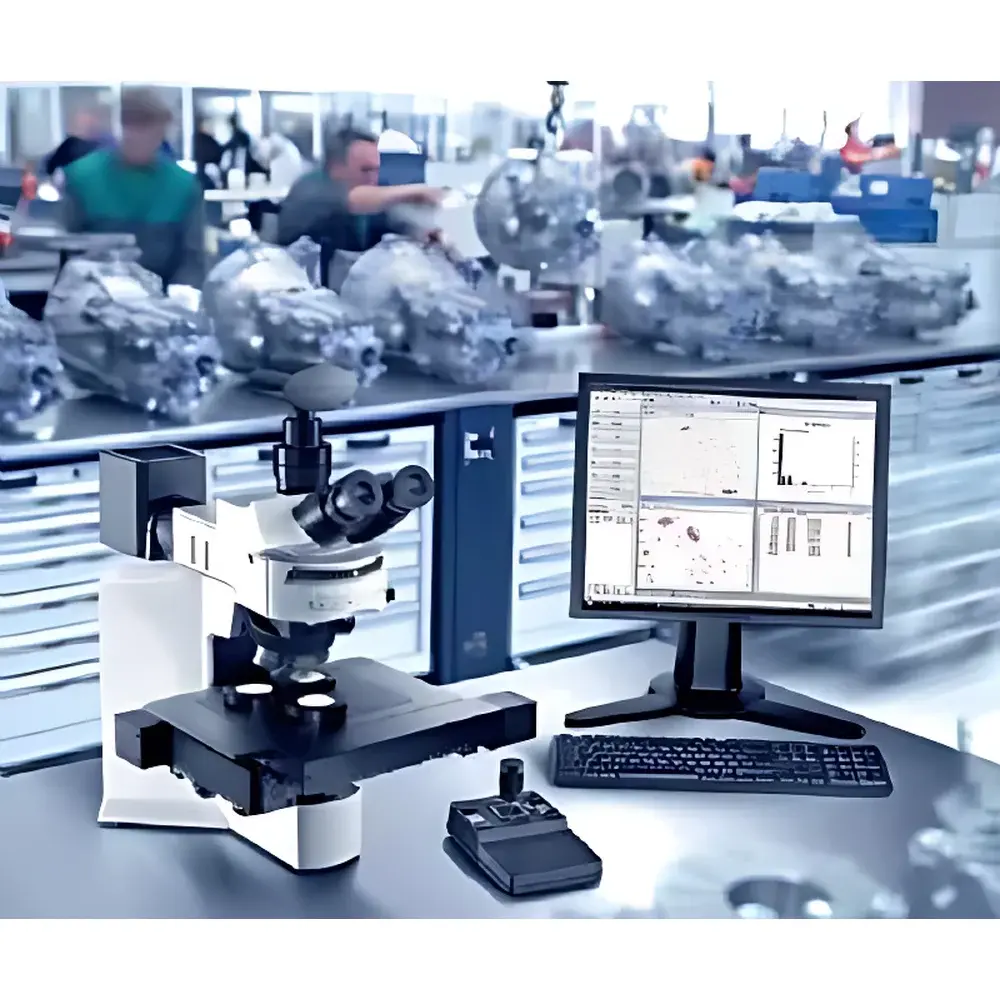
OLYMPUS Stream Microscopic Image Analysis Software
| Brand | OLYMPUS |
|---|---|
| Origin | Germany |
| Manufacturer | Olympus Corporation |
| Product Type | Imported |
| Model | Stream |
| Pricing | Upon Request |
Overview
OLYMPUS Stream is a modular, high-precision microscopic image analysis software platform engineered for integration with Olympus BX51M and other compatible upright and inverted research-grade optical microscopes. Built on a robust architecture compliant with ISO/IEC 17025 and GLP laboratory requirements, Stream implements core digital microscopy workflows grounded in quantitative image metrology and standardized materials characterization. Its computational framework supports pixel-accurate spatial calibration, Z-axis motorized stage synchronization, and traceable measurement chains—ensuring data integrity from acquisition through reporting. Designed for metallurgical laboratories, QC/QA departments, and academic materials science facilities, Stream enables reproducible, audit-ready analysis of microstructural features including grain boundaries, phase distributions, inclusion populations, and surface topography—without requiring scripting or third-party plugins.
Key Features
- Extended Focus Imaging (EFI): Automated Z-stack acquisition and depth-fused image synthesis for specimens exceeding objective depth of field; output includes calibrated XY measurements and exportable TIFF stacks.
- Manual Image Alignment (MIA): Seamless panoramic stitching of multi-field-of-view acquisitions with sub-pixel registration accuracy; supports both linear and grid-based tile acquisition protocols.
- 3D Surface Reconstruction: Integration with Olympus motorized Z-drive units to acquire calibrated Z-stacks; generation of height maps, contour plots, and surface roughness profiles (Ra, Rz) using 3D-EFI algorithms.
- Real-time Image Enhancement Suite: Non-destructive application of convolution-based filters—including Sobel edge detection, Gaussian smoothing, histogram equalization, and DCE (Dynamic Contrast Enhancement)—with live preview and parameter adjustment.
- Automated Particle & Feature Analysis: Threshold-driven segmentation engine supporting over 50 morphological and photometric parameters (e.g., Feret diameter, aspect ratio, circularity, integrated density, gray-level variance) per detected object.
- Standards-Compliant Quantification Modules: Preconfigured analysis workflows aligned with ASTM E247 (graphite nodule evaluation), ASTM E112 / ISO 643 / JIS G 0552 (grain size by intercept and planimetric methods), and ASTM E45 / DIN 50602 (non-metallic inclusion rating).
Sample Compatibility & Compliance
Stream operates across a broad spectrum of metallurgical and industrial samples—including polished/etched steel sections, cast iron specimens, coated substrates, and mineral thin sections. All quantification modules enforce strict adherence to international standards: graphite spheroidization analysis conforms to JIS G 5502, ASTM E247, and ISO 945; grain size determination satisfies ASTM E112 (intercept and planimetric), ISO 643, and JIS G 0552; non-metallic inclusion classification follows ASTM E45 Method A (macro/micro) and DIN 50602 Method M. The software maintains full traceability of calibration sources, magnification factors, and pixel-to-micron scaling—critical for ISO 17025 accreditation and FDA 21 CFR Part 11–compliant environments when deployed with optional audit trail and electronic signature modules.
Software & Data Management
Stream employs a project-based database architecture with embedded metadata tagging (microscope model, objective ID, illumination mode, camera exposure, stage coordinates). All measurements are saved in structured XML format alongside original TIFF images, enabling version-controlled archival and cross-platform interoperability. Reports are exportable as PDF (with embedded calibration certificates), Excel (.xlsx), or CSV for statistical process control (SPC) integration. Optional Stream Premium licenses support network deployment, centralized license management, and role-based access control—facilitating compliance with enterprise IT security policies and GxP documentation requirements.
Applications
- Metallurgical QC: Automated graphite morphology assessment in ductile iron; nodularity, count, and distribution analysis per ASTM E247.
- Steel Certification: Grain size grading of hot-rolled and annealed steels via automated intercept and planimetric counting; full compliance with ASTM E112 and ISO 643 reporting templates.
- Inclusion Rating: Classification and sizing of oxide, sulfide, alumina, and silicate inclusions in high-purity steels per ASTM E45 Method A and DIN 50602.
- Surface Defect Metrology: 3D profiling of wear tracks, machining marks, and coating delamination using Z-stack-derived topographic maps.
- Failure Analysis: Multi-scale correlation between optical micrographs, EFI-combined overview images, and stitched panoramas for root cause investigation.
- Educational Research: Interactive measurement training with real-time feedback on distance, angle, area, and polygonal ROI annotation—integrated with Olympus microscope hardware for automatic magnification compensation.
FAQ
Is OLYMPUS Stream compatible with non-Olympus microscopes?
Stream is validated exclusively for use with Olympus BX, IX, and CKX series microscopes equipped with supported digital cameras and motorized stages. Third-party hardware integration is not supported.
Does Stream support FDA 21 CFR Part 11 compliance?
Yes—when deployed with the optional Audit Trail and Electronic Signature module, Stream provides full electronic record integrity, user authentication, and immutable activity logging required for regulated pharmaceutical and medical device manufacturing environments.
Can measurement data be exported to statistical process control (SPC) systems?
All quantitative results—including particle counts, grain size distributions, and inclusion ratings—are exportable in .xlsx and .csv formats with column headers mapped to standard SPC input schemas.
How is calibration maintained across different objectives and magnifications?
Stream automatically reads objective identification data via Olympus’ UIS2 lens communication protocol and applies pre-registered pixel-to-µm scaling factors, eliminating manual recalibration during objective changes.
What file formats does Stream support for import and export?
Native acquisition: Olympus RAW (.OIB/.OIF), TIFF, JPEG, PNG. Export formats include TIFF (8/16-bit), PDF, Excel (.xlsx), CSV, and XML metadata archives.



