
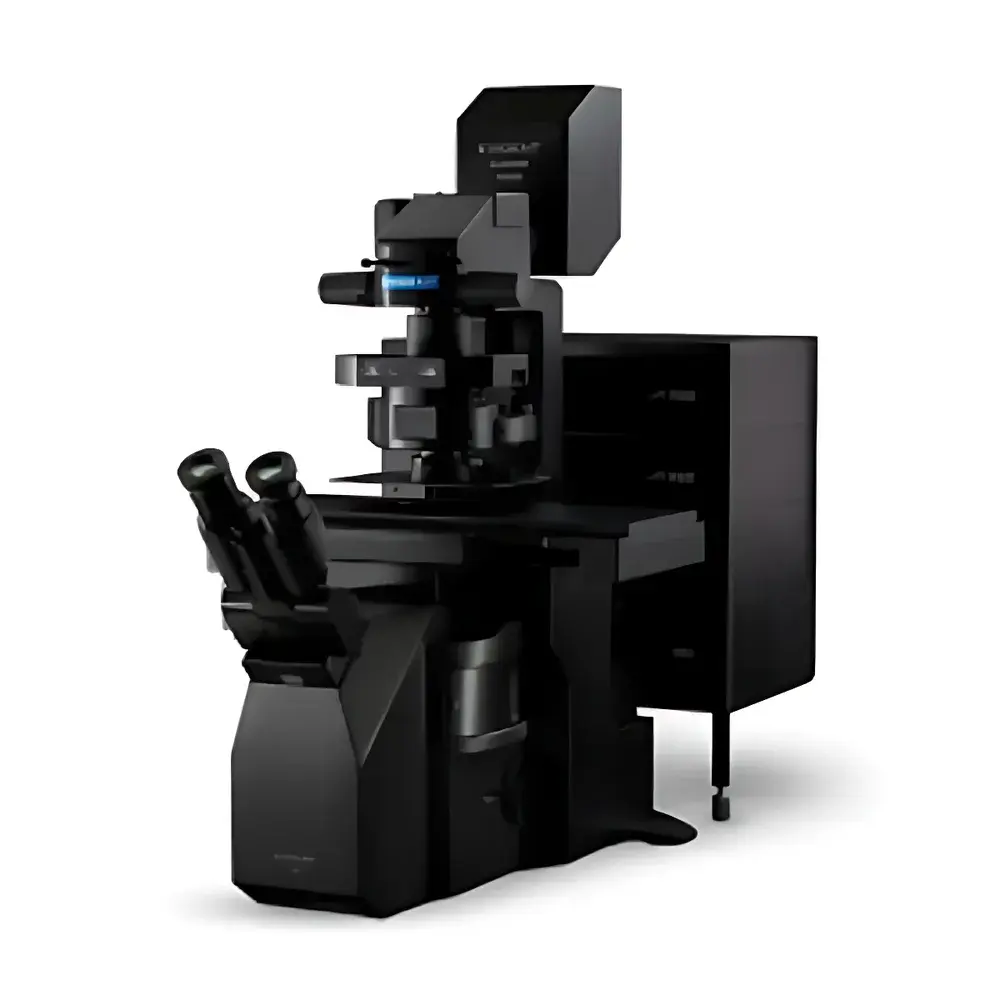
Evident FLUOVIEW FV5000 Intelligent Full-Spectrum Confocal Microscopy System
| Brand | Evident (formerly Olympus) |
|---|---|
| Origin | Japan |
| Manufacturer Type | Original Equipment Manufacturer (OEM) |
| Import Status | Imported |
| Model | FLUOVIEW FV5000 |
| Instrument Type | Point-Scanning Confocal Microscope |
| Lasers | Visible lasers at 405, 445, 488, 514, 561, 594, and 640 nm |
| Detectors | SilVIR (Silicon-based Vacuum-Insulated Photodiode Array) detectors |
| Scan Module | Monolithic integrated scan unit |
| Scanning Modes | Galvo-galvo, resonant, hybrid, and line-scan configurations |
| Objective Compatibility | Wide range of high-NA research-grade objectives (e.g., UPLSAPO, LUCPLFLN, XLPLN, and water-immersion variants) |
| Microscope Frame | Fully automated inverted research-grade microscope platform with motorized Z-focus, filter turrets, and stage control |
| Software & Workstation | FV31S-SW intelligent acquisition software with AI-assisted parameter optimization, spectral unmixing, and quantitative intensity calibration |
| Vibration Isolation | Optional dedicated active or passive anti-vibration optical tables (e.g., Newport RS series or TMC Micro-g platforms) |
Overview
The Evident FLUOVIEW FV5000 Intelligent Full-Spectrum Confocal Microscopy System is a high-performance point-scanning confocal platform engineered for quantitative fluorescence imaging in live-cell, fixed-tissue, and 3D organoid applications. Built upon a fully automated inverted microscope architecture, the system implements true spectral detection using SilVIR photodiode array detectors coupled with high-efficiency dichroic beam splitters and tunable spectral filters. Unlike conventional filter-based or PMT-limited systems, the FV5000 captures full emission spectra (typically 300–900 nm) at each pixel with sub-nanometer resolution—enabling rigorous linear unmixing of spectrally overlapping fluorophores without prior knowledge of reference spectra. Its optical design adheres to Abbe diffraction limits and incorporates chromatic aberration correction across the entire excitation-emission spectrum. The integrated laser combiner supports eight solid-state lasers (seven visible + three NIR), each with real-time power feedback via built-in photodiode monitors, ensuring stable photon flux during time-lapse or FRAP experiments. This architecture satisfies core requirements for reproducible, audit-ready imaging under GLP and GMP-aligned workflows.
Key Features
- Monolithic scan module with galvo-resonant hybrid scanning for simultaneous high-speed (up to 30 fps at 512×512) and high-resolution (≤120 nm lateral, ≤400 nm axial) acquisition
- SilVIR detector technology: silicon-based vacuum-insulated photodiode arrays offering >90% quantum efficiency from 400–900 nm, eliminating thermal noise and enabling photon-counting mode operation
- Intelligent spectral acquisition engine: real-time spectral unmixing with adaptive background subtraction, auto-thresholding, and intensity normalization referenced to NIST-traceable fluorescent standards
- Fully motorized inverted frame with six-position objective turret, five-channel filter wheel, and piezo-driven Z-stage (100 µm travel, 1 nm step resolution)
- Laser power stabilization: closed-loop monitoring and dynamic adjustment of all eight laser lines to maintain ±1.5% output stability over 8-hour sessions
- Modular expansion support: native compatibility with FV5000MPE multi-photon add-on module (700–1300 nm tunable Ti:Sapphire + OPO), enabling seamless transition between confocal and deep-tissue multiphoton imaging
Sample Compatibility & Compliance
The FV5000 accommodates standard 35 mm glass-bottom dishes, multi-well plates (6–96-well), coverslip-mounted specimens (No. 1.5H), and custom chambered slides. Its environmental control interface supports integration with stage-top incubators (37°C, 5% CO₂, humidity regulation) and perfusion systems for long-term live imaging. All hardware and firmware comply with IEC 61000-6-3 (EMC emissions), IEC 61000-6-2 (immunity), and UL 61010-1 safety standards. Software functionality meets FDA 21 CFR Part 11 requirements for electronic records and signatures—including user-level access control, audit trail logging (timestamped operator actions, parameter changes, and file exports), and data integrity validation. System validation documentation supports IQ/OQ/PQ protocols aligned with ISO/IEC 17025 and ASTM E2500-17 guidelines for analytical instrument qualification.
Software & Data Management
FV31S-SW is a Windows 10/11–based acquisition and analysis suite with modular licensing (Basic, Quantitative, and Advanced Spectral tiers). Core capabilities include spectral library management (user-defined and manufacturer-provided fluorophore references), batch processing with Python API scripting (via PyFV SDK), and DICOM-SR export for clinical correlation studies. Image metadata conforms to OMERO and Bio-Formats standards, ensuring interoperability with Fiji/ImageJ, Imaris, and commercial LIMS platforms. Raw data is saved in vendor-neutral .OME.TIFF format with embedded EXIF-style metadata (laser power, dwell time, pinhole size, objective NA, immersion medium refractive index). Encrypted local storage and optional network-attached storage (NAS) integration provide secure archival compliant with HIPAA and GDPR retention policies.
Applications
- Quantitative co-localization analysis in subcellular organelle dynamics (e.g., lysosome–mitochondria interactions using LysoTracker Red/MT-Green spectral separation)
- Longitudinal tracking of fluorescent protein expression gradients in developing zebrafish embryos (4D spectral time-lapse at ≤15 µm depth)
- High-content screening of drug-induced morphological phenotypes in iPSC-derived cardiomyocytes using multiplexed immunofluorescence (DAPI, α-actinin, cTnT, Ki67)
- Validation of CRISPR-Cas9 editing efficiency via spectral distinction of wild-type vs. edited GFP-tagged alleles
- Correlative light-electron microscopy (CLEM) sample mapping using fiducial marker registration and coordinate transformation export
FAQ
What spectral resolution does the SilVIR detector achieve?
The SilVIR array provides 10-nm spectral sampling intervals across 300–900 nm, with effective full-width-at-half-maximum (FWHM) resolution of ≤2.5 nm when used with the high-transmission spectral disperser.
Is the system compatible with super-resolution modalities?
The FV5000 serves as the foundational platform for STED implementation via optional STED depletion laser modules (592 nm and 660 nm), with integrated pulse synchronization and wavefront correction optics.
Can acquisition parameters be exported for regulatory submissions?
Yes—complete acquisition logs (including laser power logs, detector gain settings, pinhole diameters, and environmental sensor readings) are embedded in every .OME.TIFF file and can be extracted programmatically or via the FV31S-SW report generator.
Does the software support automated focus maintenance during time-lapse?
The system integrates with Evident’s Perfect Focus System (PFS4), which uses infrared reflection detection for continuous Z-drift compensation with <±50 nm accuracy over 24-hour acquisitions.
What training and service options are available?
Evident offers on-site installation qualification, application-specific workflow training (including spectral unmixing certification), and extended service contracts with 24/7 remote diagnostics and priority parts dispatch.




