
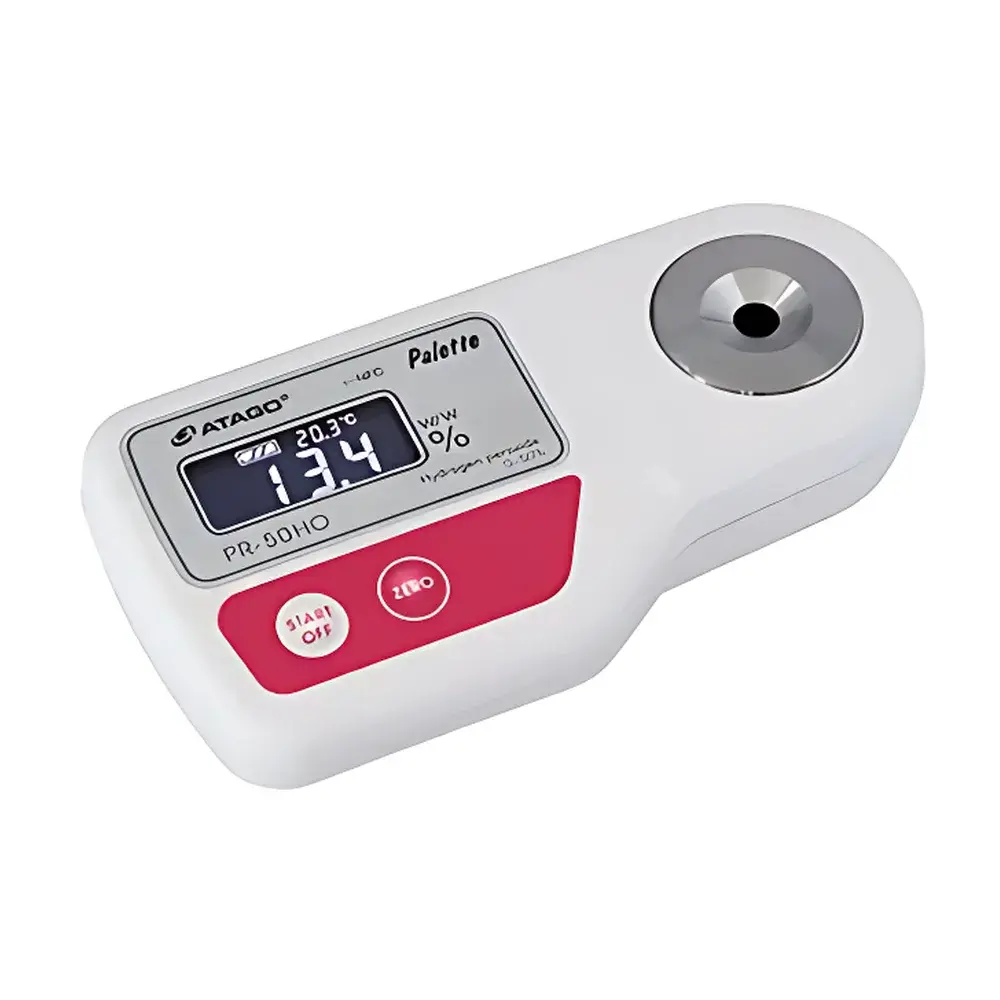
ATAGO PR-50HO Portable Digital Hydrogen Peroxide Refractometer
| Brand | ATAGO |
|---|---|
| Origin | Japan |
| Model | PR-50HO |
| Product Type | Handheld Refractometer |
| Temperature Control | Yes (Automatic Temperature Compensation) |
| Digital Display | Yes |
| Measurement Range | 0.0–50.0% (w/w) H₂O₂ |
| Accuracy | ±0.5% |
| Minimum Display Resolution | 0.1% |
| Operating Temperature | 5–40°C (sample & ambient) |
| IP Rating | IP64 |
| Power Supply | 9V alkaline battery (006P) |
| Dimensions | 170 × 90 × 40 mm |
| Weight | 300 g (without accessories) |
Overview
The ATAGO PR-50HO is a dedicated handheld digital refractometer engineered for rapid, on-site quantification of hydrogen peroxide (H₂O₂) concentration in aqueous solutions—specifically optimized for quality assurance in aseptic packaging lines. It operates on the principle of critical-angle refractometry: incident light passes through a sapphire prism in contact with the sample, and the resulting refraction angle correlates directly with the solution’s refractive index, which is empirically calibrated to H₂O₂ mass fraction (w/w %). Unlike generic Brix refractometers, the PR-50HO employs a proprietary optical calibration curve validated exclusively for hydrogen peroxide across 0.0–50.0% (w/w), eliminating cross-sensitivity to sugars, salts, or organic additives commonly present in beverage processing environments. Its built-in automatic temperature compensation (ATC) algorithm corrects readings in real time across 5–40°C, ensuring metrological consistency without external thermostating—critical for line-side verification where ambient and sample temperatures fluctuate.
Key Features
- Dedicated H₂O₂ optical calibration: Factory-calibrated against NIST-traceable reference standards for hydrogen peroxide; no user recalibration required for routine use.
- Integrated ATC system: Compensates for thermal drift using a high-stability thermistor embedded adjacent to the prism surface, maintaining ±0.5% accuracy across full operating range (5–40°C).
- Rugged industrial design: IP64-rated enclosure provides full protection against dust ingress and water splashes—suitable for humid production floors, cleanrooms (ISO Class 8), and wet-packaging zones.
- One-touch measurement protocol: Requires only 2–3 drops of sample; results stabilized and displayed within 3 seconds after START activation.
- Low-maintenance optical path: Sapphire prism resists scratching, chemical etching, and oxidation—even under repeated exposure to concentrated H₂O₂ and cleaning agents (e.g., NaOH, peracetic acid).
- Ergonomic handheld form factor: Compact 170 × 90 × 40 mm footprint and 300 g mass enable single-hand operation during line audits or shift-based QC checks.
Sample Compatibility & Compliance
The PR-50HO is validated for direct measurement of unstabilized and stabilized aqueous hydrogen peroxide solutions used in aseptic carton sterilization (e.g., Tetra Pak®, SIG Combibloc®). It exhibits negligible interference from common stabilizers (e.g., stannate, phosphoric acid) and residual surfactants at typical process concentrations. While not intended for viscous or particulate-laden samples, it performs reliably on clarified rinse waters, tank-bottom supernatants, and fill-line drip samples. The instrument complies with ISO 21748:2017 (Guidance for the use of repeatability, reproducibility and trueness estimates in measurement uncertainty evaluation) and supports GLP/GMP documentation requirements via traceable zero-point verification and temperature logging capability. Its measurement uncertainty budget is fully documented in ATAGO’s Certificate of Conformance (CoC), supplied with each unit.
Software & Data Management
The PR-50HO operates as a standalone field instrument with no embedded data logging or Bluetooth connectivity. However, its deterministic measurement output—displayed as a stable numeric value (0.1% resolution)—is designed for manual transcription into electronic batch records (EBRs) or LIMS interfaces. Zero-point verification (performed using distilled water prior to each shift or after battery replacement) generates an implicit audit trail: users record the displayed temperature during zeroing, enabling retrospective validation of ATC functionality. For regulated environments subject to FDA 21 CFR Part 11, laboratories routinely pair the PR-50HO with controlled paper logs or validated electronic forms that capture operator ID, timestamp, sample ID, measured value, zero-temperature, and environmental conditions—meeting ALCOA+ data integrity principles.
Applications
- Real-time monitoring of H₂O₂ concentration in aseptic packaging sterilization tunnels (e.g., carton pre-treatment baths).
- Verification of residual H₂O₂ levels on packaging surfaces post-rinse to ensure compliance with EU Directive 2002/72/EC migration limits.
- In-process control of H₂O₂ dilution systems supplying filler heads or cap sterilizers.
- QC release testing of incoming H₂O₂ stock solutions prior to dilution and use.
- Preventive maintenance support: trending of prism contamination or battery voltage drift via periodic zero-check deviation analysis.
FAQ
How often must the PR-50HO be zeroed?
Zeroing is mandatory before first use each shift, after any ambient temperature change exceeding ±5°C, and immediately following battery replacement. Distilled water must be used, and the zero confirmation temperature must be recorded.
Can the PR-50HO measure other oxidizing agents like sodium hypochlorite?
No. Its optical calibration is specific to hydrogen peroxide. Using it for bleach, ozone water, or peracetic acid will yield nontraceable, inaccurate results due to divergent refractive index–concentration relationships.
Is the sapphire prism chemically resistant to 35% H₂O₂?
Yes. Sapphire (Al₂O₃) exhibits no measurable etching or haze formation after >10,000 exposures to 35% w/w H₂O₂ at 25°C, as verified per ASTM F2517-18 (Standard Practice for Evaluating Chemical Resistance of Optical Materials).
Does the IP64 rating permit submersion or high-pressure washdown?
No. IP64 protects against vertical water droplets and limited splash exposure only—not immersion, hose-directed spray, or steam cleaning. Avoid direct contact with pressurized cleaning nozzles.
What is the recommended cleaning protocol between samples?
Wipe the prism gently with lint-free tissue moistened with distilled water or isopropyl alcohol (≥99%), then dry with a clean, soft microfiber cloth. Never use abrasive pads, acetone, or chlorinated solvents.




