
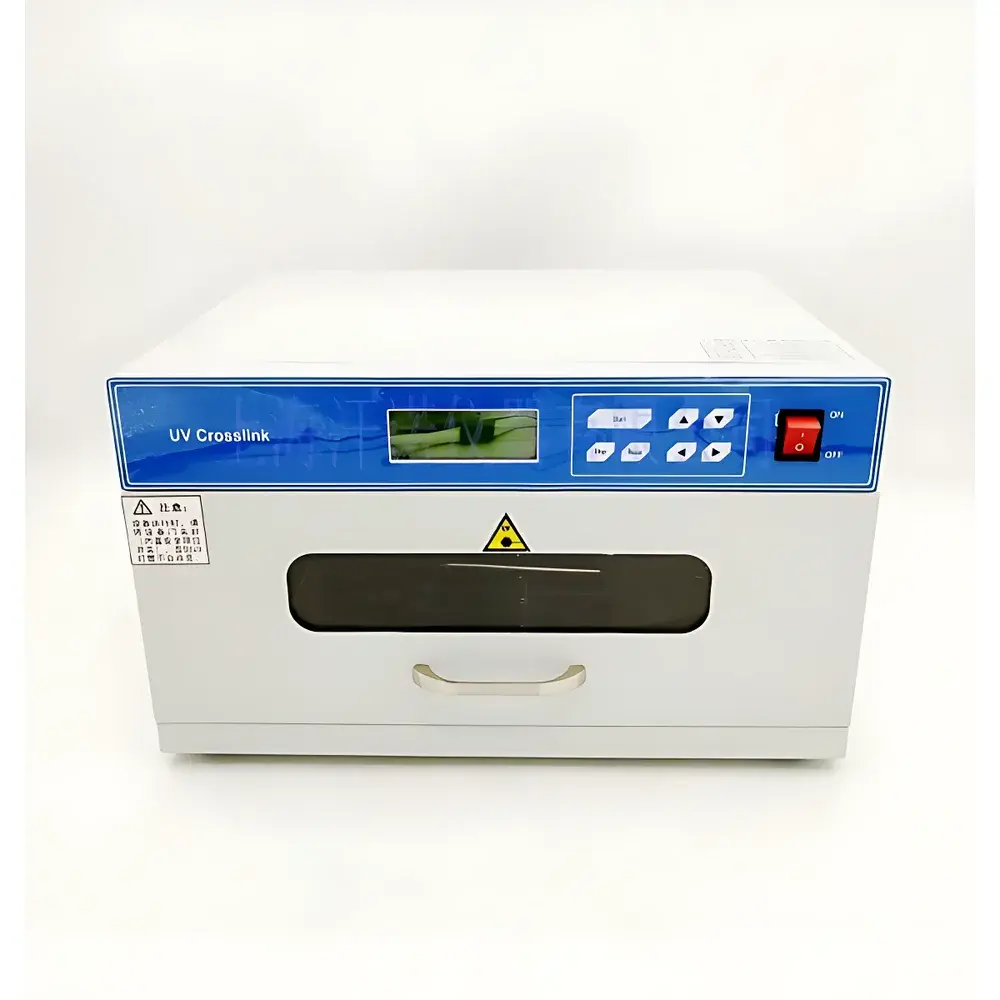
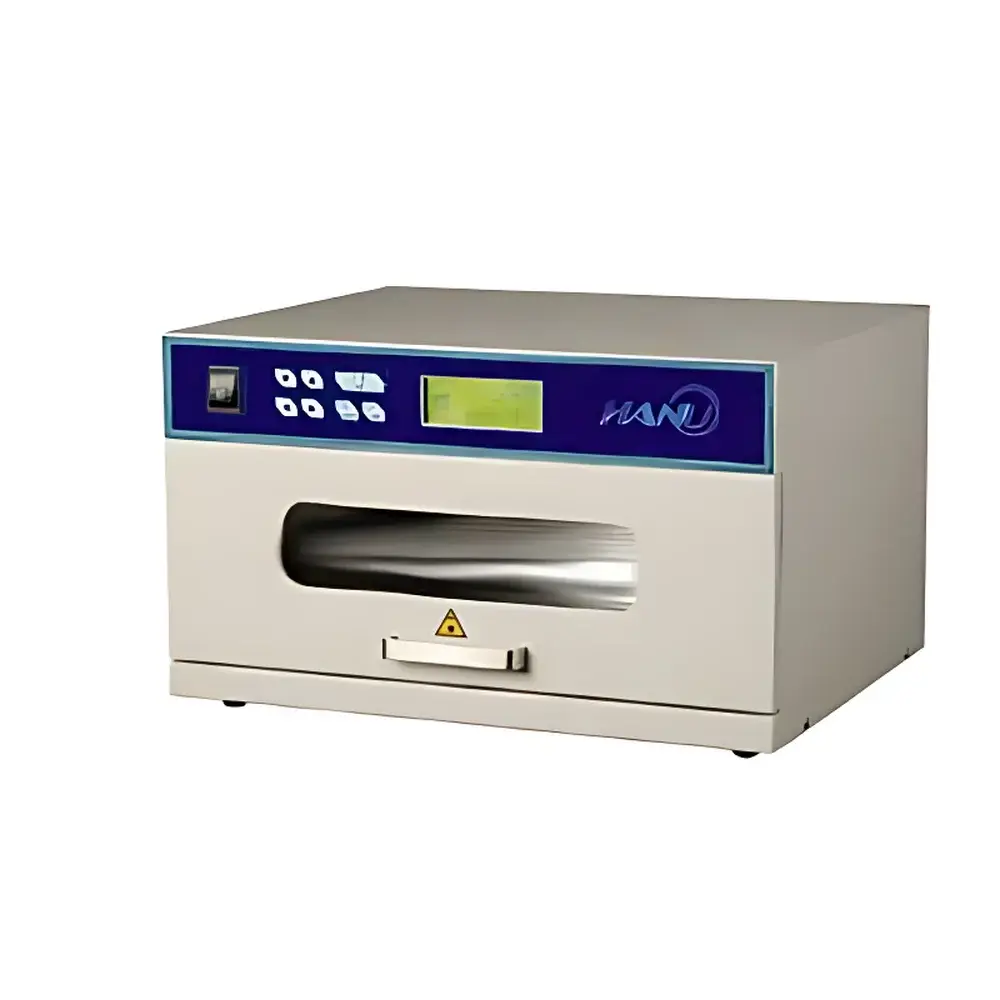
Hanuo HNUV-II UV Crosslinker
| Brand | Hanuo |
|---|---|
| Origin | Shanghai, China |
| Model | HNUV-II |
| Instrument Type | Darkroom-style UV Crosslinker |
| UV Wavelength | 254 nm |
| UV Lamp Configuration | Five 10 W low-pressure mercury lamps (total nominal output 50 W) |
| Exposure Time Range | 0.1–999.9 min (0.1 min resolution) |
| Exposure Energy Settings | 9 programmable and persistent energy presets |
| Exposure Time Settings | 9 programmable and persistent time presets |
| Display | Monochrome LCD with Chinese interface |
| Control Interface | Touch-sensitive keypad |
| UV Shielding View Window | Yes |
| Chamber Material | Stainless steel interior |
| Chamber Dimensions (L×W×H) | 340 × 260 × 150 mm |
| External Dimensions (L×W×H) | 360 × 340 × 310 mm |
| Power Supply | 220 V AC, 50 Hz |
| Compliance | Designed for laboratory use in nucleic acid immobilization, UV sterilization, and photochemical crosslinking applications per standard molecular biology workflows |
Overview
The Hanuo HNUV-II UV Crosslinker is a dedicated darkroom-style ultraviolet irradiation system engineered for precise, reproducible covalent immobilization of nucleic acids onto nylon or nitrocellulose membranes following electrophoretic transfer. Operating at a fixed germicidal wavelength of 254 nm—emitted by five low-pressure mercury vapor lamps—the instrument delivers uniform, calibrated UV-C radiation across a stainless-steel-walled exposure chamber. This wavelength corresponds to the peak absorption of nucleic acid bases, enabling efficient formation of cyclobutane pyrimidine dimers between adjacent thymine or cytosine residues and reactive groups on membrane surfaces. Compared to conventional thermal fixation (e.g., 80 °C vacuum baking for 2 hours), UV crosslinking achieves equivalent or superior binding efficiency in seconds, while simultaneously enhancing hybridization signal intensity by 5–10× due to improved orientation and reduced denaturation-induced loss. The system is routinely deployed in Southern and Northern blotting protocols, PCR carryover contamination control (via UDG/UA treatment), RecA-mediated mutagenesis assays, and UV-induced DNA damage modeling.
Key Features
- Stainless-steel UV exposure chamber with corrosion-resistant finish and integrated UV-blocking transparent viewport for real-time process monitoring without exposure interruption
- Touch-sensitive keypad with tactile feedback and non-volatile memory—retains all user-defined settings (9 exposure time presets and 9 exposure energy presets) after power cycling
- Monochrome LCD display with Chinese-language interface, showing elapsed time, remaining time, selected preset, and lamp status
- Programmable exposure timer with 0.1-minute resolution (0.1–999.9 min range) and manual override capability for time or energy mode operation
- Fixed-wavelength 254 nm UV source composed of five independently rated 10 W low-pressure mercury lamps (total nominal power: 50 W), optimized for nucleic acid crosslinking efficiency and lamp longevity
- Compact darkroom architecture (360 × 340 × 310 mm external) with light-tight sealing and interlocked safety cutoff to prevent accidental UV exposure
Sample Compatibility & Compliance
The HNUV-II accommodates standard blotting membranes (up to 340 × 260 mm), mini-gels, microcentrifuge tubes (for UV decontamination), and small polymer substrates. It supports common downstream workflows aligned with ISO/IEC 17025-accredited molecular biology laboratories, including those adhering to CLSI MM19-A and USP guidelines for nucleic acid handling. While not certified to IEC 61000-4 or FDA 21 CFR Part 11 out-of-the-box, its deterministic timer logic, non-volatile parameter storage, and absence of network connectivity make it suitable for GLP-compliant environments where audit trails are maintained manually. UV output stability meets typical requirements for reproducible crosslinking in academic, diagnostic, and QC labs performing routine blotting and contamination mitigation.
Software & Data Management
The HNUV-II operates as a standalone hardware device with no embedded firmware-based data logging or PC connectivity. All operational parameters—including exposure time, energy preset index, and active mode—are stored in EEPROM and persist across power cycles. No proprietary software, drivers, or cloud services are required. Users maintain traceability via handwritten logs or LIMS-integrated documentation referencing saved presets (e.g., “Preset #3: 120 s, 254 nm, nylon membrane”); this architecture minimizes validation overhead in regulated settings where software qualification would otherwise be mandated.
Applications
- Nucleic acid immobilization on positively charged nylon or nitrocellulose membranes post-electrophoretic transfer
- UV-mediated inactivation of carryover amplicons in PCR workspaces (in conjunction with uracil-DNA glycosylase pretreatment)
- Induction of cyclobutane pyrimidine dimers for DNA repair pathway studies and mutagenesis screening
- Surface decontamination of pipette tips, tube racks, and gel combs prior to sensitive amplification steps
- Photochemical curing of UV-reactive hydrogels and functionalized polymer films in biomaterials research
- Controlled UV degradation studies of oligonucleotides, primers, and synthetic RNA constructs
FAQ
What is the effective UV irradiance output of the HNUV-II at 254 nm?
The unit is specified by lamp count and nominal wattage (5 × 10 W), not absolute irradiance (µW/cm²). Actual surface irradiance depends on chamber geometry, lamp aging, and distance; users should validate crosslinking efficiency empirically using radiometric calibration or standardized DNA-binding assays.
Can the HNUV-II operate at wavelengths other than 254 nm?
No. It is a single-wavelength system with fixed 254 nm low-pressure mercury lamps. Alternate wavelengths (e.g., 302 nm or 365 nm) require different lamp types and optical filters not supported by this model.
Is the stainless-steel chamber compatible with ethanol or bleach cleaning?
Yes—electropolished stainless steel resists corrosion from common lab disinfectants when rinsed and dried promptly. Avoid prolonged immersion or abrasive scrubbing to preserve surface integrity.
Does the instrument include a UV intensity sensor or dose meter?
No. Dose calculation relies on time-based exposure using factory-calibrated lamp output; optional external radiometers (e.g., ILT950UV) may be used for periodic verification.
How is safety ensured during operation?
The unit features a mechanical door interlock that deactivates all UV lamps immediately upon lid opening, plus a shielded viewport with >99.9% UV-C attenuation (OD ≥ 4.0 at 254 nm) compliant with EN 62471 photobiological safety classification for Class 1 LED/UV equipment.




