
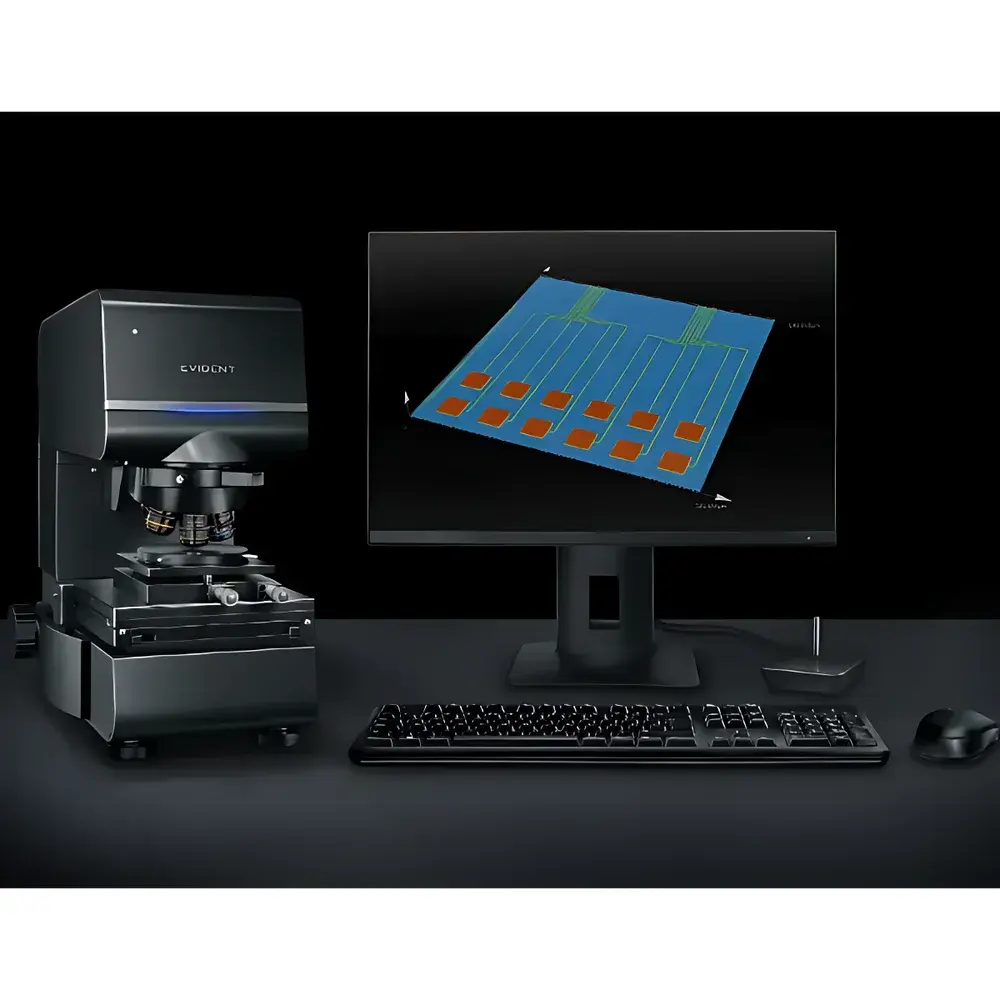
OLYMPUS LEXT OLS5500 Laser Scanning Confocal Microscope
| Brand | OLYMPUS |
|---|---|
| Origin | Japan |
| Manufacturer Type | Original Equipment Manufacturer (OEM) |
| Product Category | Imported Instrument |
| Model | LEXT OLS5500 |
| Instrument Type | Point-Scanning Confocal Microscope |
| Laser Source | 405 nm wavelength, max output 0.95 mW, Class 2 laser (compliant with JIS C 6802:2018, IEC 60825-1:2014, EN 60825-1:2014/A11:2021, GB/T 7247.1-2024) |
| Scanning Module | Integrated design |
| Scan Speed & Resolution | Up to 4096 × 4096 pixels per single measurement |
| Objective Lenses | Interchangeable high-NA objectives including dedicated LEXT confocal and WLI objectives (up to NA 0.8) |
| Illumination | White LED for brightfield and contrast-enhanced imaging |
| Software Platform | Intelligent acquisition and analysis suite with automated parameter optimization |
| XY Stage Control | Motorized precision stage with sub-micron repeatability |
Overview
The OLYMPUS LEXT OLS5500 Laser Scanning Confocal Microscope is an engineered solution for quantitative 3D surface topography and microstructural characterization at scales spanning nanometers to millimeters. Unlike conventional optical microscopes, the OLS5500 integrates three complementary optical metrology principles—Laser Scanning Microscopy (LSM), White Light Interferometry (WLI), and Focus Variation Microscopy (FVM)—within a single platform. This multimodal architecture enables deterministic selection of the optimal measurement modality based on surface geometry, reflectivity, slope angle, and material optical properties. LSM delivers diffraction-limited lateral resolution (~250 nm at 405 nm) for high-fidelity imaging of steep edges, fine textures, and micro-defects. WLI provides sub-nanometer vertical repeatability (<0.1 nm RMS) on smooth or semi-reflective surfaces, supporting thin-film thickness evaluation and step-height metrology traceable to SI units. FVM extends measurement capability across large fields-of-view (up to 10 mm × 10 mm) while maintaining depth discrimination on complex, non-planar, or low-contrast specimens. The system operates under ISO 25178-601 (areal surface texture) and ASTM E2925 (3D surface topography) frameworks, ensuring compliance in quality assurance, R&D, and failure analysis workflows.
Key Features
- Multimodal optical engine combining LSM, WLI, and FVM for adaptive surface measurement strategy
- Class 2 405 nm diode laser (0.95 mW max) with integrated safety interlocks compliant with international laser safety standards (IEC 60825-1, EN 60825-1/A11, GB/T 7247.1)
- Dedicated LEXT objective lenses optimized for confocal performance across full field—preserving shape fidelity and edge sharpness even at incidence angles >70°
- High-NA white light interferometric objectives (up to 0.8 NA) enabling stable interference fringe generation on textured or inclined surfaces
- Motorized XYZ stage with closed-loop positioning (repeatability ≤ ±50 nm) and programmable scan path definition
- 4K-resolution sCMOS sensor with high quantum efficiency (>75% at 405 nm) and dynamic range >70 dB for low-noise, high-fidelity intensity mapping
- Laser DIC and color DIC modes for enhanced phase-gradient contrast without staining or coating
- Top-surface isolation filter to suppress subsurface scattering from transparent or multilayer samples
Sample Compatibility & Compliance
The OLS5500 accommodates diverse sample classes—including metallic alloys, ceramics, polymers, semiconductors, optical coatings, MEMS devices, and biological substrates—without vacuum requirements or conductive coating. Its non-contact, non-destructive operation supports in-process inspection and post-fabrication validation. Surface slope tolerance exceeds ±85°, making it suitable for turbine blade leading edges, microfluidic channel walls, and additive-manufactured lattice structures. All measurement algorithms adhere to ISO/IEC 17025 documentation practices, with audit trails enabled for GLP/GMP environments. Data export formats (e.g., .xyz, .stp, .tif) are compatible with third-party metrology software (e.g., MountainsMap®, Gwyddion, MetroPro) and support FDA 21 CFR Part 11–compliant electronic signatures when deployed with validated IT infrastructure.
Software & Data Management
The bundled OLS5500 Analysis Software provides a unified interface for acquisition, reconstruction, filtering, and reporting. It features intelligent mode selection that recommends LSM/WLI/FVM based on preliminary focus map analysis. Quantitative outputs include Sa, Sq, Sz (ISO 25178-2), bearing ratio curves (Abbott-Firestone), grain boundary detection, and defect classification via threshold-based segmentation. All processing steps are logged with timestamped metadata, user ID, instrument configuration, and calibration status—enabling full traceability. Batch analysis workflows support statistical process control (SPC) integration, and custom report templates can be exported in PDF or Excel formats with embedded traceable uncertainty budgets.
Applications
- Surface roughness and waviness quantification in precision machining and polishing validation
- 3D defect metrology for semiconductor wafer inspection and photomask verification
- Coating thickness and delamination assessment in aerospace thermal barrier systems
- Microstructure analysis of sintered metals, battery electrode porosity, and composite fiber alignment
- Biomedical device surface texturing for osseointegration studies and implant wear simulation
- Failure root-cause analysis via crack propagation mapping and fatigue striation measurement
- Reverse engineering of micro-optical components using high-density point-cloud registration
FAQ
What distinguishes the LEXT OLS5500 from standard confocal microscopes?
It uniquely combines LSM, WLI, and FVM in one hardware platform—eliminating the need for separate instruments or compromises in resolution, slope tolerance, or vertical accuracy.
Is the system suitable for measuring transparent or semi-transparent materials?
Yes—the top-surface isolation filter and multi-wavelength DIC modes suppress subsurface signal, enabling accurate topography capture on glass, PDMS, hydrogels, and thin-film stacks.
Does the software support automated pass/fail inspection against GD&T tolerances?
Yes—custom inspection routines can be scripted to evaluate form errors (flatness, curvature), position deviations, and surface texture parameters against user-defined specification limits.
How is calibration maintained across measurement modes?
Each optical path includes traceable reference artifacts (NIST-traceable step height standards, roughness standards, and pitch standards); calibration routines are executed per ISO 25178-603 and documented in the system log.
Can the OLS5500 integrate into existing laboratory informatics systems?
Yes—it supports OPC UA communication protocol and exports structured metadata via XML and JSON APIs for LIMS and MES integration.




