
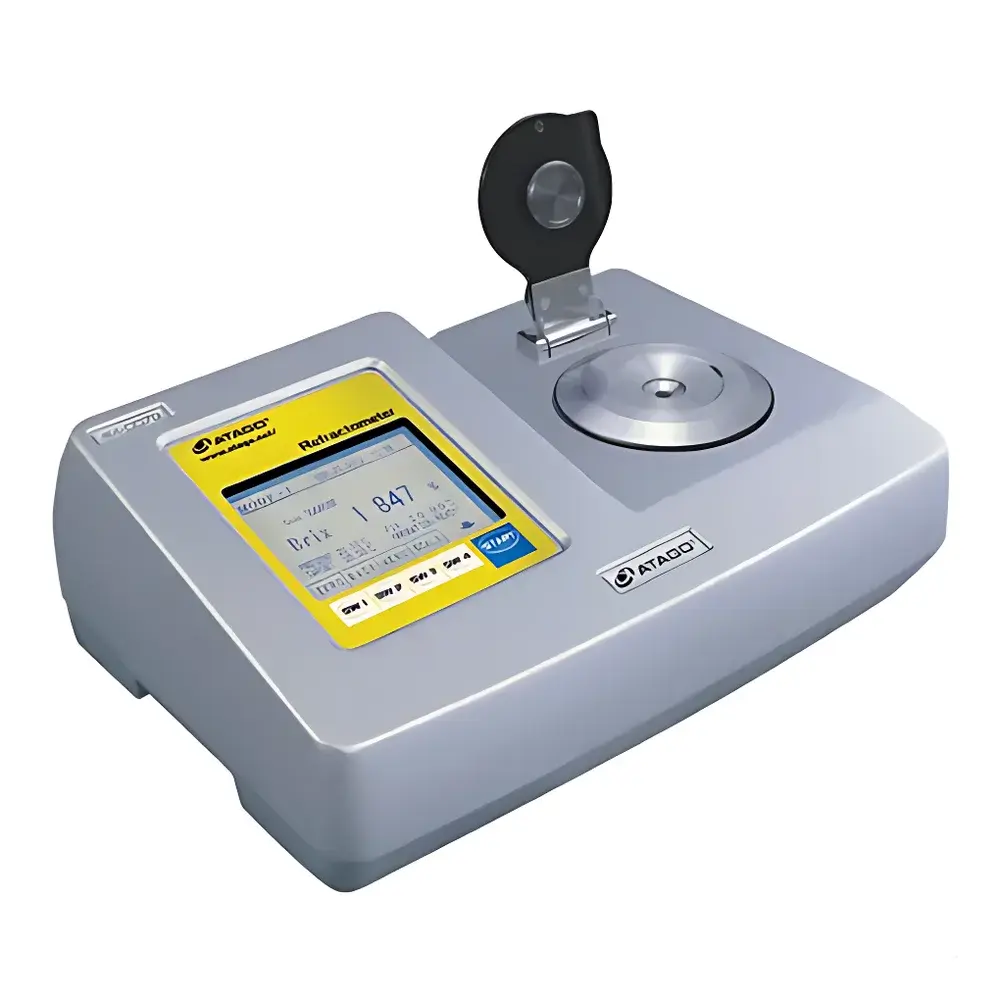
ATAGO RX-007α Automated Desktop Refractometer for Low-Concentration Aqueous Solutions
| Brand | ATAGO |
|---|---|
| Origin | Japan |
| Model | RX-007α |
| Measurement Range | RI: 1.330150–1.341500 |
| Brix | 0.000–5.000% |
| Accuracy | RI: ±0.000010 |
| Brix | ±0.005% |
| Temperature Control | Yes (ATC, ±0.05 °C) |
| Display | Digital LCD |
| Resolution | RI: 0.000001 |
| Brix | 0.001% |
| Temperature | 0.01 °C |
| Sample Cell Material | SUS316 Stainless Steel |
| Prism Material | Optical Glass |
| Interface | RS-232C |
| Power Supply | AC 100–240 V, 50–60 Hz |
| Dimensions | 37 × 26 × 14 cm |
| Weight | 6.7 kg |
Overview
The ATAGO RX-007α is a high-precision automated desktop refractometer engineered for the accurate, repeatable measurement of low-concentration aqueous solutions—particularly tea infusions, low-sugar beverages, surfactant solutions, rust inhibitors, and other dilute water-based formulations. It operates on the principle of critical-angle refractometry: a collimated light beam passes through a precisely temperature-controlled sample in contact with a high-grade optical glass prism; the resulting refraction angle is detected by a linear CCD array and converted into refractive index (nD) and Brix values via calibrated algorithms traceable to NIST-standard sucrose solutions. With a dedicated measurement range of 1.330150–1.341500 RI and 0.000–5.000% Brix, the RX-007α addresses a niche but technically demanding segment where conventional benchtop refractometers lack sufficient resolution and thermal stability. Its integrated Peltier-based automatic temperature control (ATC) ensures measurement consistency across ambient fluctuations, maintaining sample temperature within ±0.05 °C—critical for minimizing thermal drift in low-delta RI applications.
Key Features
- Ultra-high-resolution detection: 0.000001 RI and 0.001% Brix resolution enables discrimination of minute compositional changes in dilute systems.
- Active temperature stabilization: Dual-mode ATC system dynamically adjusts cooling/heating based on ambient conditions (operational range: 15–25 °C), eliminating manual water-bath dependency and reducing measurement variance.
- Corrosion-resistant fluid path: Sample stage constructed from electropolished SUS316 stainless steel, compatible with mildly acidic, alkaline, or surfactant-laden samples without degradation.
- Optical integrity assurance: Precision-ground optical glass prism with anti-reflective coating ensures long-term repeatability and minimizes stray-light interference.
- Traceable calibration architecture: Supports up to 30 user-defined calibration curves, each configurable with multi-point validation and audit-ready metadata logging.
- Regulatory-ready connectivity: RS-232C serial interface enables integration with LIMS and supports time-stamped data export compliant with FDA 21 CFR Part 11 requirements when paired with validated software.
Sample Compatibility & Compliance
The RX-007α is validated for homogeneous, non-turbid, non-volatile aqueous solutions with viscosity below 100 mPa·s and no suspended solids. It is routinely deployed in QC laboratories adhering to ISO 21542 (refractometric analysis of beverages), AOAC Official Method 932.12 (Brix determination), and internal SOPs aligned with GLP and GMP frameworks. The instrument’s ATC performance and RI accuracy meet the metrological requirements specified in ASTM D1218 for refractive index measurements of transparent liquids. All firmware and calibration routines are version-controlled and support full traceability—including operator ID, timestamp, ambient conditions, and calibration history—for audit readiness.
Software & Data Management
Data acquisition and reporting are managed via ATAGO’s proprietary PC software (compatible with Windows 10/11), which provides real-time graphing, statistical process control (SPC) charts, batch trending, and PDF report generation with embedded digital signatures. Raw measurement logs include instrument ID, firmware revision, sensor diagnostics, and environmental parameters. Export formats include CSV, XML, and secure encrypted binary files. When configured with optional digital printer support, hard-copy reports include QR-coded metadata linking directly to the original dataset in centralized storage—facilitating full chain-of-custody documentation per ISO/IEC 17025 clause 7.7.
Applications
- Tea processing: Quantification of extractables (polyphenols, caffeine, amino acids) during infusion optimization and standardization.
- Beverage R&D: Formulation verification of low-Brix functional drinks (e.g., electrolyte waters, herbal infusions, lightly sweetened RTDs).
- Industrial chemistry: Monitoring concentration stability of aqueous surfactant blends used in metalworking fluids and cleaning agents.
- Pharmaceutical excipient QC: Verification of dilute glycerin, propylene glycol, or PEG solutions prior to blending.
- Academic research: Kinetic studies of hydrolysis, dissolution, or diffusion processes where sub-0.01% Brix resolution is essential.
FAQ
What is the minimum sample volume required for measurement?
0.2 mL—sufficient to fully cover the prism surface without overflow; compatible with automated liquid handlers via optional sample cup adapter.
Does the RX-007α comply with FDA 21 CFR Part 11 for electronic records?
Yes—when operated with ATAGO’s validated software suite and configured with user authentication, audit trail logging, and electronic signature protocols.
Can it measure samples containing ethanol or organic co-solvents?
No—this model is optimized exclusively for aqueous systems; ethanol or acetone-based solutions require the RX-5000α series with solvent-resistant prism coating.
Is routine calibration verification required between measurements?
Not for routine use; however, daily verification using certified RI reference standards (e.g., distilled water at 20 °C, nD = 1.33300) is recommended per ISO 8655-7.
How does the ATC system compensate for ambient temperature shifts beyond its nominal range?
The unit automatically disables measurement if ambient temperature falls below 15 °C or exceeds 30 °C, displaying an advisory warning to prevent thermally induced error propagation.



