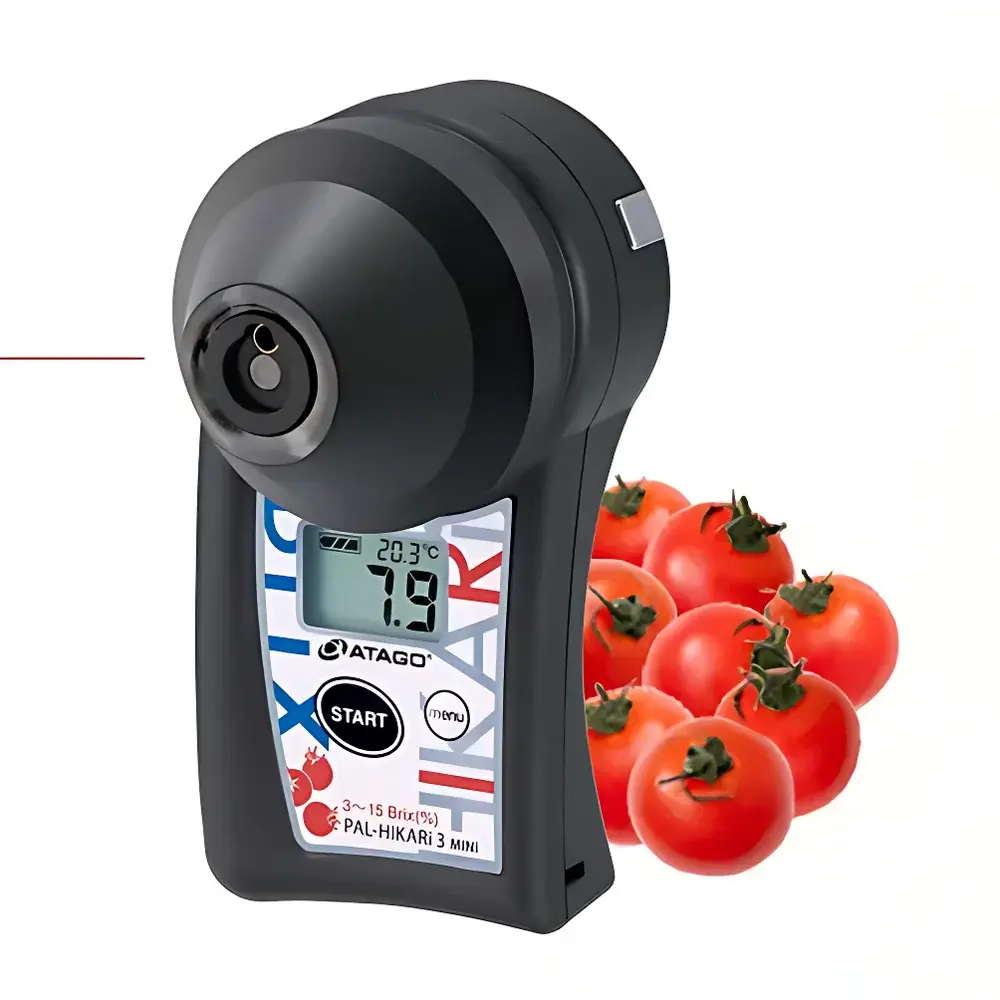
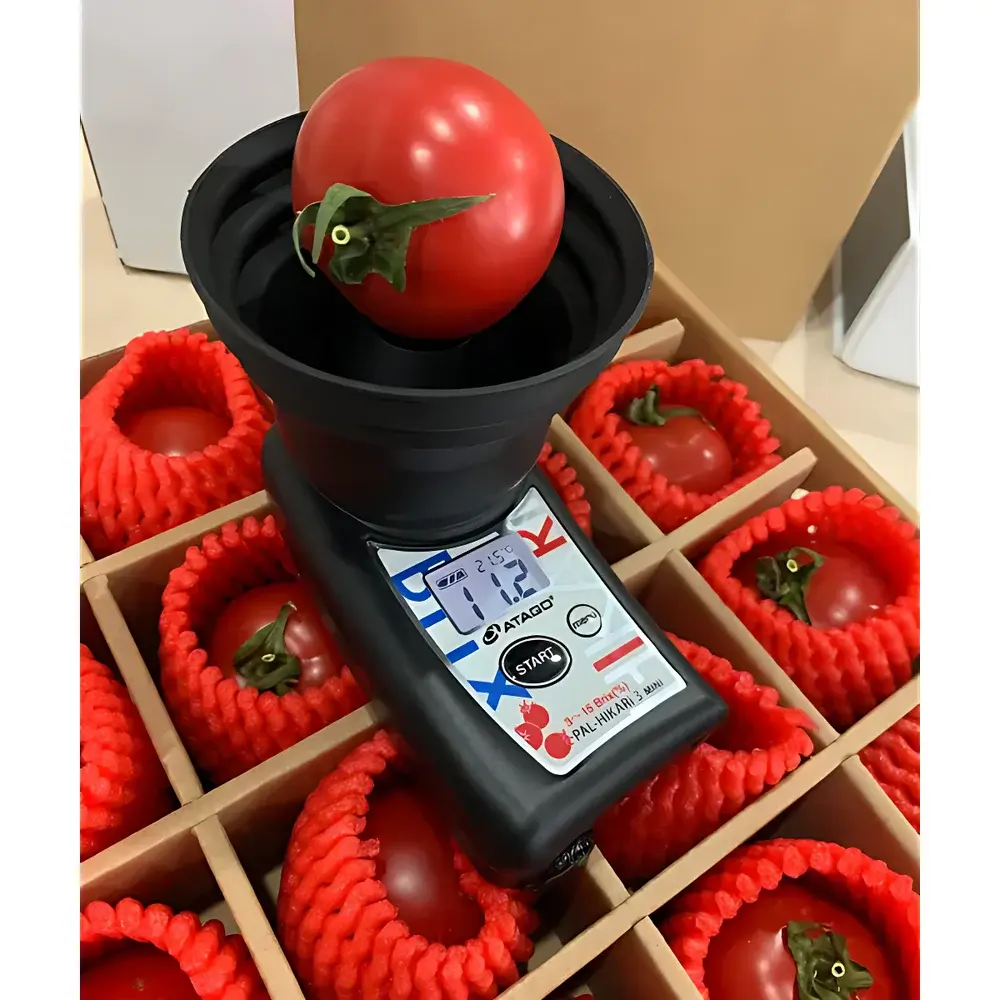
ATAGO PAL-HIKARi 3 Non-Destructive Infrared Brix Meter for Cherry Tomatoes
| Brand | ATAGO |
|---|---|
| Origin | Japan |
| Model | PAL-HIKARi 3 (Cherry Tomato Specific) |
| Instrument Type | Non-Destructive |
| Measurement Principle | Near-Infrared (NIR) Absorption Spectroscopy |
| Measurement Range | 3.0–15.0 °Brix |
| Resolution | 0.1 °Brix |
| Accuracy | ±1.5 °Brix* |
| Temperature Compensation Range | 15.0–35.0 °C |
| Operating Ambient Temperature | 10.0–45.0 °C |
| Power Supply | Two AAA alkaline batteries |
| IP Rating | IP64 |
| Dimensions | 6.1 × 6.4 × 11.5 cm |
| Weight | 153 g (instrument only) |
| Offset Correction Function | Yes |
| Catalog Number | 5453 |
Overview
The ATAGO PAL-HIKARi 3 is a handheld, non-destructive near-infrared (NIR) brix meter engineered exclusively for in-situ sugar content assessment of intact cherry tomatoes (Solanum lycopersicum var. cerasiforme). Unlike conventional refractometers requiring juice extraction or destructive sampling, the PAL-HIKARi 3 employs calibrated NIR spectroscopy at specific absorption bands sensitive to sucrose, glucose, and fructose molecular vibrations. The device delivers rapid, repeatable °Brix estimates within three seconds by optically probing subsurface fruit tissue—without piercing the epidermis, compromising structural integrity, or inducing post-measurement physiological stress. Its optical architecture integrates a stabilized NIR LED source, a silicon photodiode detector, and proprietary spectral filtering optimized for the 700–1100 nm range, where carbohydrate-related overtones dominate. Designed for field-deployable metrology, it operates independently of external power infrastructure and requires no consumables or calibration fluids.
Key Features
- True non-destructive measurement: No fruit puncture, incision, or juice expression required—preserves sample viability for longitudinal studies or commercial grading.
- Cherry tomato–optimized optical path: Fixed focal depth and wavelength bandpass tuned to typical skin thickness (80–120 µm), flesh density (~0.92 g/cm³), and spectral scattering profile of miniature tomato cultivars.
- Automatic temperature compensation (ATC): Real-time correction across 15.0–35.0 °C using integrated thermistor, ensuring stability under variable greenhouse, orchard, or post-harvest storage conditions.
- Ruggedized industrial design: IP64-rated enclosure resists dust ingress and water splashing—suitable for humid greenhouses, open-field operations, and cold-chain inspection points.
- Offset correction function: Enables user-defined bias adjustment to align instrument output with reference laboratory data (e.g., AOAC 932.12 or ISO 21527-1 validated HPLC or enzymatic assays).
- Low-power operation: Dual AAA alkaline battery configuration supports >5,000 measurements per set under typical ambient conditions; auto-shutdown after 3 minutes of inactivity.
Sample Compatibility & Compliance
The PAL-HIKARi 3 is validated for use on mature, unblemished cherry tomato fruits with smooth, taut pericarp and uniform surface reflectance. It is not intended for use on cracked, sunburnt, or overripe specimens exhibiting significant cutin degradation or internal translucency. While not certified to ISO/IEC 17025 as a primary reference instrument, its measurement protocol aligns with principles outlined in ASTM D8142–21 (Standard Guide for NIR Spectroscopy in Agricultural Product Analysis) and supports GLP-compliant data recording when paired with traceable offset calibration logs. Device firmware and hardware architecture meet RoHS 2011/65/EU and REACH (EC 1907/2006) material restrictions. No regulatory submission (e.g., FDA 510(k), CE medical device classification) applies, as it functions solely as a process analytical tool—not a diagnostic or clinical device.
Software & Data Management
The PAL-HIKARi 3 operates as a standalone field instrument with no onboard memory or wireless interface. All measurement values are displayed in real time on a high-contrast LCD and are not stored internally. For traceability, users must manually record results alongside contextual metadata (e.g., cultivar ID, harvest date, location tag). When integrated into QA/QC workflows, the offset correction value and environmental temperature reading serve as essential audit trail elements. Laboratories implementing digital quality management systems (QMS) may pair the instrument with external barcode-scanned logging platforms or LIMS modules that accept manual entry of °Brix, operator ID, and timestamp—ensuring alignment with ISO 9001:2015 clause 8.5.2 (Identification and traceability) and FDA 21 CFR Part 11 requirements for electronic records when supplemented with procedural controls.
Applications
- Plant breeding programs: High-throughput phenotyping of sugar accumulation kinetics across F₂ or BC₁ populations under controlled-environment growth chambers.
- Commercial horticulture: Dynamic harvest scheduling based on real-time °Brix thresholds correlated with flavor intensity and shelf-life prediction models.
- Fruit packinghouse QC: Lot-level screening prior to cold storage or export shipment—reducing reliance on destructive sampling protocols that increase spoilage risk.
- Retail supply chain assurance: In-store verification of incoming shipments against contractual Brix specifications (e.g., ≥8.5 °Brix for premium cherry tomato SKUs).
- Postharvest physiology research: Monitoring sugar flux during ripening transitions (breaker to red-ripe stages) without altering fruit respiration or ethylene emission profiles.
FAQ
Can the PAL-HIKARi 3 be used on other fruit types?
No—the optical calibration, probe geometry, and firmware algorithms are specifically derived from empirical NIR response curves of cherry tomato pericarp and mesocarp. Use on grape, strawberry, or standard tomato will yield nontraceable, nonvalidated results.
Does the device require annual recalibration by ATAGO?
ATAGO does not mandate scheduled recalibration; however, users should verify performance quarterly using homogeneous cherry tomato reference standards traceable to NIST SRM 1977 (Sugar Solutions) or in-house matrix-matched controls.
How does skin thickness variation affect measurement accuracy?
Accuracy remains within ±1.5 °Brix for skin thicknesses between 70–130 µm. Specimens outside this range require offset correction validated against destructive reference analysis.
Is the instrument compliant with Good Agricultural Practice (GAP) documentation requirements?
Yes—when used with documented offset values, environmental temperature logs, and operator identification, measurements satisfy GAP audit criteria for objective maturity assessment under GLOBALG.A.P. Control Point 4.3.2.