
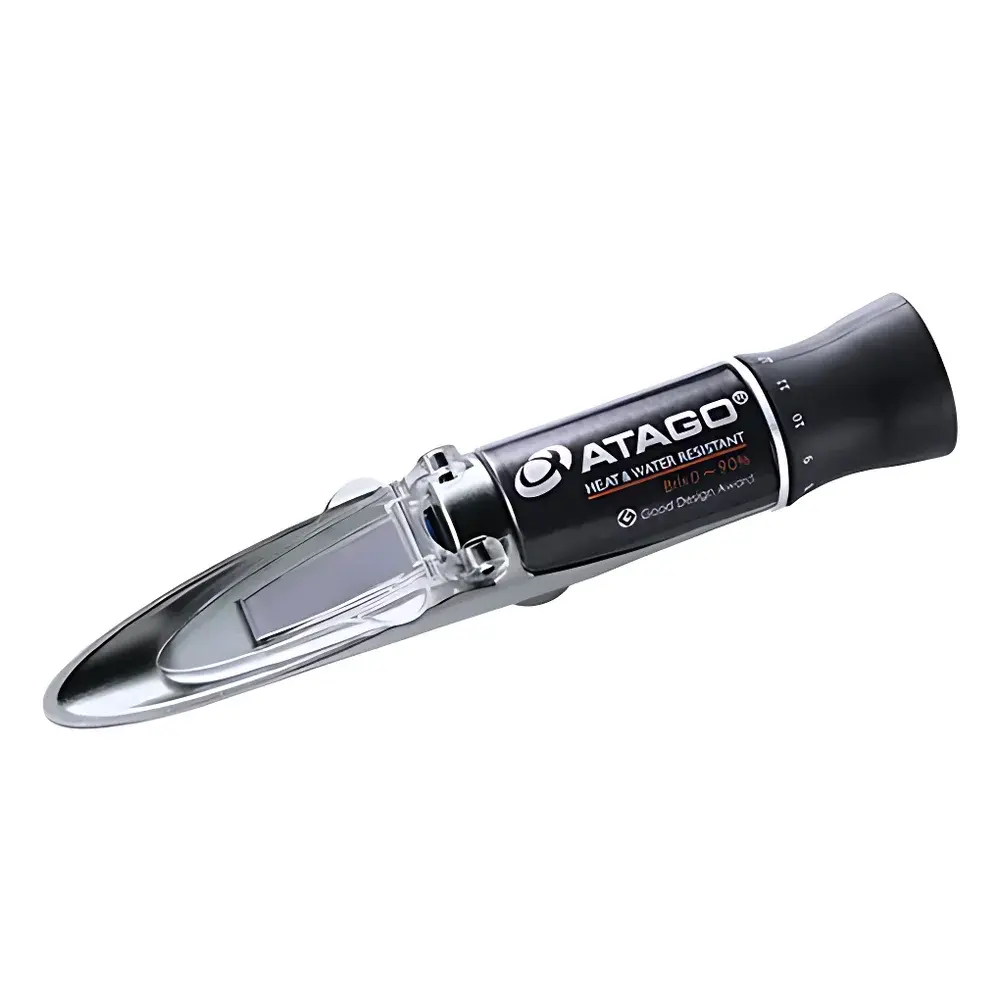
ATAGO MASTER-α / MASTER-Pα Analog Handheld Refractometer for Brix Measurement in Food & Beverage Applications
| Brand | ATAGO |
|---|---|
| Origin | Japan |
| Model | MASTER-α / MASTER-Pα |
| Measurement Principle | Optical Refraction (Snell’s Law) |
| Measuring Range | 0.0–33.0% Brix |
| Resolution | 0.2% Brix |
| Accuracy | ±0.2% Brix (at 10–30°C) |
| Automatic Temperature Compensation (ATC) | Yes |
| IP Rating | IP65 |
| Body Material | MASTER-α — Stainless Steel |
| Dimensions (L×W×H) | MASTER-α — 3.2×3.4×2.0 cm, 155 g |
| Sample Type | Liquid, Low-Viscosity Aqueous Solutions |
| Instrument Type | Destructive (Direct Surface Application) |
| Compliance | Designed for routine QC per ISO 21542:2020 (Refractometric Determination of Sucrose Content), ASTM D1074–22 Annex A1, and USP <788> supporting clarity and concentration verification |
Overview
The ATAGO MASTER-α and MASTER-Pα are precision analog handheld refractometers engineered specifically for rapid, field-deployable Brix (°Bx) measurement in food and beverage quality control environments. Based on the fundamental optical principle of Snell’s Law—where the refractive index of a solution correlates directly with its dissolved solids concentration, primarily sucrose—the instruments deliver direct, real-time % Brix readings without electrical power or software dependency. Unlike digital alternatives requiring calibration routines or battery management, these mechanical refractometers operate via collimated light transmission through a prism-solution interface, generating a sharp shadow line on an internal engraved scale. The MASTER-α was the first ATAGO handheld refractometer to integrate full IP65-rated ingress protection, enabling reliable operation in humid production floors, cold storage areas, and wet processing zones where condensation or incidental splashing is common. Its stainless steel construction ensures long-term dimensional stability and resistance to mechanical wear during high-frequency use.
Key Features
- Automatic Temperature Compensation (ATC) across 10–30°C ambient range, eliminating manual correction tables and reducing operator error in variable-temperature environments.
- IP65-rated housing—dust-tight and protected against low-pressure water jets—validated for repeated exposure in juice extraction lines, carbonated beverage filling stations, and tea concentrate blending rooms.
- Dual-material platform: MASTER-α (stainless steel body) optimized for general-purpose use; MASTER-Pα (polymer body) chemically resistant to acidic fruit juices (e.g., lemon, grapefruit), vinegar-based dressings, and saline solutions—minimizing corrosion risk during extended contact.
- High-contrast optical scale with blue/white boundary line for unambiguous visual interpolation at 0.2% Brix resolution.
- No batteries, no firmware, no connectivity—designed for GLP-compliant manual recording in regulated facilities where electronic audit trails are not required or permitted.
Sample Compatibility & Compliance
These refractometers are validated for clear, low-turbidity aqueous solutions typical in beverage manufacturing: carbonated soft drinks (post-degassing), clarified fruit juices (apple, orange, grape), ready-to-drink teas (green, black, oolong), sports drinks, syrups, and liquid flavor concentrates. Particulate-containing samples—including pulpy citrus juices or nectars—must be filtered (e.g., through 0.45 µm nylon membrane) prior to measurement to avoid prism surface interference and reading distortion. While not intended for highly viscous or opaque media (e.g., honey, tomato paste), the MASTER series meets functional requirements outlined in ISO 21542:2020 for sucrose quantification in beverages and ASTM D1074–22 Annex A1 for refractive index–based concentration assessment. Units are supplied with NIST-traceable calibration certificate (certified at 10%, 20%, and 30% sucrose standards), supporting internal calibration verification per FDA 21 CFR Part 11-aligned SOPs.
Software & Data Management
As fully analog instruments, the MASTER-α and MASTER-Pα do not incorporate embedded processors, memory, or data output interfaces. All measurements are recorded manually into paper-based or LIMS-linked logbooks. This architecture aligns with facilities operating under strict cybersecurity protocols or legacy GMP environments where electronic device validation is cost-prohibitive. Calibration records—including date, technician ID, standard lot number, and observed deviation—can be maintained in accordance with ISO/IEC 17025:2017 clause 7.7 (Equipment Calibration). Optional accessories include ATAGO’s RS-232-compatible digital refractometer (RX-5000α) for automated data capture when traceability beyond manual entry is mandated.
Applications
- Inline QC of incoming fruit juice concentrates prior to dilution and pasteurization.
- Final product verification of carbonated beverage Brix consistency pre-bottling (after CO₂ removal).
- Batch release testing of RTD tea formulations to ensure compliance with label claims (e.g., “5% fruit juice” equivalent).
- Monitoring sugar content in sports drink electrolyte blends during formulation development.
- Verification of syrup-to-water ratios in fountain dispensing systems across restaurant chains.
- Supplier qualification audits where portable, non-invasive verification of declared Brix values is required on-site.
FAQ
Is degassing required before measuring carbonated beverages?
Yes. Dissolved CO₂ alters refractive index and introduces microbubbles that scatter light. Samples must be stirred vigorously for ≥30 seconds or sonicated briefly to ensure complete CO₂ release prior to prism application.
Can I measure undiluted vinegar or citric acid solutions?
Yes—with the MASTER-Pα model only. Its polymer body resists corrosion from low-pH (<3.0) and high-acid-content samples where stainless steel (MASTER-α) may degrade over time.
What is the recommended cleaning protocol for the prism surface?
Rinse immediately after each use with distilled water, then gently wipe with lens tissue—not cloth or paper towel—to prevent micro-scratches. Avoid alcohol or acetone, which may damage anti-reflective coatings.
Does ATC compensate for sample temperature or ambient temperature?
ATC compensates for sample temperature via bimetallic strip coupling between prism and scale. Ambient temperature outside the 10–30°C range may affect thermal equilibrium and requires equilibration time (≥2 min) before measurement.
How often should calibration verification be performed?
Per ISO/IEC 17025:2017, verify daily using certified 10% and 30% sucrose standards before first use and after any physical impact; document deviations exceeding ±0.2% Brix in the equipment log.





