
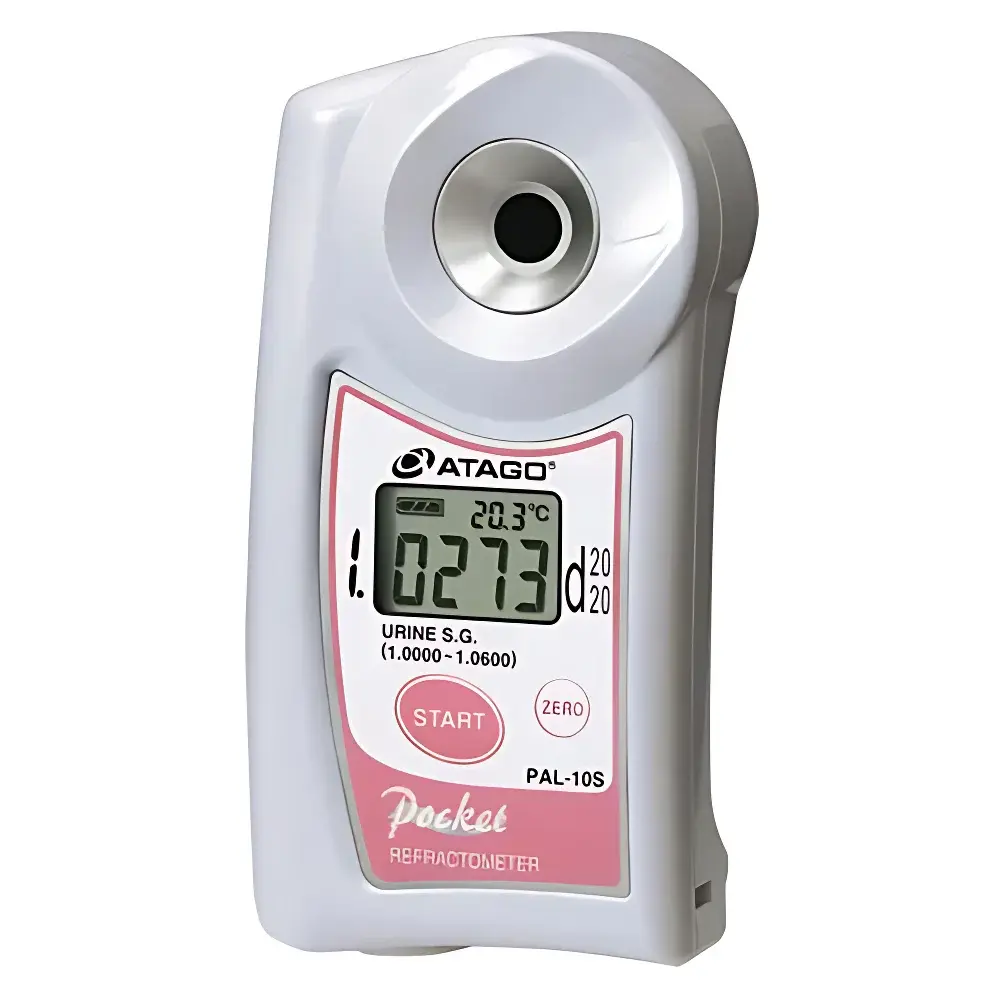
ATAGO PAL-10S Digital Urine Specific Gravity Refractometer
| Brand | ATAGO |
|---|---|
| Origin | Japan |
| Model | PAL-10S |
| Product Type | Handheld Refractometer |
| Temperature Control | Yes (Automatic Temperature Compensation) |
| Digital Display | Yes |
| Measurement Range | 1.0000–1.0600 SG |
| Resolution | 0.0001 |
| Accuracy | ±0.001 |
| Sample Volume | 0.3 mL |
| Measurement Time | 3 seconds |
| Operating Temperature | 10–35°C |
| Ambient Temperature Range | 10–35°C |
| Power Supply | 2 × AAA batteries |
| IP Rating | IP65 |
| Dimensions | 55(W) × 31(D) × 109(H) mm |
| Weight | 100 g (instrument only) |
Overview
The ATAGO PAL-10S Digital Urine Specific Gravity Refractometer is a precision handheld optical instrument engineered for rapid, reliable determination of urine specific gravity (USG) in clinical, sports medicine, anti-doping, and point-of-care settings. It operates on the principle of critical angle refractometry: light passing through a urine sample undergoes refraction at the prism–sample interface, with the resulting critical angle directly correlating to the solution’s refractive index—and thus its solute concentration. This refractive index is mathematically converted to specific gravity using a validated calibration curve traceable to NIST-certified reference standards. Unlike hydrometers or dipstick methods, the PAL-10S eliminates subjective interpretation, operator variability, and temperature-induced drift through built-in automatic temperature compensation (ATC) across its full operational range (10–35°C). Its compact, rugged design supports deployment in mobile clinics, doping control stations, athletic training rooms, and field laboratories where portability, speed, and regulatory compliance are essential.
Key Features
- High-resolution digital display showing USG values to four decimal places (e.g., 1.0245), enabling detection of subtle hydration shifts relevant to athlete monitoring and renal function assessment.
- Integrated automatic temperature compensation (ATC) using a high-stability thermistor sensor ensures measurement integrity without manual correction or external thermostating.
- Rugged magnesium alloy body and IP65-rated enclosure provide resistance to dust ingress and water splashes—critical for use in gym environments, anti-doping collection sites, and emergency response vehicles.
- Optimized optical path and high-transmittance sapphire prism deliver long-term stability and resistance to scratching or chemical degradation from repeated urine exposure.
- Low sample requirement (0.3 mL) minimizes waste and supports analysis of small-volume specimens common in pediatric or catheterized collections.
- Three-second measurement cycle enables high-throughput screening—ideal for pre-competition hydration checks or routine urinalysis workflows.
Sample Compatibility & Compliance
The PAL-10S is calibrated exclusively for human urine matrices and validated per ISO 8655-6 (volumetric instruments) and JIS Z 8015 (refractometer accuracy standards). It complies with World Anti-Doping Agency (WADA) Technical Document TD2023URINALYSIS for urine specific gravity verification prior to sample admission. The instrument meets GLP requirements for documented measurement traceability when used with ATAGO’s optional calibration logbook (CAT. No. 3110) and certified reference solutions (e.g., 1.0000, 1.0200, and 1.0400 SG standards). No user recalibration is required; factory calibration is verified annually using traceable refractive index standards. The device does not require connection to external networks or data systems, eliminating cybersecurity concerns associated with connected medical devices under FDA 21 CFR Part 11 or EU MDR Annex I.
Software & Data Management
The PAL-10S operates as a standalone instrument with no embedded software, firmware updates, or cloud connectivity. All measurements are displayed locally and retained only in real time—no internal memory or data logging capability is present. This architecture ensures zero risk of data corruption, unauthorized access, or audit trail gaps. For facilities requiring documentation, users may manually record readings into LIMS or electronic health records (EHR) following institutional SOPs. Optional accessories—including a protective carrying case (CAT. No. 3105), cleaning tissue set (CAT. No. 3107), and calibration verification kit—support consistent operation within ISO/IEC 17025-accredited laboratories.
Applications
- Sports medicine: Rapid assessment of euhydration status before competition or training sessions, supporting evidence-based fluid replacement protocols.
- Anti-doping control: Mandatory USG verification per WADA guidelines to ensure specimen validity and prevent substitution or dilution attempts.
- Clinical nephrology: Screening tool for concentrating ability in outpatient evaluation of renal tubular function.
- Emergency departments: Triage-level estimation of dehydration severity in acute gastroenteritis or heat-related illness.
- Research laboratories: Standardized USG measurement in longitudinal hydration studies where inter-device reproducibility is critical.
FAQ
Does the PAL-10S require periodic recalibration by the user?
No. The instrument is factory-calibrated and designed for maintenance-free operation. Users should perform daily verification using ATAGO-certified reference solutions; recalibration is performed only by authorized ATAGO service centers.
Can the PAL-10S measure other bodily fluids such as saliva or serum?
No. Its optical calibration and temperature compensation algorithm are optimized specifically for human urine. Use outside this matrix voids accuracy specifications and regulatory compliance claims.
Is the device compatible with laboratory information systems (LIS) or electronic medical records (EMR)?
Not natively. The PAL-10S has no data output interface (e.g., USB, Bluetooth, RS-232). Readings must be transcribed manually or via external capture tools.
What is the expected service life of the prism under routine clinical use?
With proper cleaning after each use (using ATAGO lens tissue and distilled water), the sapphire prism maintains optical performance for >10,000 measurements—equivalent to approximately five years of daily use in a mid-volume clinic.
How does automatic temperature compensation (ATC) function without external power?
The ATC system uses a solid-state thermistor integrated into the prism assembly, drawing minimal current from the AAA batteries. Compensation is applied in real time via analog circuitry—no microprocessor intervention is required.





