
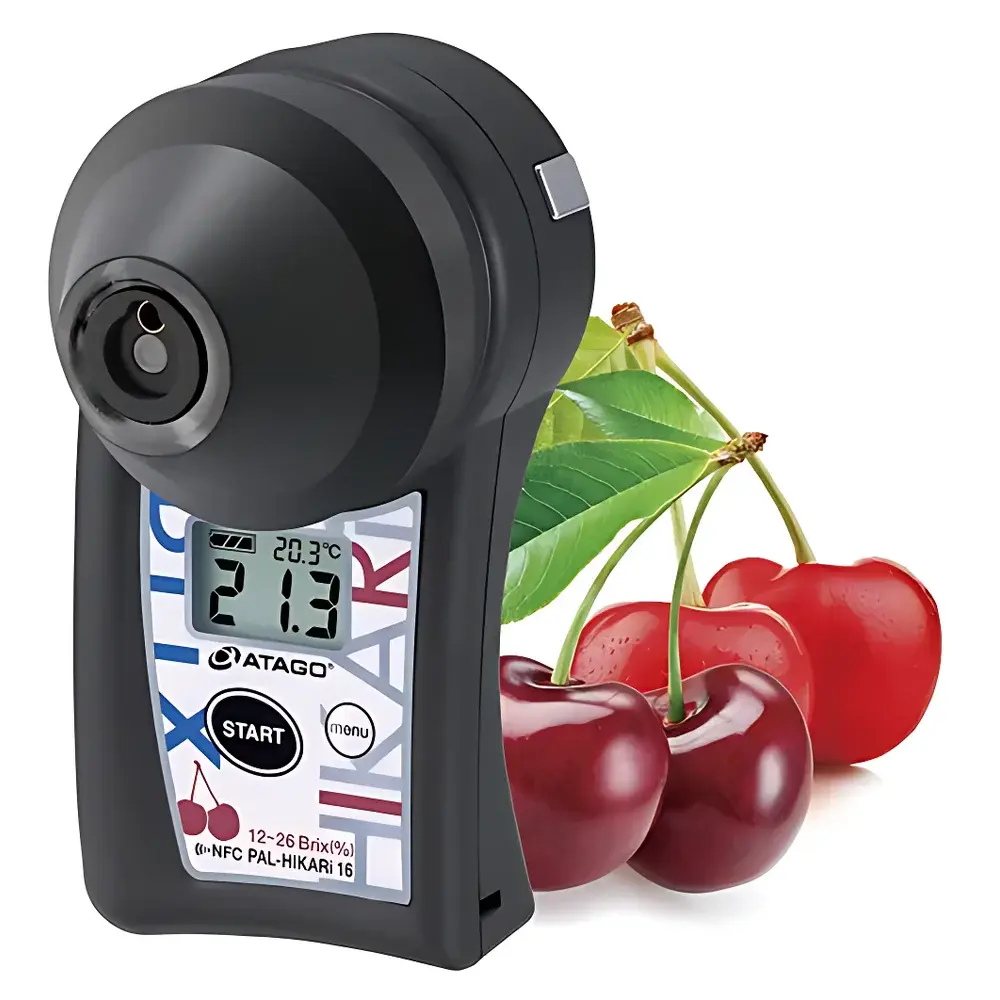
ATAGO PAL-HIKARi 16 Non-Destructive Infrared Refractometer for Cherries
| Brand | ATAGO |
|---|---|
| Origin | Japan |
| Model | PAL-HIKARi 16 (Cherry-Specific) |
| Instrument Type | Non-Destructive |
| Measurement Principle | Near-Infrared Absorption at 940 nm |
| Brix Range | 12.0–26.0% |
| Temperature Range | 15.0–35.0°C |
| Brix Resolution | 0.1% |
| Temperature Resolution | 0.1°C |
| Brix Accuracy | ±1.5% |
| Temperature Accuracy | ±1.0°C |
| Automatic Temperature Compensation | 10.0–35.0°C |
| Battery Life | ~4,000 measurements (2 × AAA alkaline) |
| IP Rating | IP64 |
| Dimensions | 6.1 × 5.2 × 11.5 cm |
| Weight | 142 g (instrument only) |
Overview
The ATAGO PAL-HIKARi 16 is a handheld, non-destructive near-infrared (NIR) refractometer engineered specifically for in-situ Brix measurement of intact cherry fruit. Unlike conventional destructive refractometers requiring juice extraction, the PAL-HIKARi 16 employs a calibrated 940 nm NIR optical sensor that penetrates the epidermis and measures soluble solids concentration directly within the mesocarp tissue. This principle leverages the characteristic absorption band of sucrose and fructose in the short-wave infrared region, enabling rapid, repeatable estimation of Brix without compromising fruit integrity. Designed for field-deployable use in orchards, packing houses, and postharvest laboratories, the instrument operates under ambient conditions (15.0–35.0°C), with built-in automatic temperature compensation (10.0–35.0°C) to minimize thermal drift. Its compact form factor (142 g), IP64-rated enclosure, and battery-powered operation support continuous deployment across variable environmental conditions—making it suitable for GLP-aligned quality monitoring workflows where sample preservation and throughput are critical.
Key Features
- Non-destructive measurement: No fruit cutting, piercing, or juice extraction required—preserves sample integrity for downstream ripening studies or commercial sale.
- Cherry-optimized optical calibration: Factory-calibrated using reference cherry cultivars across the Brix range of 12.0–26.0%, minimizing inter-varietal bias under controlled ambient conditions.
- Three-second measurement cycle: Real-time digital display with 0.1% Brix resolution; supports sequential multi-point acquisition with on-device averaging.
- Robust environmental adaptation: IP64 ingress protection ensures resistance to dust and water splashes during outdoor orchard use; operating temperature range aligned with typical cherry harvest and storage environments.
- Low-power architecture: Powered by two standard AAA alkaline batteries, delivering approximately 4,000 measurements per set—ideal for extended field campaigns without recharging infrastructure.
- User-configurable offset correction: Enables fine-tuning of readings against laboratory-grade benchtop refractometer baselines (e.g., ATAGO PR-101α or digital Abbe refractometers) to harmonize field and lab data streams.
Sample Compatibility & Compliance
The PAL-HIKARi 16 is validated exclusively for intact, mature sweet cherry fruit (Prunus avium L.) with intact skin, uniform surface texture, and absence of significant bruising or cracking. It is not intended for use on stone fruits with thick cuticles (e.g., plums), berries with high surface wax content (e.g., blueberries), or processed or frozen samples. While not certified to ISO 21527 or AOAC Official Method 932.12 (which pertain to destructive juice-based Brix determination), the instrument conforms to JIS Z 8015:2019 for portable optical measurement devices and meets electromagnetic compatibility requirements per IEC 61326-1. Its design supports traceability in GMP-adjacent environments when paired with documented offset calibration records and operator training logs—particularly relevant for exporters complying with EU Regulation (EC) No 543/2011 Annex VII (fruit quality standards) and USDA AMS Grade Standards for Sweet Cherries.
Software & Data Management
The PAL-HIKARi 16 operates as a standalone, embedded-system device with no Bluetooth, USB, or cloud connectivity. All measurement data remain local to the LCD interface. However, its consistent output format (Brix % ± value, timestamp-agnostic) enables manual transcription into LIMS or Excel-based QA/QC databases. For regulated environments requiring audit trails, users may integrate the device into SOPs that mandate dual-operator verification, daily zero-checks using NIST-traceable sucrose standards (e.g., 15.0% w/w aqueous solution at 20°C), and logbook entries documenting ambient temperature, fruit variety, and offset adjustments. Though lacking FDA 21 CFR Part 11 electronic signature capability, its simplicity supports ALCOA+ principles (Attributable, Legible, Contemporaneous, Original, Accurate) when used within defined procedural controls.
Applications
- Orchard precision harvesting: Enables real-time Brix mapping across tree canopies to identify optimal harvest windows per block—reducing over-/under-ripeness losses.
- Postharvest grading: Facilitates rapid lot-level screening prior to packing, supporting compliance with export Brix thresholds (e.g., ≥16.0% for Japanese premium cherries).
- Cultivar development trials: Provides longitudinal, non-lethal Brix tracking during breeding programs—critical for evaluating sugar accumulation kinetics without sacrificing experimental units.
- Supply chain quality assurance: Deployed at border inspection points or cold-chain hubs to verify incoming shipments against contractual Brix specifications before cold storage allocation.
- Academic horticultural research: Supports studies on carbohydrate partitioning, rootstock-scion interactions, and deficit irrigation effects on fruit sweetness—without introducing sampling artifacts.
FAQ
Can the PAL-HIKARi 16 be used on other fruits besides cherries?
No. Its optical model and calibration curve are specific to cherry mesocarp optical properties; applying it to apples, grapes, or strawberries will yield non-validated, potentially inaccurate results.
Does the device require periodic recalibration by the user?
No field recalibration is supported. Users should perform daily verification using a certified 15.0% Brix sucrose standard at ambient temperature and apply the offset function if deviation exceeds ±0.5%.
How does skin thickness or surface moisture affect measurement accuracy?
Excess surface condensation or rainwater must be gently blotted prior to measurement; thick or waxy cuticles (e.g., ‘Lapins’ vs. ‘Bing’) may require cultivar-specific offset adjustments validated against destructively measured juice Brix.
Is the PAL-HIKARi 16 compliant with FDA or EU food safety regulations?
It is not a regulatory compliance device per se, but its measurements may serve as objective evidence in HACCP or FSMA preventive control records when integrated into documented, validated procedures.
What is the expected service life under regular field use?
With proper storage (dry, 10–30°C), routine lens cleaning using lint-free optical tissue, and battery replacement before deep discharge, the unit maintains specification performance for ≥5 years based on ATAGO’s field reliability data.



