
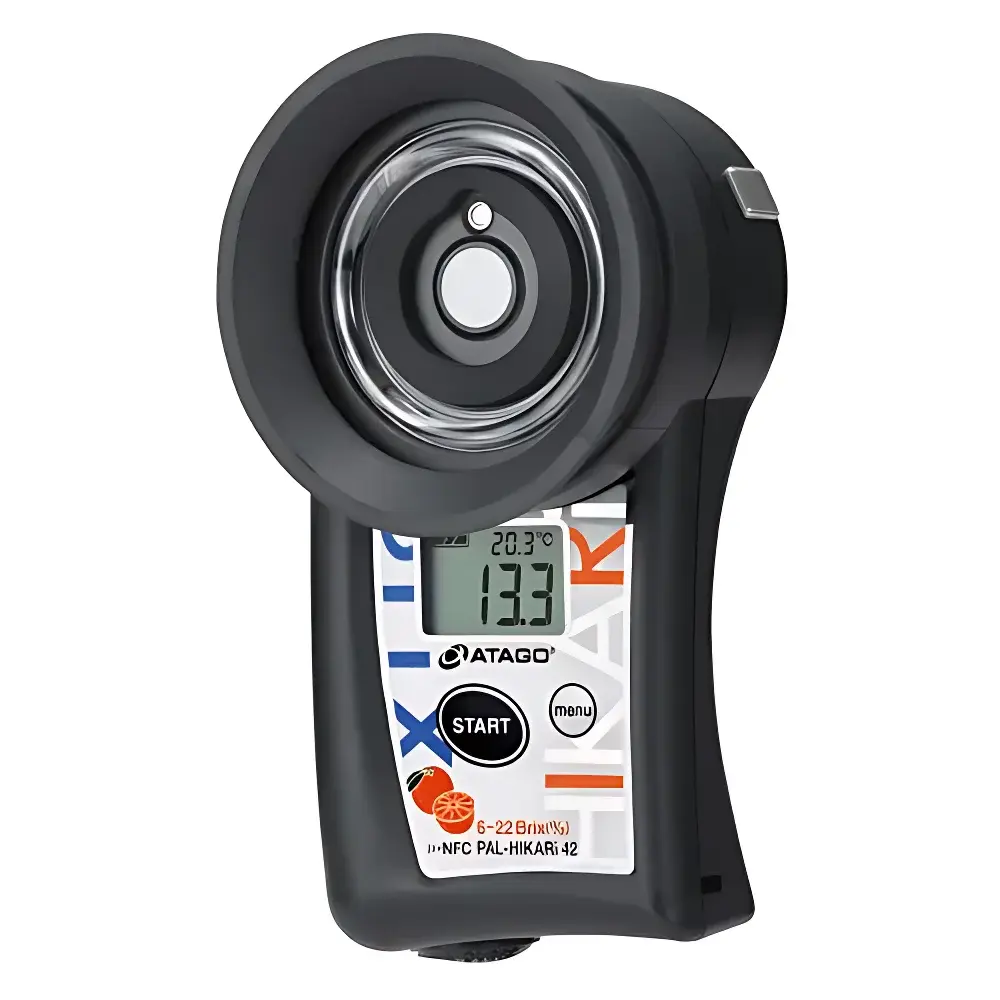
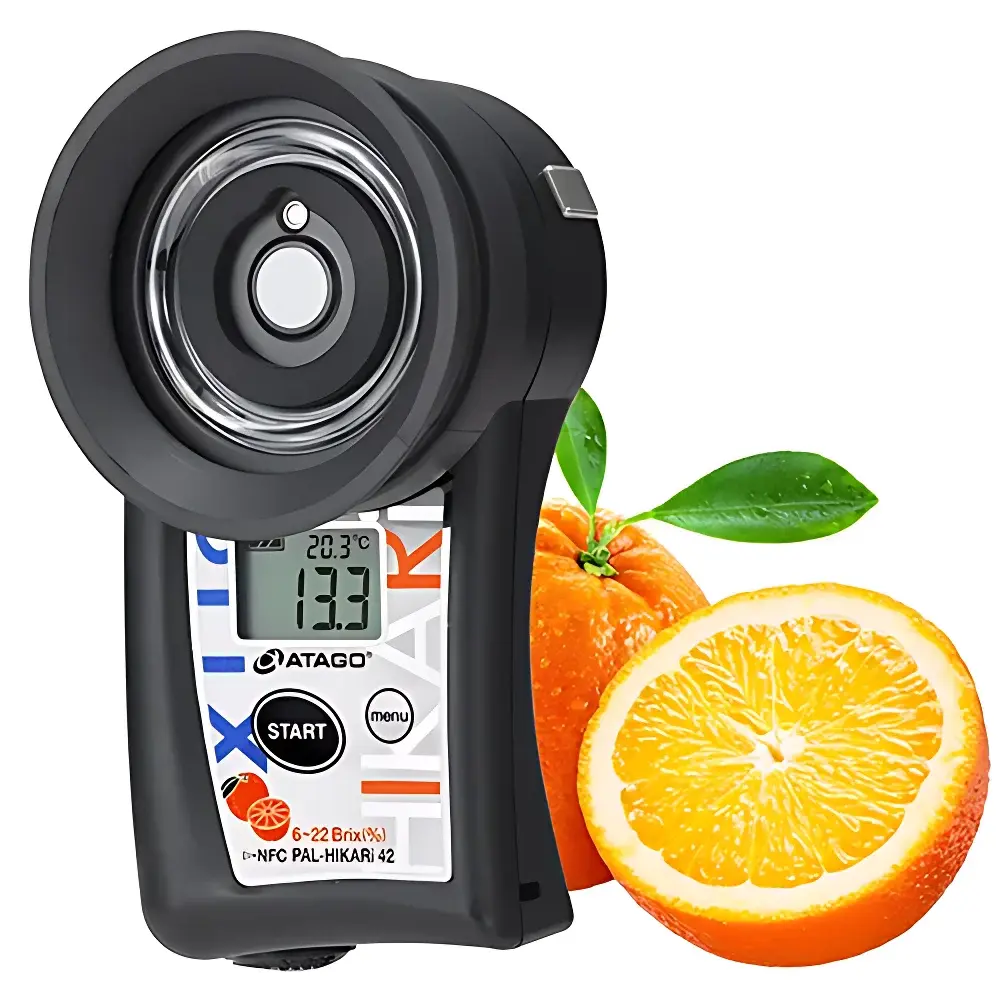
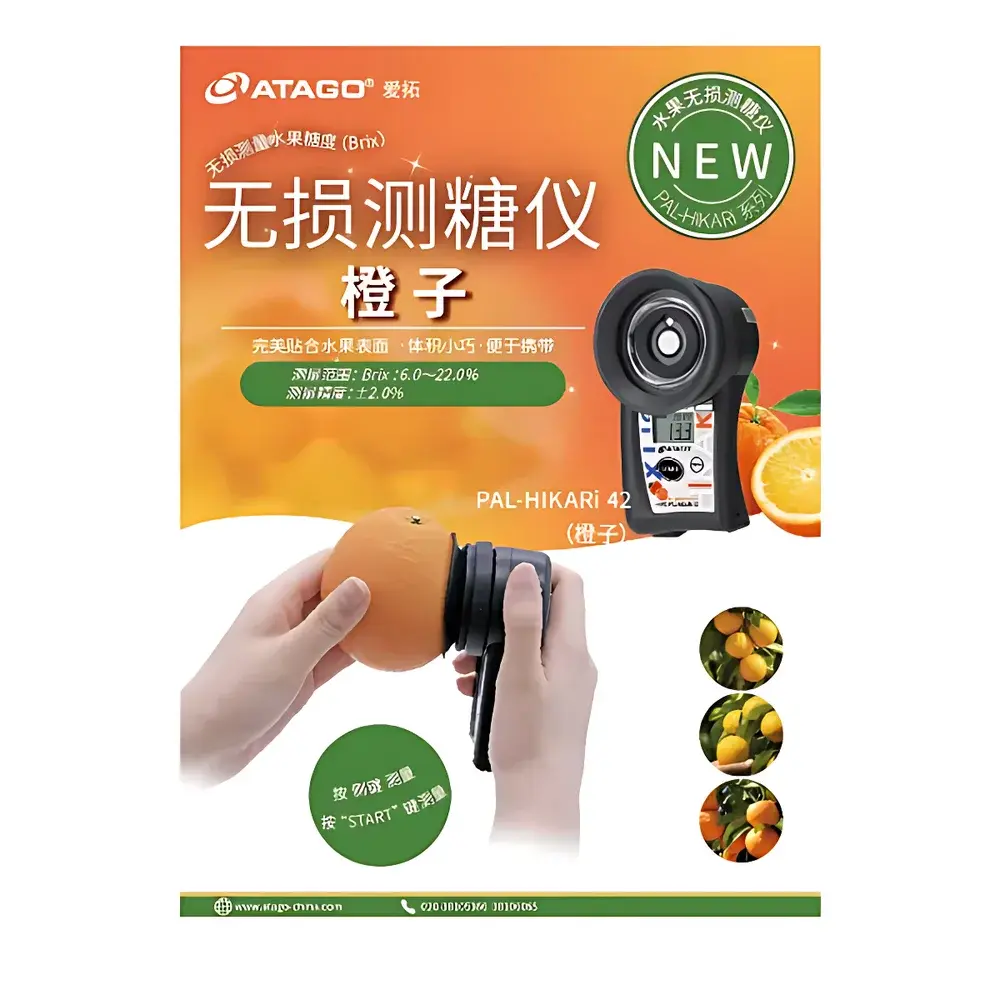
ATAGO PAL-HIKARi 42 Non-Destructive Orange Brix Meter
| Brand | ATAGO |
|---|---|
| Origin | Japan |
| Model | PAL-HIKARi 42 |
| Instrument Type | Non-Destructive |
| Measurement Principle | Near-Infrared (NIR) Reflectance |
| Measuring Range | 6.0–22.0% Brix |
| Accuracy | ±2.0% Brix (varies by orange cultivar and ambient conditions) |
| Resolution | 0.1% Brix |
| Automatic Temperature Compensation | 5.0–35.0°C |
| IP Rating | IP64 |
| Power Supply | 2× AAA alkaline batteries |
| Dimensions | 6.1×4.4×11.5 cm |
| Weight | 120 g (instrument only) |
Overview
The ATAGO PAL-HIKARi 42 is a handheld, non-destructive near-infrared (NIR) reflectance meter engineered for rapid, in-situ Brix measurement on intact orange fruit. Unlike traditional refractometers requiring juice extraction or destructive sampling, the PAL-HIKARi 42 operates via optical penetration—emitting NIR light from the device’s contact probe onto the fruit surface and analyzing spectral reflectance characteristics correlated with soluble solids concentration (SSC). This principle leverages established empirical calibration models developed across multiple orange cultivars (e.g., Navel, Valencia, Cara Cara), enabling field- and packinghouse-ready assessment without compromising fruit integrity, shelf life, or post-harvest quality. The instrument is optimized for orchard scouting, harvest timing decisions, pre-sorting evaluation, and QC verification at receiving stations—supporting data-driven agricultural practices aligned with Good Agricultural Practices (GAP) and traceability frameworks.
Key Features
- True non-destructive operation: No fruit puncturing, peeling, or juice expression required—preserves marketability and reduces post-harvest handling losses.
- NIR-based optical sensing architecture with factory-calibrated algorithm specific to orange peel morphology and internal optical scattering properties.
- Integrated automatic temperature compensation (5.0–35.0°C) ensures stable readings across seasonal field environments; users are advised to equilibrate fruit to ambient measurement temperature prior to testing per ISO 2173:2003 guidance for fruit SSC determination.
- Rugged, portable design compliant with IP64 ingress protection—resistant to dust and water splashes encountered during outdoor orchard use.
- High-resolution display showing Brix values to 0.1% resolution, with real-time measurement confirmation and audible feedback upon successful acquisition.
- Battery-powered (2× AAA alkaline), enabling >5,000 measurements per set—ideal for extended field surveys without external power dependency.
Sample Compatibility & Compliance
The PAL-HIKARi 42 is validated exclusively for mature, commercially grown orange varieties with typical rind thickness (1.5–3.0 mm) and surface reflectivity within defined spectral bands (700–1100 nm). It is not intended for use on green/unripe fruit, waxed or coated fruit, or fruit exhibiting severe surface blemishes, scarring, or excessive moisture. While not certified to FDA 21 CFR Part 11, the device supports GLP-aligned documentation workflows when paired with ATAGO’s optional data logging accessories (e.g., PAL-Log software interface). Its measurement methodology aligns with the physical basis of ISO 2173 (fruit and vegetable products — determination of soluble solids content — refractometric method) and ASTM D8079-20 (standard guide for NIR spectroscopy of horticultural produce), though it serves as a screening tool rather than a primary reference method.
Software & Data Management
The PAL-HIKARi 42 operates as a standalone field instrument with no embedded memory or Bluetooth connectivity. For traceable data capture, ATAGO recommends pairing with the optional PAL-Log PC application (Windows-compatible) via USB-C adapter (sold separately), enabling timestamped export of measurement sequences—including operator ID, location metadata (manual entry), and environmental notes—to CSV or Excel formats. All exported datasets retain full audit trail capability for internal QA review and can be integrated into LIMS or farm management systems (FMS) supporting standard import protocols. Firmware updates are distributed through ATAGO’s global technical support portal and require authorized service center intervention.
Applications
- Orchard maturity mapping: Quantify spatial Brix gradients across blocks to optimize harvest windows and reduce variability in delivered fruit quality.
- Packinghouse inbound inspection: Rapid triage of incoming lots to segregate by sweetness grade prior to washing, sorting, and grading lines.
- Post-harvest storage monitoring: Track SSC changes over time in controlled atmosphere (CA) storage to assess ripening kinetics and predict shelf-life endpoints.
- Rootstock and cultivar trials: Support comparative horticultural research by enabling repeated longitudinal measurements on the same fruit across developmental stages.
- Extension and grower education: Demonstrate objective quality metrics during field days and cooperative training sessions without generating waste or altering fruit condition.
FAQ
Can the PAL-HIKARi 42 measure other citrus fruits such as grapefruit or tangerines?
It is calibrated specifically for oranges (Citrus sinensis); cross-application to other citrus species is not validated and may yield inaccurate results due to differences in rind structure, juice vesicle density, and NIR absorption profiles.
Does the device require periodic recalibration by the user?
No field recalibration is supported. Calibration is performed at the factory using NIST-traceable sucrose standards and validated against reference juice-extracted Brix values per ATAGO’s internal QA protocol. Users should perform daily verification using the included ceramic reference tile before critical measurements.
How does ambient light affect measurement accuracy?
The optical system incorporates ambient light rejection via pulsed NIR illumination and synchronous detection. Performance remains stable under direct sunlight, shaded orchard conditions, or indoor warehouse lighting—no shielding hood or dark enclosure is required.
Is the probe surface sterilizable between samples?
The stainless-steel measurement window is compatible with 70% isopropyl alcohol wipes. Avoid abrasive cleaners or submersion. Disinfection must be completed prior to each new orchard block or variety to prevent cross-contamination of surface microbes affecting reflectance.




