
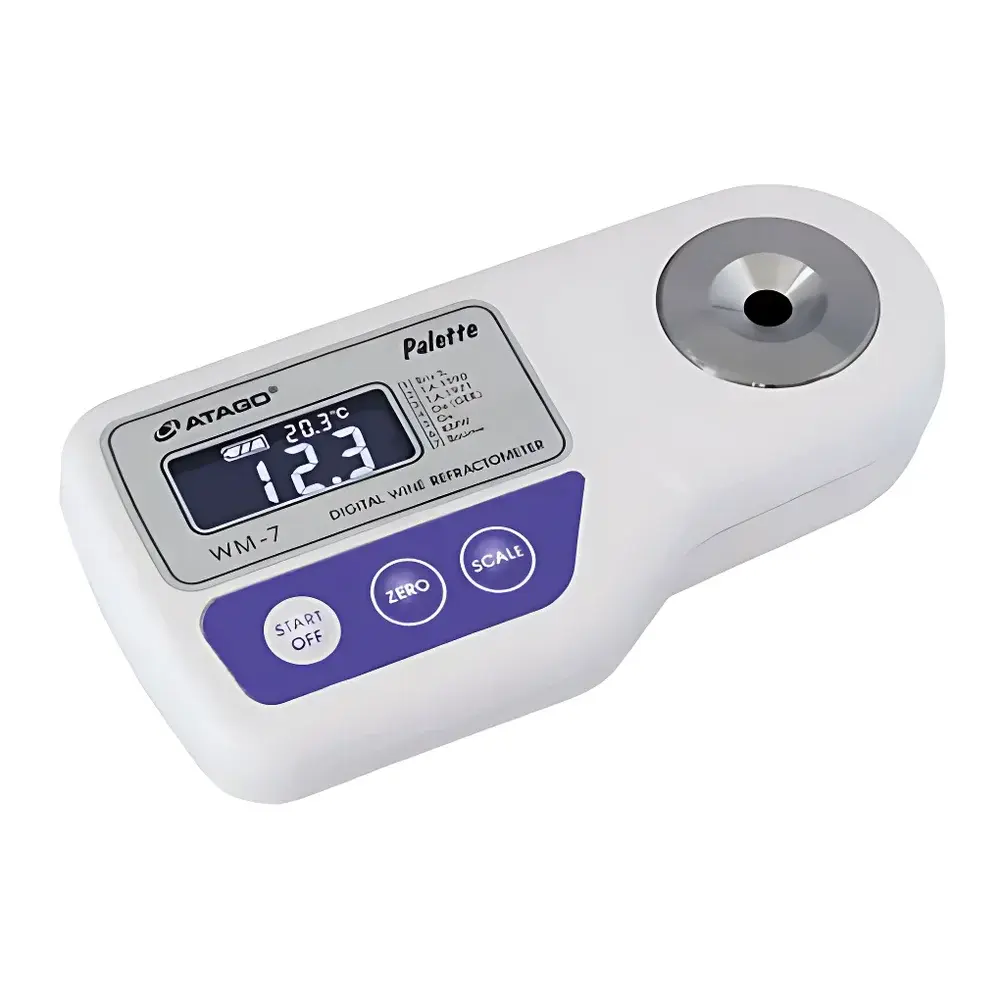
ATAGO WM-7 Digital Wine Refractometer
| Brand | ATAGO |
|---|---|
| Origin | Japan |
| Model | WM-7 |
| Measurement Principle | Abbe Refraction (Critical Angle Method) |
| Measurement Range | Brix 0.0–45.0%, TA 1990 0.0–26.0%, TA 1971 0.0–25.0%, °Oe (GER) 0–240, °Oe (General) 0–240, KMW (°Babo) 0.0–40.0, °Bé 0.0–21.0 |
| Resolution | Brix 0.1%, TA 0.1%, KMW 0.1°, °Bé 0.1°, °Oe 1° |
| Accuracy | ±0.1% Brix, ±0.2% TA, ±0.2° KMW, ±0.2° Bé, ±1° Oe |
| Response Time | 3 s |
| Temperature Compensation | Automatic (5–40°C sample temp |
| IP Rating | IP64 |
| Power | 9V alkaline battery (006P) |
| Dimensions | 170 × 90 × 40 mm |
| Weight | 300 g (instrument only) |
| Compliance | ICUMSA, OIV, DIN 38405, ISO 2173 |
Overview
The ATAGO WM-7 Digital Wine Refractometer is a purpose-built optical instrument engineered for rapid, field-deployable measurement of soluble solids concentration in grape must and wine-related samples. Based on the Abbe refractometry principle—measuring the critical angle of total internal reflection—the WM-7 determines refractive index and converts it into seven industry-standard concentration scales via built-in calibration algorithms. Its primary application lies in pre-fermentation must analysis, where Brix (ICUMSA) values serve as the foundational input for estimating potential alcohol content using established conversion models (e.g., Balling, Gay-Lussac, or OIV-recommended formulas). Unlike destructive hydrometric methods requiring large sample volumes and temperature equilibration, the WM-7 operates on micro-volume (0.3 mL), non-temperature-controlled samples with automatic digital temperature compensation (ATC) across 5–40°C, ensuring consistent accuracy under variable vineyard or cellar conditions.
Key Features
- Seven integrated scales compliant with global enological standards: Brix (ICUMSA), Total Acidity (TA) 1990 and 1971 definitions, German °Oe (GER), general °Oe, KMW (Klosterneuburger Mostwaage), and Baumé (°Bé).
- High-precision optical system delivering ±0.1% Brix accuracy and 0.1% resolution—validated per ISO 2173 for saccharimetric refractometers.
- External Light Interception (ELI) optical design, enabling reliable outdoor use in direct sunlight without measurement drift.
- Rugged, IP64-rated housing resistant to dust ingress and water splashing—suitable for humid winery environments, fermentation halls, and open-air vineyard sampling.
- Three-second measurement cycle with auto-hold function, minimizing operator dependency and throughput bottlenecks during harvest season.
- Compact, handheld form factor (170 × 90 × 40 mm; 300 g) powered by a single 9V alkaline battery (006P), supporting >5,000 measurements per charge.
Sample Compatibility & Compliance
The WM-7 is optimized for aqueous sugar solutions typical of grape must, juice, and early-stage fermentations. It accommodates viscous or particulate-laden samples when filtered through standard 0.45 µm membrane filters—consistent with OIV Method OIV-MA-AS313-01A. While classified as a “destructive” instrument in regulatory documentation (due to required sample contact with the prism surface), no chemical reagents or consumables beyond standard cleaning tissue are needed. The device meets DIN 38405 Part 27 for refractometric sugar determination and supports traceability requirements under GLP-aligned workflows. Its Brix scale is directly traceable to NIST SRM 84d sucrose reference solutions, and all calibration verification procedures align with ISO/IEC 17025 clause 6.5.2 for field instruments used in quality control.
Software & Data Management
The WM-7 operates as a standalone, embedded-system instrument with no onboard data logging or USB connectivity. However, its repeatable output and stable calibration enable seamless integration into paper-based or LIMS-managed QC records. Users routinely document readings manually alongside batch ID, vineyard block, sampling date/time, and operator initials—fulfilling minimum record-keeping requirements under EU Regulation (EC) No 607/2009 and US TTB guidelines for wine production documentation. For laboratories implementing 21 CFR Part 11 compliance, the WM-7 serves as a validated manual entry point when paired with electronic lab notebooks (ELNs) featuring audit trails, electronic signatures, and controlled access protocols.
Applications
- Pre-harvest grape maturity assessment via Brix monitoring across vineyard blocks.
- Must evaluation prior to inoculation to determine optimal yeast strain selection and nutrient supplementation.
- Monitoring sugar depletion kinetics during active fermentation (when sampled post-racking or via thief).
- Verification of chaptalization or water addition compliance per OIV and national wine regulations.
- Quality assurance screening of purchased grape concentrate or rectified grape must (RGM).
- Teaching and extension activities in viticulture and enology programs, where rapid visual correlation between refractive index and sugar concentration reinforces core physicochemical concepts.
FAQ
Is the WM-7 suitable for measuring finished wine?
No—the instrument is calibrated for high-sugar must and juice. Ethanol and organic acids in fermented wine alter refractive index behavior outside the WM-7’s linear calibration range; dedicated alcohol refractometers or densitometers are recommended for final product analysis.
Does the WM-7 require periodic recalibration with certified standards?
Yes. ATAGO recommends daily verification using distilled water (0.0% Brix) and a 10.0% sucrose standard (traceable to ICUMSA) before first use and after extended storage. Full recalibration is advised every 6 months or per internal QA schedule.
Can the WM-7 be used in cold-climate vineyards where must temperatures fall below 5°C?
The instrument’s ATC compensates only for sample temperatures between 5–40°C. Samples below 5°C must be warmed to at least 5°C prior to measurement to ensure accuracy and avoid prism condensation.
What cleaning protocol maintains optical integrity over time?
Wipe the sapphire prism gently with lint-free optical tissue moistened with distilled water after each use. Avoid acetone, ethanol, or abrasive cleaners, which may degrade the anti-reflective coating or prism sealant.
How does the WM-7 comply with international wine regulatory frameworks?
Its Brix scale adheres to ICUMSA Method GS2/3-14 and OIV Resolution 23/2000; TA scales conform to OIV Method OIV-MA-AS311-01A. Documentation of instrument model, serial number, calibration history, and operator training satisfies traceability clauses in ISO 22000 and HACCP-based wine safety plans.



