
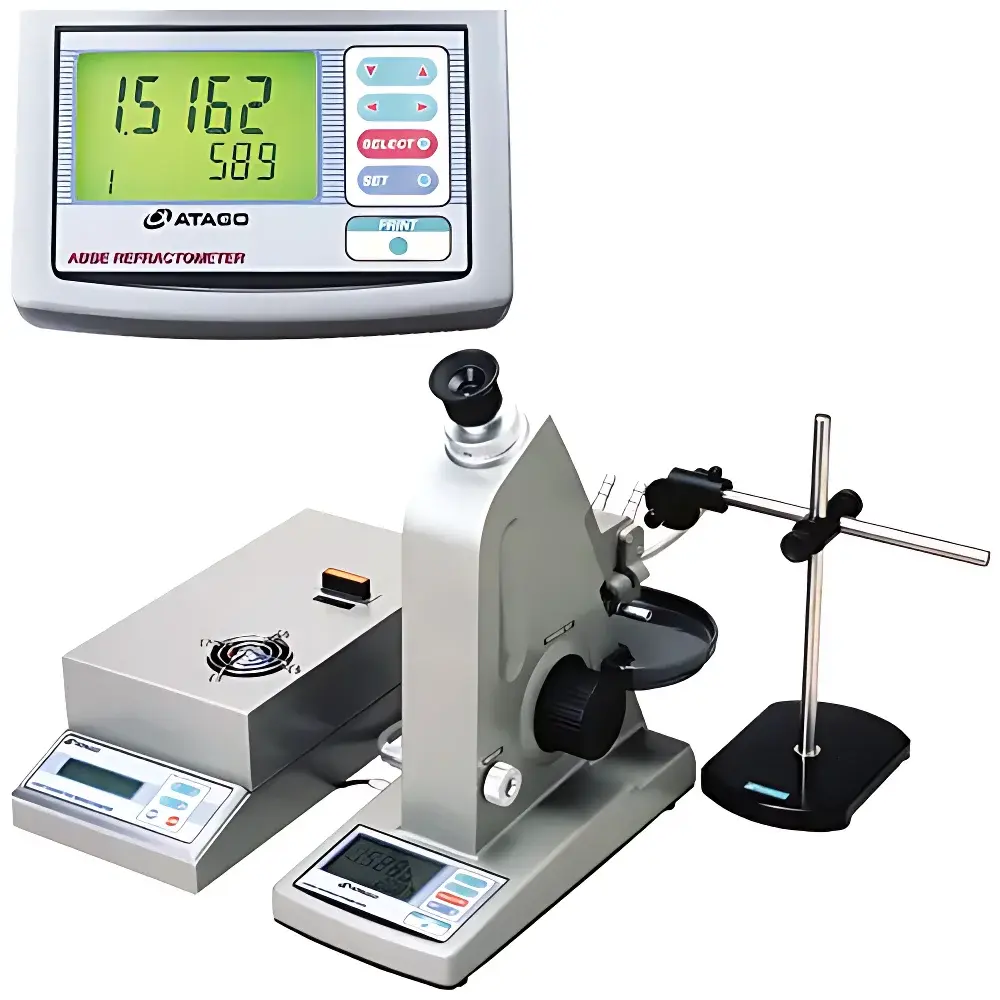
ATAGO DR-M4 Multi-Wavelength Abbe Refractometer
| Brand | ATAGO |
|---|---|
| Origin | Japan |
| Model | DR-M4 (Up to 1100 nm) |
| Type | Benchtop Refractometer |
| Temperature Control | Yes |
| Digital Display | Yes |
| Refractive Index Range | 1.3278–1.6840 |
| Accuracy | ±0.0002 |
Overview
The ATAGO DR-M4 Multi-Wavelength Abbe Refractometer is a precision optical instrument engineered for high-accuracy measurement of refractive index (n), Abbe number (vd or ve), birefringence, and dispersion (nF – nC) across a broad spectral range from 450 nm to 1100 nm. Based on the classical Abbe principle—utilizing critical angle determination at the sample-prism interface—the DR-M4 delivers traceable, reproducible optical characterization essential for advanced materials research and industrial quality assurance. Its dual-wavelength capability (standard visible range + optional NIR extension up to 1100 nm via RE-9119 near-infrared viewer) enables wavelength-dependent analysis required for evaluating chromatic dispersion in optical glasses, polymers, liquid crystals, and semiconductor thin films. The instrument’s robust mechanical architecture, integrated Peltier temperature control (±0.1 °C stability), and high-resolution digital display ensure consistent measurements under controlled thermal conditions—critical for correlating optical properties with molecular structure, crystallinity, internal stress, and compositional homogeneity.
Key Features
- Multi-wavelength refractive index measurement from 450 nm to 1100 nm (NIR extension requires optional RE-9119 viewer)
- Digital readout of refractive index (n) and Abbe number (vd/ve) directly on integrated LCD screen
- Precision temperature regulation via built-in Peltier element (operable within standard laboratory ambient range; typical setpoint accuracy ±0.1 °C)
- Measurement accuracy of ±0.0002 refractive index units (RIU) with resolution of 0.0001 RIU
- Benchtop design optimized for stability and vibration resistance during high-magnification boundary-line observation
- Compliant optical path geometry per ISO 2114 and ASTM D1218 standards for Abbe refractometry
Sample Compatibility & Compliance
The DR-M4 accommodates transparent and semi-transparent solid samples (e.g., optical glass blanks, polymer pellets, crystalline wafers) as well as homogeneous liquids and gels. Sample volume requirements are minimal (typically < 0.5 mL for liquids or ~10 × 10 mm surface area for solids). For birefringence evaluation, anisotropic samples are rotated manually while monitoring directional shifts in the critical angle boundary line—enabling quantitative assessment of Δn = ne – no. All measurements adhere to internationally recognized metrological frameworks: calibration traceability to NIST-certified reference oils (e.g., Cargille series), alignment with ISO 7884-2 (refractometers for liquids) and JIS K 0061 (Abbe refractometer specifications), and compatibility with GLP-compliant documentation workflows when paired with external data logging systems.
Software & Data Management
While the DR-M4 operates as a standalone benchtop instrument with real-time digital display, its analog voltage output (0–5 V DC proportional to n-value) supports integration into custom SCADA or LIMS environments. Users may record time-stamped measurement sequences—including temperature, wavelength selection, and n/Abbe values—via third-party DAQ hardware. Though no proprietary software is bundled, the instrument’s stable analog signal and deterministic response time (< 2 s settling per reading) facilitate compliance with FDA 21 CFR Part 11 requirements when implemented within validated electronic record systems featuring audit trail, user authentication, and electronic signature capabilities.
Applications
- Optical material development: Quantifying dispersion profiles (nF–nC, ng–nF) for lens design and achromatic doublet optimization
- Pharmaceutical solid-state characterization: Detecting polymorphic transitions via refractive index shifts in API powders or lyophilized formulations
- Thin-film metrology: Assessing thickness and composition uniformity in spin-coated polymer layers using multi-angle, multi-wavelength n-mapping
- Stress-induced birefringence analysis in tempered glass, injection-molded optics, and fiber-reinforced composites
- Thermo-optic coefficient (dn/dT) determination through controlled-temperature refractive index profiling
- Quality control of optical adhesives, encapsulants, and immersion fluids where n-matching and thermal stability are mission-critical
FAQ
What wavelength ranges does the DR-M4 support without accessories?
The base configuration covers 450–680 nm (visible spectrum); wavelengths from 681–1100 nm require the optional RE-9119 near-infrared viewer.
Can the DR-M4 measure birefringence quantitatively?
Yes—by rotating anisotropic samples and recording extremal n-values along orthogonal crystallographic axes, users derive Δn with uncertainty governed by the instrument’s ±0.0002 RIU accuracy.
Is temperature calibration traceable to national standards?
The Peltier system is factory-calibrated against PT100 reference sensors; users may verify thermal accuracy using NIST-traceable thermistor probes inserted into the sample stage port.
How is refractive index data validated for regulatory submissions?
When coupled with validated external recording systems, DR-M4 outputs satisfy ALCOA+ principles (Attributable, Legible, Contemporaneous, Original, Accurate) and support 21 CFR Part 11 compliance through configurable audit trails and role-based access controls.
Does ATAGO provide certified reference materials for routine verification?
Yes—ATAGO supplies ISO 17025-accredited calibration oils (e.g., nD = 1.4850 ± 0.0001 at 20 °C) with full uncertainty budgets and certificate of analysis.




