
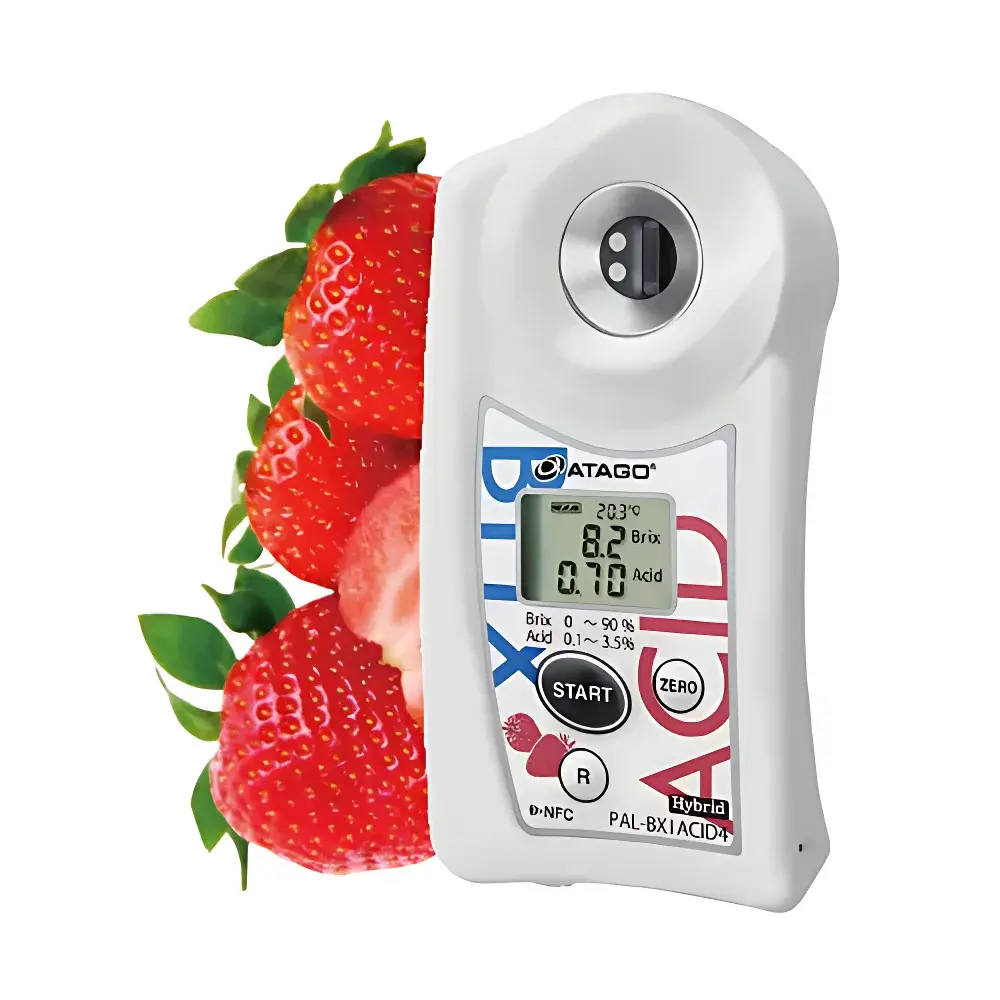
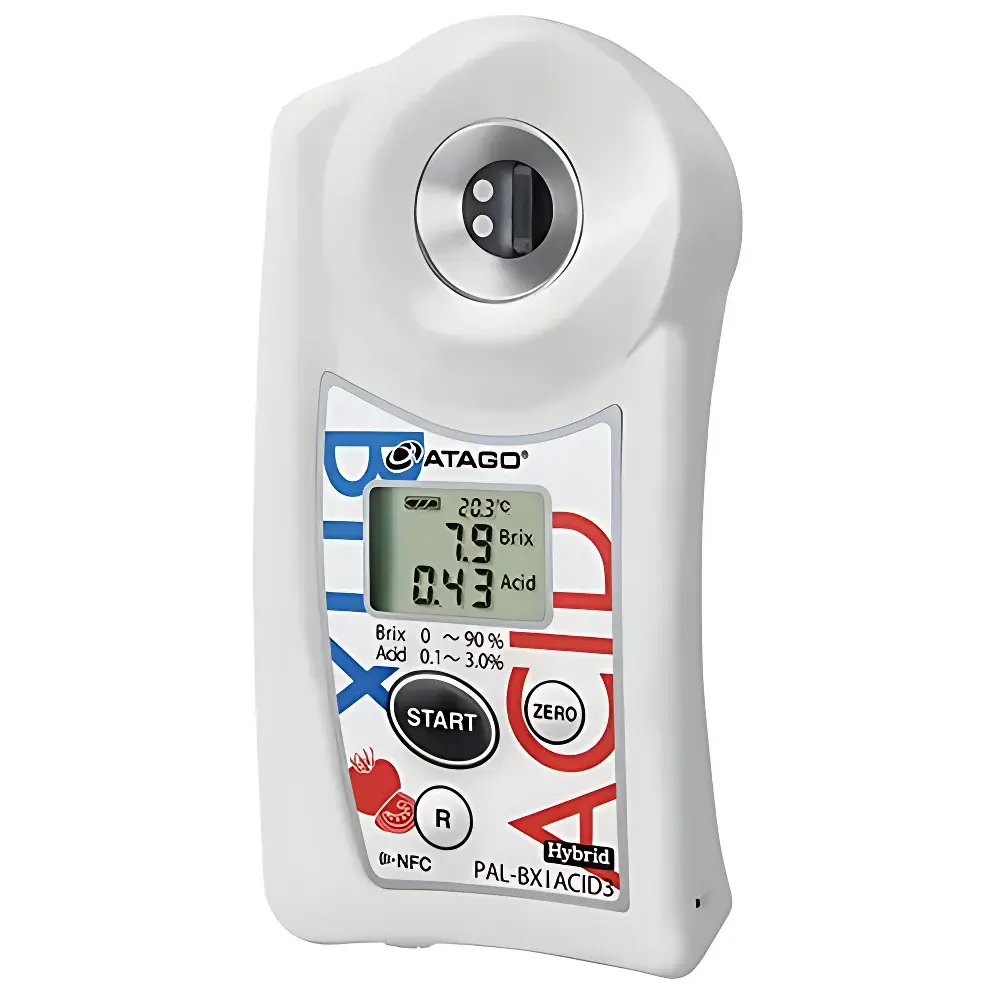
ATAGO PAL-BX/ACID 4 Strawberry Brix & Acidity Refractometer
| Brand | ATAGO |
|---|---|
| Origin | Japan |
| Model | PAL-BX/ACID 4 |
| Product Type | Handheld Digital Refractometer |
| Temperature Compensation Range | 10–40°C |
| Brix Measurement Range | 0.0–90.0% |
| Acid Measurement Range (as citric acid) | 0.10–3.50% |
| Brix Accuracy | ±0.2% |
| Acid Accuracy | ±0.10% (0.10–1.00%), ±10% relative (1.01–8.80%) |
| Brix Resolution | 0.1% |
| Acid Resolution | 0.01% (0.00–9.99%), 0.1% (≥10.0%) |
| Sugar-Acid Ratio Display | Yes (R-key activation) |
| Auto-Temperature Compensation | Yes |
| IP Rating | IP65 |
| Power | Two AAA alkaline batteries |
| Dimensions | 5.5 × 3.1 × 10.9 cm |
| Weight | 100 g (instrument only) |
Overview
The ATAGO PAL-BX/ACID 4 is a dedicated handheld digital refractometer engineered for rapid, simultaneous measurement of soluble solids content (Brix) and titratable acidity (expressed as citric acid equivalent) in fresh strawberries and strawberry-derived products. Unlike conventional benchtop analyzers or wet-chemistry methods, this instrument leverages Abbe-type optical refractometry combined with proprietary calibration algorithms to derive acidity from refractive index shifts induced by dilute aqueous acid solutions. Its core function—real-time sugar-acid ratio calculation via the dedicated R-key—is grounded in empirical correlation between refractive index, density, and proton concentration in standardized 1:50 (w/w) juice-to-distilled-water dilutions. Designed specifically for horticultural quality control workflows, the PAL-BX/ACID 4 eliminates dependency on laboratory-based titration, reducing analysis time from minutes to seconds while maintaining metrological traceability to reference methods per ISO 2173 (fruit juice Brix) and AOAC Official Method 942.15 (titratable acidity). The device operates within a biologically relevant temperature range (10–40°C) and incorporates automatic temperature compensation (ATC) based on internal thermistor feedback, ensuring consistent output across ambient field or packing-line conditions.
Key Features
- Dedicated dual-parameter calibration for strawberry matrix: factory-optimized Brix and acid curves validated against homogenized fresh strawberry pulp and clarified juice.
- Integrated sugar-acid ratio computation: press the R-key after sequential Brix and acid measurements to display ratio (0.00–999), formatted dynamically (0.00, 00.0, or 000) based on magnitude.
- OFFSET correction function: enables user-defined bias adjustment to align instrument readings with lab-reference titration data or alternate acid quantification units (e.g., malic or tartaric acid equivalents).
- Rugged field-ready design: IP65-rated enclosure resists dust ingress and low-pressure water jets; impact-resistant polycarbonate body withstands repeated handling in packing houses and orchard environments.
- High-resolution LCD with backlight: displays Brix (0.1% resolution), acid (0.01% below 10.0%), and ratio simultaneously; intuitive icon-driven interface requires no training.
- Battery-operated portability: powered by two standard AAA alkaline cells (typical life > 10,000 measurements); zero warm-up time and instant on/off functionality support high-throughput sampling.
Sample Compatibility & Compliance
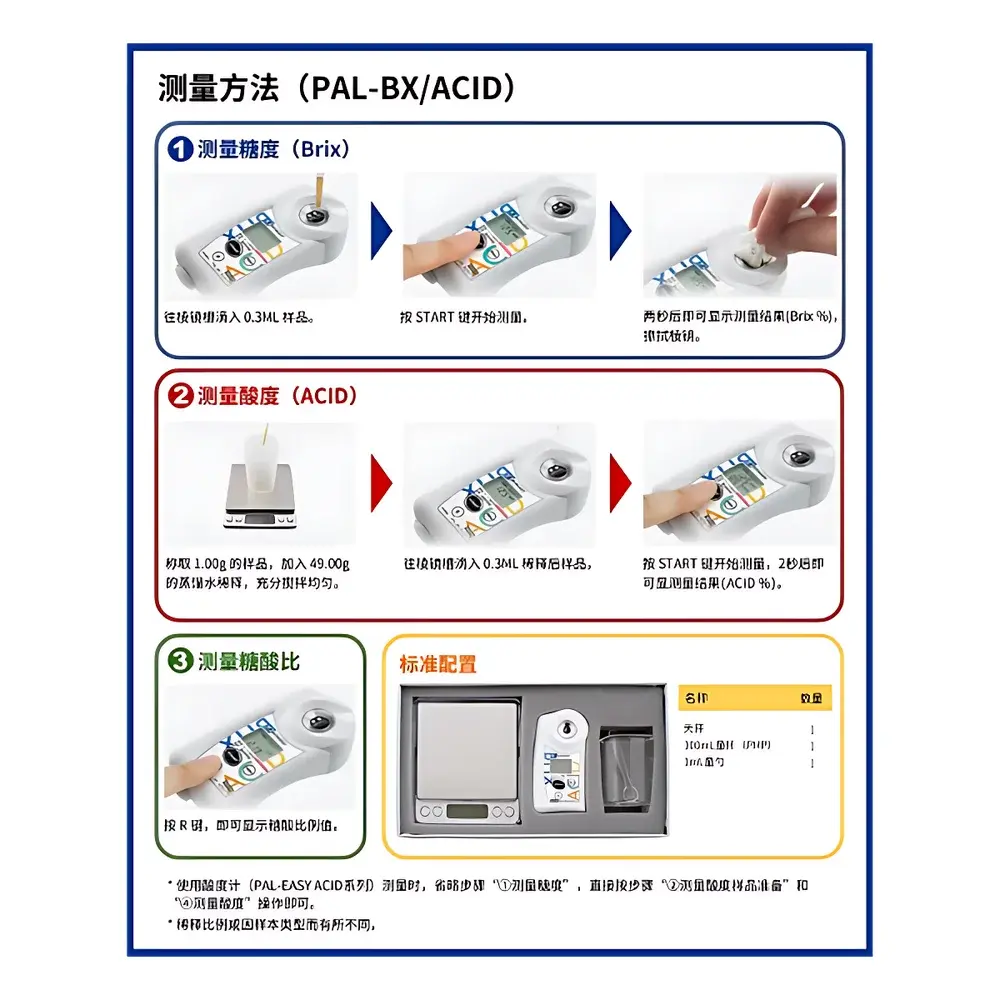
The PAL-BX/ACID 4 is validated for use with freshly expressed strawberry juice, homogenized whole-fruit extracts, and processed products including purees, jams, and frozen concentrates—provided samples are free of suspended particulates that may scatter incident light. Sample preparation follows a strict 1:50 (w/w) dilution protocol: 1.00 g of filtered juice mixed with 49.00 g of ASTM Type III distilled water, vortexed for 15 s, and measured immediately. This protocol ensures linear response within the calibrated acid range (0.10–3.50% citric acid) and mitigates matrix interference from anthocyanins and pectin. The instrument complies with ISO 2173 for Brix determination and supports GLP-aligned documentation when paired with ATAGO’s optional RS-232 data logging accessories. While not FDA 21 CFR Part 11 compliant out-of-the-box, its measurement records satisfy internal QA requirements for Grade A fruit classification per USDA AMS standards and EU Regulation (EC) No 1221/2008 on strawberry quality parameters.
Software & Data Management
The PAL-BX/ACID 4 operates as a standalone optical-electronic system with no embedded firmware upgradability or cloud connectivity. All calculations—including ATC compensation, OFFSET application, and R-key ratio derivation—are executed in real time by onboard microcontroller logic without external dependencies. Measurement data can be exported via optional RS-232 interface (cable model K-102) to Windows-based PCs running ATAGO’s free “Refractometer Data Manager” software, which logs timestamps, operator IDs, sample IDs, and full parameter sets (Brix, acid, ratio, temperature) in CSV or Excel-compatible formats. Audit trails include instrument serial number, firmware version, and calibration date—supporting basic GMP traceability in contract manufacturing environments where raw material verification is required prior to processing.
Applications
- Strawberry cultivar selection trials: rapid phenotyping of sugar-acid balance across breeding lines under field conditions.
- Harvest timing optimization: objective determination of physiological maturity by tracking sugar-acid ratio trends during ripening.
- In-line quality sorting: integration into post-harvest grading lines to reject lots falling outside target ratio thresholds (e.g., 25.0 for processing types).
- Processing consistency monitoring: verification of acid adjustment in jam and syrup formulations before thermal treatment.
- Research applications: correlation studies between refractometric acid values and HPLC-quantified organic acid profiles in germplasm collections.
- Educational use: demonstration tool for food science curricula covering non-destructive quality assessment principles.
FAQ
How is acidity measured without titration?
The PAL-BX/ACID 4 infers citric acid concentration indirectly via refractive index changes in standardized 1:50 dilutions. Calibration is traceable to primary acid reference materials; accuracy is maintained through rigorous dilution protocol adherence.
Can I measure other fruits with this instrument?
It is optimized exclusively for strawberry matrices. Using it on apples, citrus, or grapes introduces uncorrected matrix errors due to differing organic acid profiles and colloidal content.
What does the OFFSET function correct for?
OFFSET adjusts for systematic deviations between refractometric acid values and lab-reference titration results—common when comparing citric-equivalent readings to malic- or tartaric-based lab reports.
Is temperature compensation sufficient for uncontrolled field use?
Yes. The ATC algorithm covers 10–40°C using a high-stability thermistor; measurements outside this range require manual correction per included lookup table.
How often must the instrument be recalibrated?
Factory calibration remains stable for ≥12 months under normal use. Verification with ATAGO Brix Standard Solution (10.00%) and Acid Reference Fluid (1.00% citric acid) is recommended before each daily shift.






