ATAGO NAR-1T LIQUID Abbe Refractometer
| Brand | ATAGO |
|---|---|
| Origin | Japan |
| Model | NAR-1T LIQUID |
| Type | Benchtop Abbe Refractometer |
| Light Source | LED-based D-line simulation (589.3 nm) |
| Measurement Range | Refractive Index (nD): 1.3000–1.7000 |
| Brix | 0.0–95.0% |
| Resolution | nD: 0.001, Brix: 0.5% |
| Accuracy | nD: ±0.0002, Brix: ±0.1% |
| Temperature Display Range | 0.0–50.0°C (Accuracy: ±0.2°C, Resolution: 0.1°C) |
| Operating Ambient Temperature | 5–40°C |
| Power Supply | AC 100–240 V, 50/60 Hz |
| Power Consumption | 5 VA |
| Dimensions (Main Unit) | 13 × 18 × 23 cm |
| Weight (Main Unit) | 1.8 kg |
| Dimensions (Temperature Display Unit) | 10 × 11 × 7 cm |
| Weight (Temperature Display Unit) | 0.5 kg |
| Sample Compatibility | Transparent to semi-transparent liquids only |
| Temperature Control | None (external thermostatic bath required for precise temperature regulation) |
| Digital Readout | None (analog scale with ocular eyepiece reading) |
| Compliance | Designed per JIS Z 8806 and ISO 21348 principles for refractive index measurement |
Overview
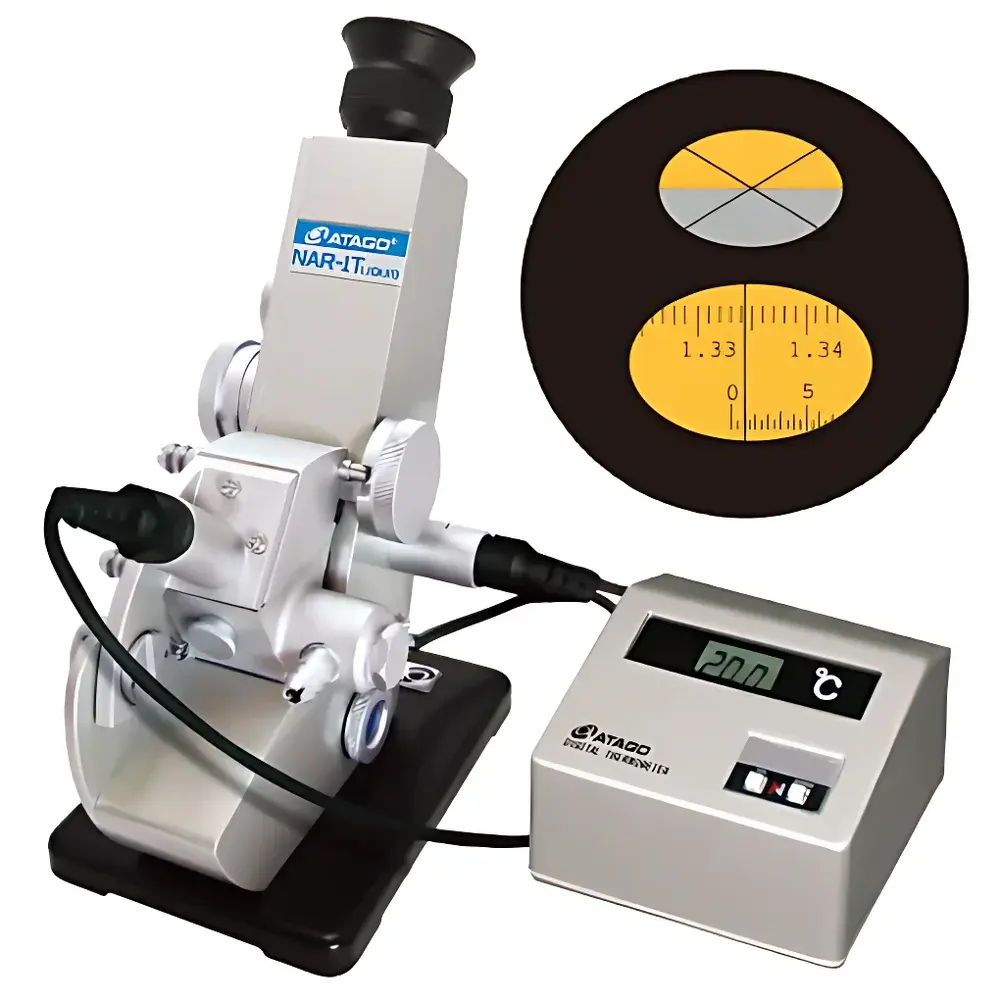
The ATAGO NAR-1T LIQUID is a precision benchtop Abbe refractometer engineered for high-reproducibility measurement of refractive index (nD) and Brix concentration in transparent or semi-transparent liquid samples. Based on the classical Abbe principle—utilizing total internal reflection at the prism-sample interface under monochromatic illumination—the instrument employs an LED light source calibrated to simulate the sodium D-line (589.3 nm), ensuring spectral consistency aligned with international refractometric standards. Unlike digital or automated units, the NAR-1T LIQUID maintains a manually operated optical architecture optimized for laboratory environments where traceability, mechanical stability, and operator-controlled observation are prioritized. Its compact footprint (13 × 18 × 23 cm) and lightweight construction (1.8 kg main unit) support flexible integration into QC labs, R&D workstations, and teaching laboratories without requiring dedicated infrastructure. The device delivers fundamental metrological performance: ±0.0002 accuracy in nD and ±0.1% in Brix—validated against certified reference liquids traceable to NIST SRMs.
Key Features
- Optically stabilized Abbe configuration with high-precision ground glass prisms and collimated LED D-line illumination (589.3 nm)
- Manual ocular eyepiece with dual-scale reticle for simultaneous nD (1.3000–1.7000) and Brix (0.0–95.0%) readout
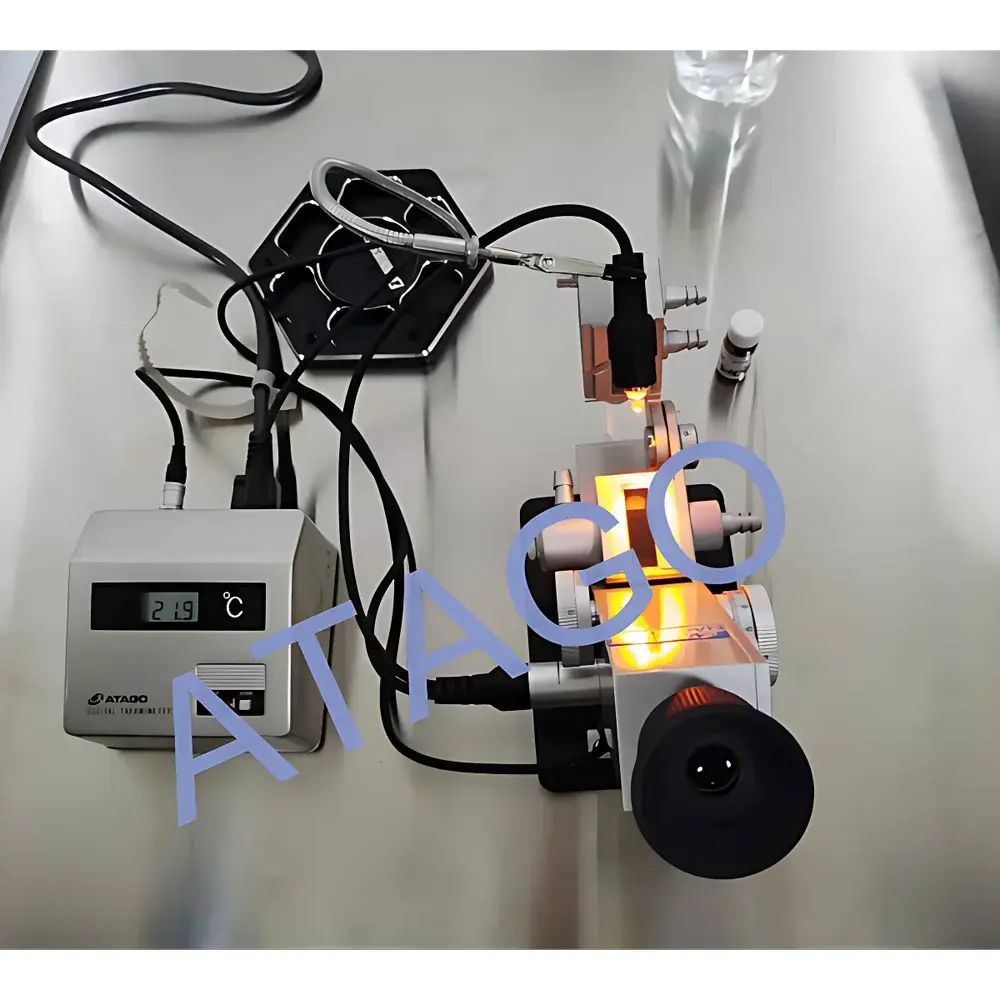
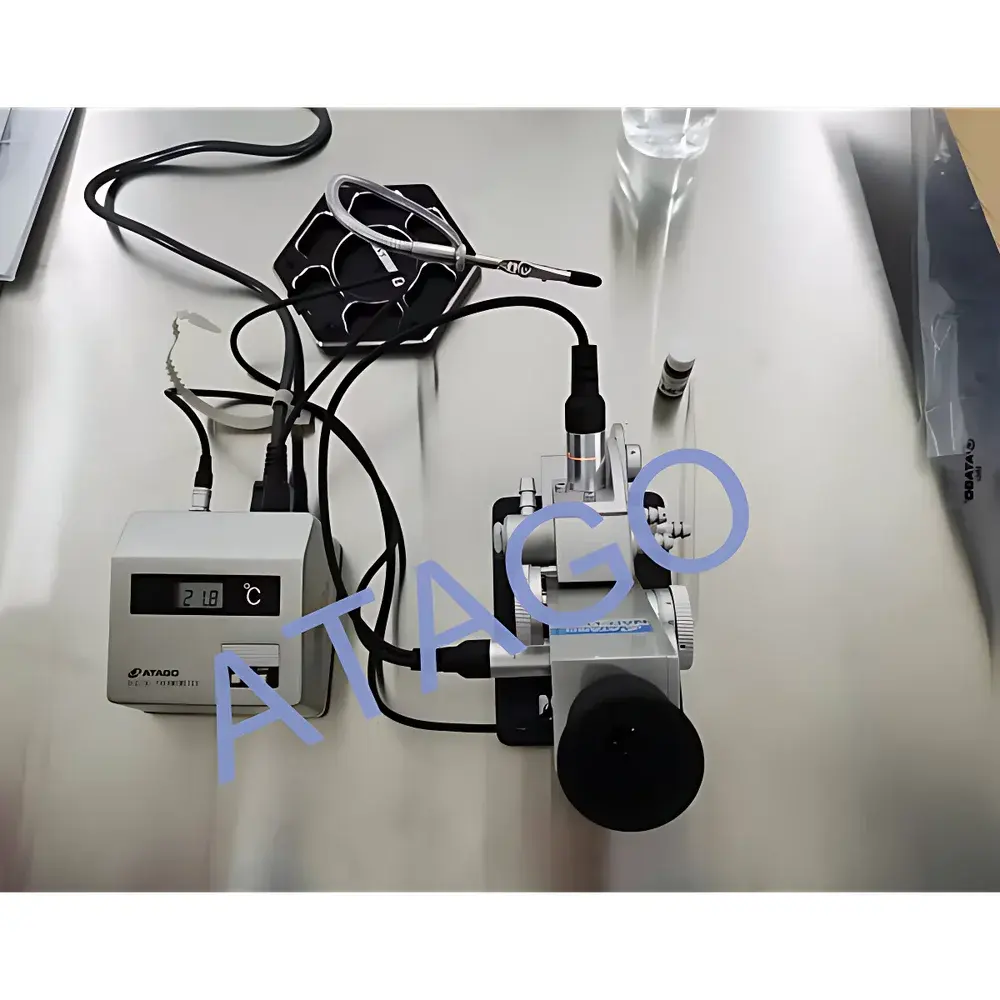
- Integrated digital temperature display unit (separate module) with 0.1°C resolution and ±0.2°C accuracy (range: 0.0–50.0°C)
- No built-in temperature control—designed for use with external thermostatic baths or Peltier stages when ISO 2859-1 or ASTM D1218-compliant thermal conditioning is required
- Mechanically robust aluminum alloy housing resistant to thermal drift and vibration-induced misalignment
- Low power consumption (5 VA) compatible with universal AC input (100–240 V, 50/60 Hz), suitable for multi-site deployment
Sample Compatibility & Compliance
The NAR-1T LIQUID is validated exclusively for homogeneous, non-scattering liquid samples—such as aqueous solutions, organic solvents, glycerol mixtures, syrups, essential oils, and pharmaceutical excipients—that exhibit sufficient optical clarity for sharp critical-angle definition. Suspensions, emulsions, or highly viscous media (>500 mPa·s) are not supported due to prism wetting limitations and meniscus distortion. The instrument conforms to core refractometry metrology frameworks: its optical design follows JIS Z 8806 (Japanese Industrial Standard for refractometers), and its measurement uncertainty profile aligns with ISO 21348 (spectral irradiance definitions for D-line equivalence). While not FDA 21 CFR Part 11–certified (as it lacks electronic data capture), its analog readout supports GLP-compliant manual recording when paired with controlled logbooks and trained operators—common practice in ISO/IEC 17025-accredited testing labs for raw material verification.
Software & Data Management
The NAR-1T LIQUID operates as a standalone optical instrument with no embedded microprocessor, firmware, or connectivity interfaces. All measurements are recorded manually via ocular scale interpolation; no software drivers, USB protocols, or cloud synchronization are provided or required. This architecture eliminates cybersecurity risks, firmware obsolescence, and calibration drift associated with digital signal processing chains. For laboratories implementing LIMS or ELN systems, users typically transcribe readings—including timestamp, sample ID, temperature, and observer initials—into structured spreadsheets or validated electronic notebooks. Optional third-party digital cameras (e.g., USB microscope adapters) may be mounted coaxially to document scale images for audit trails, though such configurations fall outside ATAGO’s factory validation scope.
Applications
- Food & Beverage: Brix quantification in fruit juices, soft drinks, honey, and dairy-based concentrates per AOAC 932.12 and ICUMSA GS4/7-10
- Pharmaceuticals: Excipient purity verification (e.g., propylene glycol, glycerin) per USP and EP 2.2.2
- Chemical Manufacturing: Solvent identity confirmation and mixture composition analysis (e.g., ethanol/water, methanol/glycerol)
- Academic Research: Teaching optical physics principles including Snell’s law, dispersion, and critical angle phenomena
- Quality Control Labs: In-process verification of batch homogeneity prior to HPLC or titration assays
FAQ
Does the NAR-1T LIQUID include built-in temperature control?
No. It features only a passive temperature display module. Precise thermal regulation requires an external thermostatic bath or Peltier stage.
Can it measure opaque or turbid liquids?
No. Only transparent or semi-transparent liquids producing a well-defined shadow line are suitable.
Is calibration traceable to national standards?
Yes—using ATAGO-certified calibration fluids (e.g., distilled water, benzene, bromonaphthalene) with NIST-traceable nD values.
What maintenance is required?
Daily prism cleaning with lens tissue and xylene-free optical cleaner; annual verification of scale alignment by authorized service centers.
Is it compliant with ISO/IEC 17025 requirements?
Yes—as a Type A measuring instrument, when operated within defined environmental conditions and with documented calibration history.