
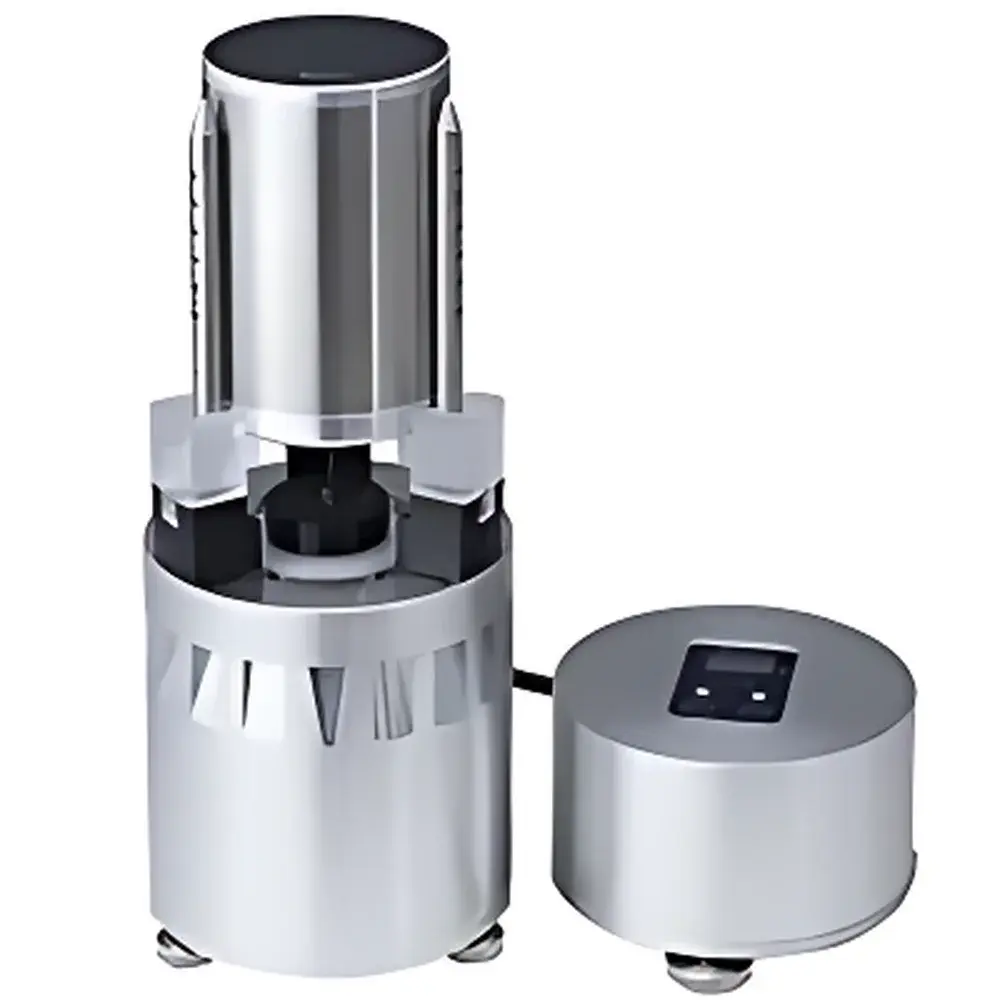
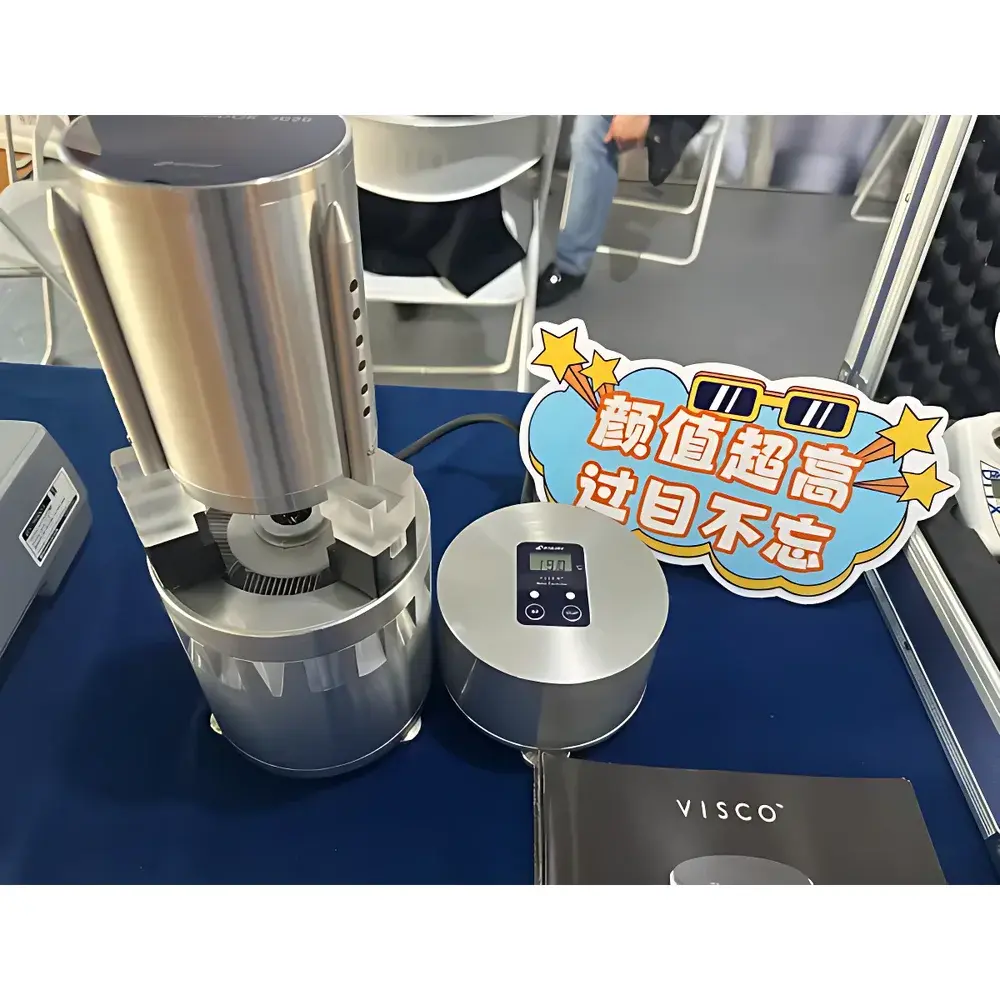
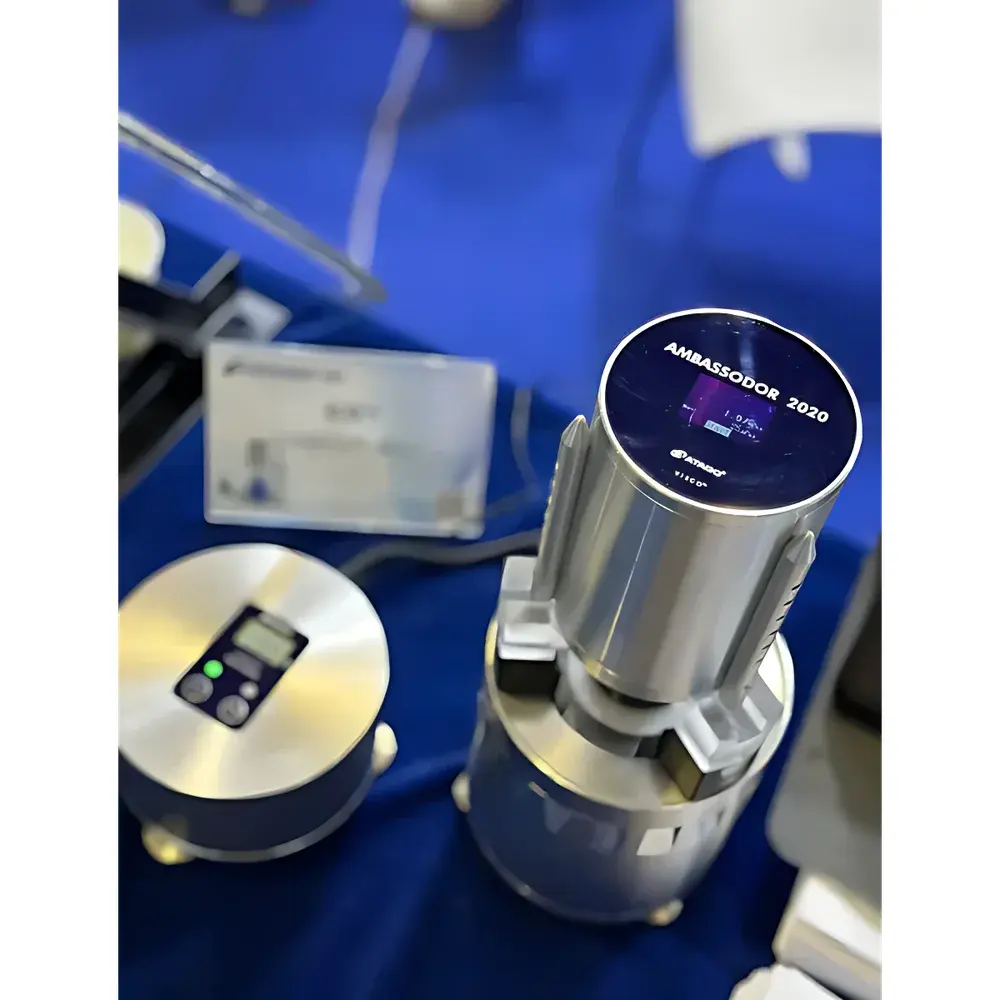
ATAGO VISCO Series Temperature-Controlled Rotational Viscometer
| Brand | ATAGO |
|---|---|
| Origin | Japan |
| Model | VISCO Series Temperature-Controlled Rotational Viscometer |
| Instrument Type | Portable Rotational Viscometer |
| Viscosity Range | 1 to 350,000,000 mPa·s |
| Temperature Range | 5.0 to 90.0 °C |
| Temperature Resolution | 0.1 °C |
| Temperature Accuracy | ±0.2 °C |
| Sample Volume Requirement | ≥15 mL |
| Power Supply | AC adapter and standard batteries |
| Data Interface | USB |
| Display | LCD with viscosity, % torque, and spindle identification |
Overview
The ATAGO VISCO Series Temperature-Controlled Rotational Viscometer is an engineered solution for precise, repeatable viscosity measurement under controlled thermal conditions. Based on Couette flow rheometry, the instrument determines dynamic viscosity by quantifying the torque required to rotate a spindle (rotor) at a defined angular velocity within a fluid sample. This principle enables accurate characterization of both Newtonian fluids—where viscosity remains constant across shear rates—and non-Newtonian fluids—where apparent viscosity varies with shear history and rate. Unlike ambient-only viscometers, the VISCO system integrates a dedicated, water-free temperature control module that actively regulates sample temperature from 5.0 °C to 90.0 °C with ±0.2 °C accuracy and 0.1 °C resolution. This eliminates thermal gradients common in conventional water baths and significantly reduces equilibration time—critical for high-throughput QC labs, field-based quality verification, and R&D workflows requiring strict thermal reproducibility.
Key Features
- Integrated dry-block temperature control unit: Compact, maintenance-free design with no water refilling, draining, or evaporation concerns—ideal for cleanroom, mobile lab, or production floor deployment.
- Low sample volume requirement: Validated performance with as little as 15 mL sample volume; compatible with disposable paper cups to eliminate cross-contamination and reduce cleaning downtime.
- Dual power architecture: Operates seamlessly via AC adapter for benchtop use or standard alkaline batteries for true portability—enabling viscosity testing at remote locations or during process line audits.
- Intuitive one-button operation: Simplified interface with real-time LCD display showing viscosity (mPa·s), % torque, spindle ID, and current temperature—minimizing operator training burden and reducing input error.
- Robust mechanical construction: Full stainless-steel housing ensures chemical resistance, long-term dimensional stability, and compliance with ISO 17025 environmental robustness requirements for accredited laboratories.
- USB data export: Direct transfer of time-stamped viscosity readings, temperature logs, and spindle parameters to PC for traceable reporting and integration into LIMS or ELN systems.
Sample Compatibility & Compliance
The VISCO platform accommodates a broad range of industrial and research samples—including syrups, polymer melts, emulsions, gels, coatings, pharmaceutical suspensions, and food pastes—without requiring solvent dilution or pre-shearing. Its wide dynamic viscosity range (1–350,000,000 mPa·s) supports both low-viscosity solvents and highly structured materials such as uncured silicone elastomers or battery electrode slurries. Temperature control complies with ASTM D2196 and ISO 2555 standards for viscosity measurement under specified thermal conditions. The system’s thermal uniformity and rapid stabilization support GLP/GMP-aligned workflows where temperature deviation must be documented per FDA 21 CFR Part 11 audit trail requirements. No external calibration fluids are needed—the built-in temperature sensor is factory-traceable to NIST-certified references.
Software & Data Management
While the VISCO operates autonomously via its embedded firmware, raw measurement data (viscosity, temperature, torque, timestamp, spindle code) is exported in CSV format via USB connection. This facilitates post-acquisition analysis in Excel, MATLAB, or statistical process control (SPC) platforms. For regulated environments, users may implement third-party data acquisition software validated under 21 CFR Part 11 to enforce electronic signatures, user access controls, and immutable audit trails. The instrument stores no internal user data; all records reside externally—supporting data integrity principles outlined in ICH E6(R3) and ISO/IEC 17025:2017 clause 7.5.2.
Applications
- Food & Beverage: Monitoring consistency of ketchups, dressings, dairy creams, and plant-based alternatives across batch release and shelf-life studies.
- Pharmaceuticals: Quantifying viscosity of topical gels, ophthalmic solutions, and injectable suspensions per USP and Ph. Eur. 2.9.35.
- Chemical Manufacturing: In-process verification of resin curing progression, surfactant micelle formation, and latex coagulation kinetics.
- Automotive & Lubricants: Screening base oil blends and grease thickeners under simulated operating temperatures.
- Academic Research: Teaching fundamental rheological concepts—including yield stress estimation via controlled shear rate ramps—and supporting graduate-level material science projects.
FAQ
Does the VISCO require calibration fluids for routine operation?
No. The instrument uses factory-calibrated torque and temperature sensors traceable to international standards. Periodic verification using certified reference oils (e.g., Cannon-Fenske or NIST SRM 2364 series) is recommended annually or per internal QA protocol.
Can the VISCO measure yield stress or thixotropy?
It is not designed for full rheological profiling (e.g., oscillatory tests or creep recovery). However, apparent yield point estimation is possible via stepwise shear rate reduction protocols using optional PC-based acquisition software.
Is the temperature-controlled module compatible with all VISCO models?
Yes—the dry-block VISCO Thermo Unit is mechanically and electrically standardized for all current-generation VISCO mainframes (VISCO, VISCO-1, VISCO-2).
What spindle configurations are supported?
Standard spindles include LV (low-viscosity), RV (medium-viscosity), and HA/HB (high-viscosity) geometries compliant with ISO 3219 and ASTM D1824. Custom spindles (e.g., T-bar, vane) can be integrated upon request with firmware validation.
How is thermal equilibrium confirmed before measurement?
The LCD displays real-time sample temperature; measurement is only enabled once thermal drift falls below 0.05 °C/min for ≥30 seconds—a built-in stabilization logic ensuring metrological reliability.



