
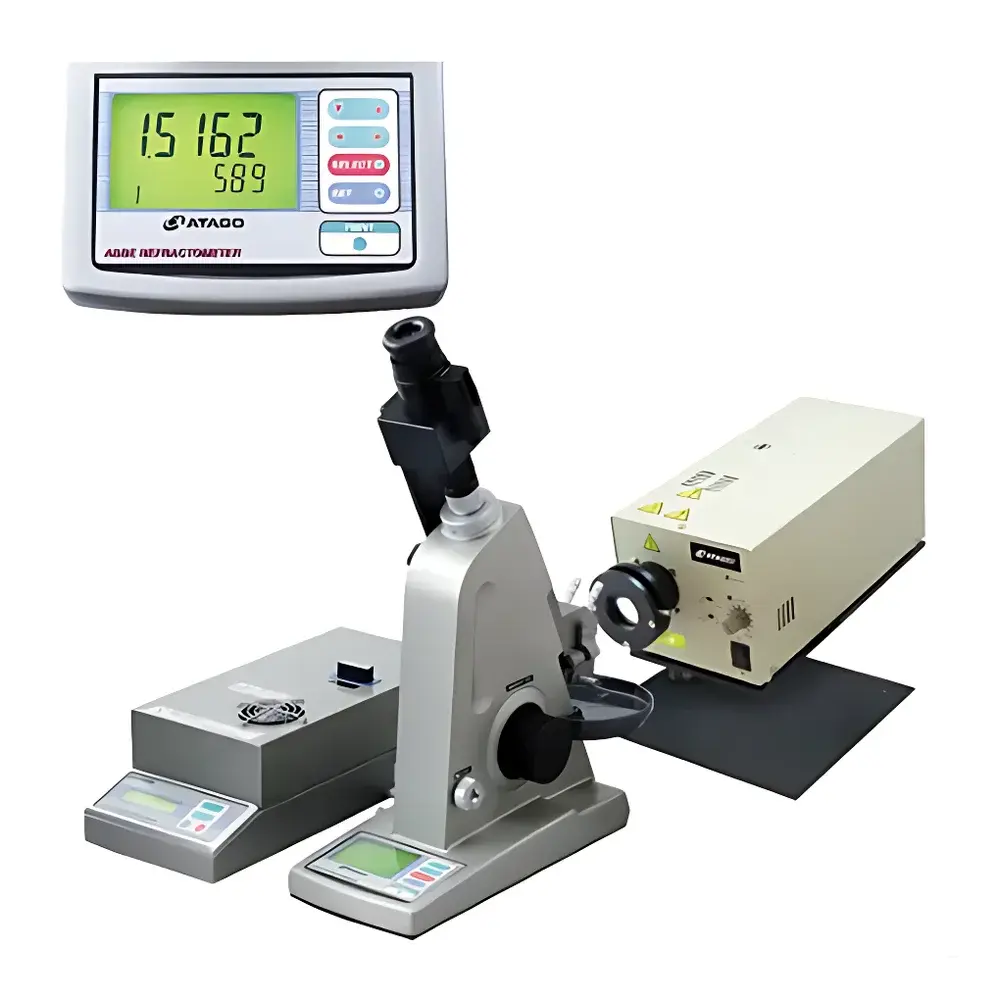
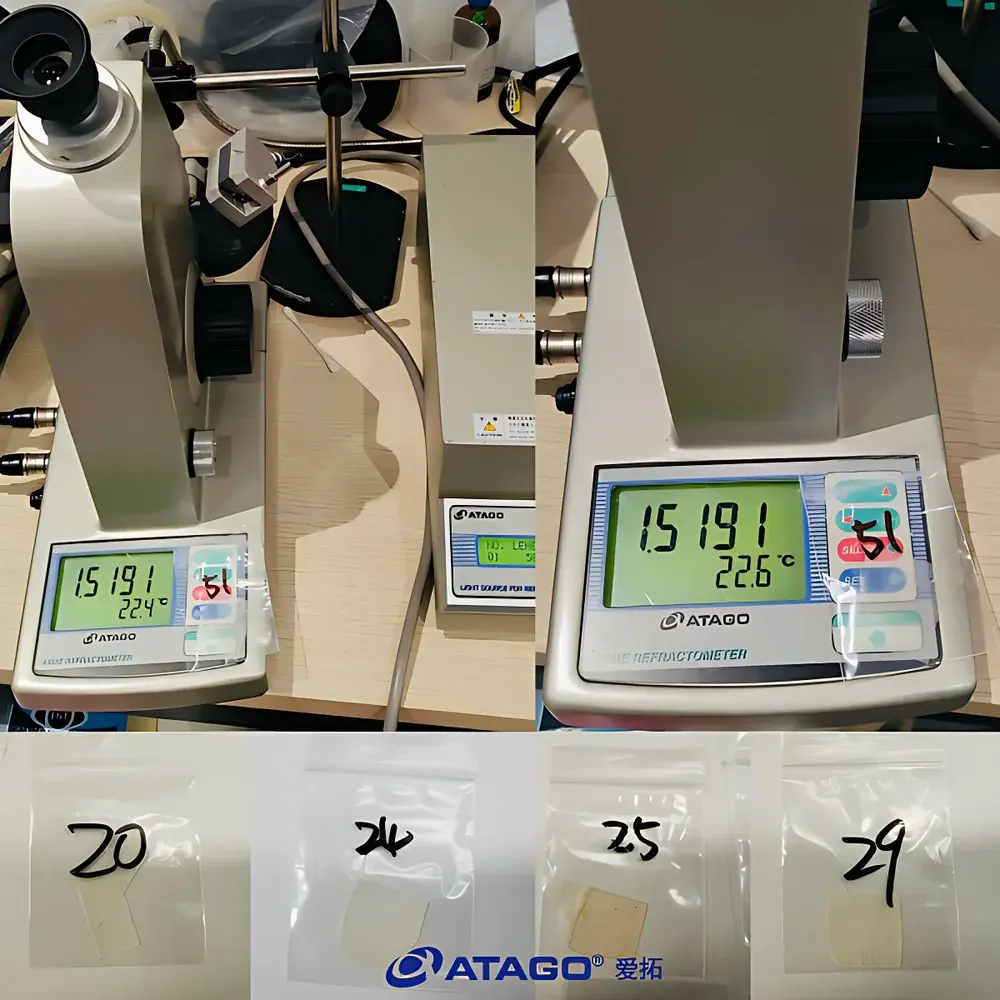
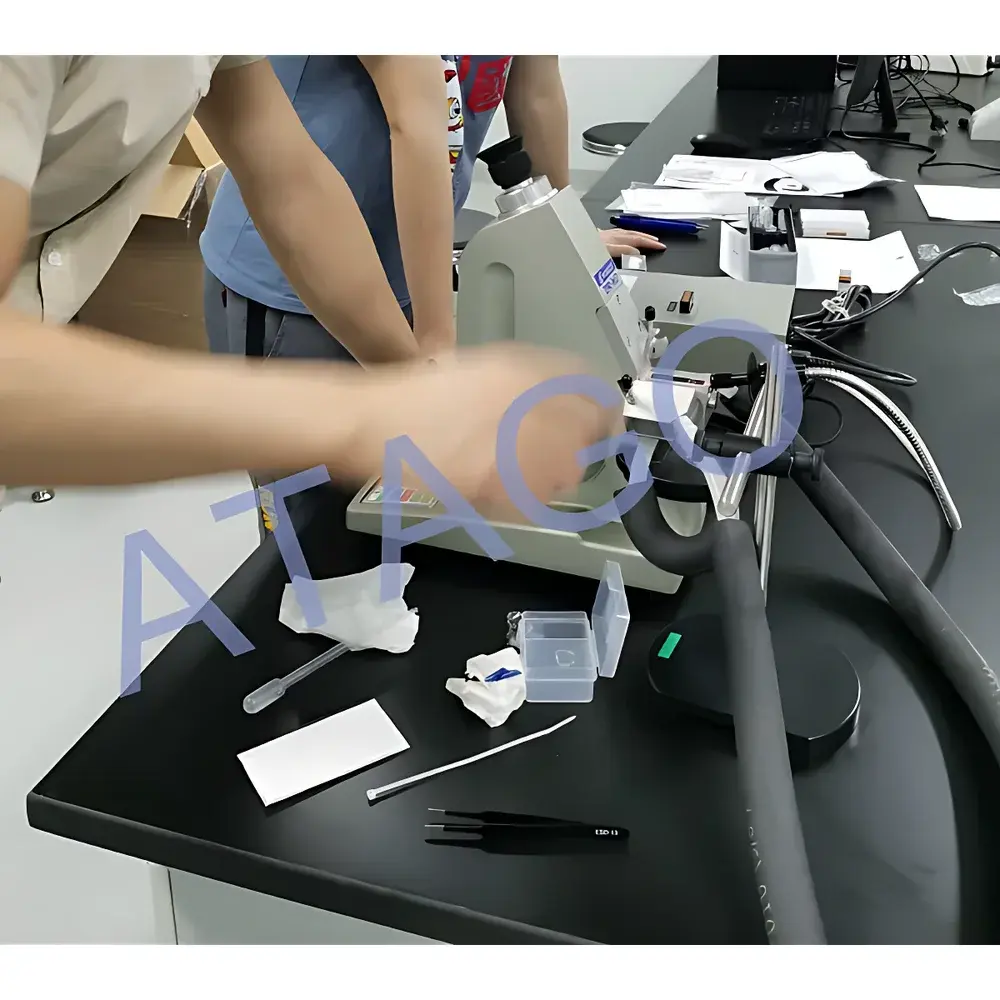
ATAGO DR-M2 Multi-Wavelength Abbe Refractometer (1550 nm)
| Brand | ATAGO |
|---|---|
| Origin | Japan |
| Model | DR-M2 (1550 nm) |
| Type | Benchtop Abbe Refractometer |
| Digital Display | Yes |
| Temperature Control | None |
| Refractive Index Range | 1.2662–1.6759 (at 1550 nm) |
| Refractive Index Accuracy | ±0.0002 (measured with 589 nm calibration plate) |
| Wavelength Range | 450–1550 nm (via interchangeable interference filters) |
| Resolution | 0.0001 (nD), 0.1 (Abbe number) |
| Operating Temperature | 5–50 °C |
| Power Supply | AC 100–240 V, 50/60 Hz |
| Dimensions (main unit) | 13 × 29 × 31 cm |
| Weight (main unit) | 6.0 kg |
Overview
The ATAGO DR-M2 Multi-Wavelength Abbe Refractometer (1550 nm) is a precision benchtop optical instrument engineered for high-accuracy measurement of refractive index (nD) and Abbe number across a broad spectral range—from 450 nm (visible blue) to 1550 nm (near-infrared). Based on the classical Abbe principle—utilizing critical angle determination at the sample-prism interface—the DR-M2 employs monochromatic illumination through user-selectable interference filters to isolate discrete wavelengths. Unlike conventional fixed-wavelength Abbe refractometers, this system enables wavelength-dependent dispersion analysis essential for characterizing optical polymers, lens materials, specialty glasses, and IR-transmissive substrates. Its digital readout eliminates parallax error and subjective interpretation of the shadow line, delivering reproducible nD values with ±0.0002 accuracy (verified at 589 nm using NIST-traceable calibration plates). Designed for laboratory environments where spectral fidelity and material dispersion profiling are critical, the DR-M2 supports R&D and QC workflows in optics manufacturing, semiconductor packaging, and advanced photonic material development.
Key Features
- Multi-wavelength capability: Selectable wavelengths from 450 nm to 1550 nm via precision interference filters—enabling full dispersion curve generation (n vs. λ)
- Digital Abbe measurement: Simultaneous display of refractive index (nD) and Abbe number (vD) on high-contrast LCD screen with 0.0001 resolution for nD and 0.1 for vD
- Optimized for IR-transparent materials: Calibrated measurement range extends to 1.2662–1.6759 at 1550 nm—critical for evaluating polycarbonate, CR-39, MR-8, and silicone-based ophthalmic lenses
- Robust mechanical architecture: Precision-ground glass prism assembly, rigid aluminum housing, and vibration-damped base ensure long-term stability and minimal drift
- Compliance-ready operation: Supports manual data recording protocols aligned with ISO 17025 and ASTM D1218 for refractive index testing; audit trail compatible when paired with optional DP-63 digital printer
Sample Compatibility & Compliance
The DR-M2 accommodates solid, liquid, and gel-like samples—including thermoset resins, cured polymer films, optical adhesives, and molten preforms—with minimal volume requirements (typically < 0.5 mL for liquids or ~10 mm² surface area for solids). Sample contact occurs only with the sapphire-coated measuring prism, ensuring chemical resistance and scratch durability. While the instrument does not integrate active temperature control, its specified operating range (5–50 °C) permits ambient-condition measurements compliant with ISO 489 and JIS K 0061 for plastics and optical materials. For applications requiring thermal stabilization—such as temperature-dependent dn/dT characterization—the optional 60-C5 circulating water bath (sold separately) provides external temperature regulation within ±0.1 °C. All measurements adhere to the fundamental Abbe method defined in ISO 11781 and are traceable to national standards via ATAGO’s factory calibration certificates.
Software & Data Management
The DR-M2 operates as a standalone instrument without embedded software or USB connectivity. Data output is provided via RS-232 serial interface (standard) or optional DP-63 digital printer (model #3135), enabling hard-copy documentation suitable for GLP-compliant laboratories. Printed reports include date/time stamp, selected wavelength, measured nD, Abbe number, operator ID (manually entered), and calibration verification status. When integrated into regulated environments (e.g., medical device optics QA), the instrument supports 21 CFR Part 11 compliance through procedural controls: handwritten logbooks, dual-operator verification, and periodic recalibration against certified reference standards (e.g., SF10 glass blocks at 589 nm and 1550 nm). ATAGO provides NIST-traceable calibration services and maintains full metrological documentation per ISO/IEC 17025 requirements.
Applications
- Characterization of ophthalmic lens materials (e.g., high-index plastics, photochromic coatings) across visible and NIR bands
- Dispersion analysis of optical adhesives used in AR/VR waveguide bonding
- Quality control of IR-transmissive windows and lenses for LIDAR, fiber optic coupling, and thermal imaging systems
- Development and validation of gradient-index (GRIN) polymer optics
- Material identification and batch verification in semiconductor packaging (e.g., underfill epoxies, molding compounds)
- Academic research in photonics, metamaterials, and tunable dielectric thin films
FAQ
What wavelengths are supported, and how are they selected?
The DR-M2 accepts interchangeable interference filters covering 450 nm, 589 nm, 680 nm, 1100 nm, and 1550 nm. Filters are manually inserted into the optical path prior to measurement; each filter is individually calibrated and labeled with its center wavelength and bandwidth.
Is temperature control built into the instrument?
No. The DR-M2 lacks integrated Peltier or fluidic temperature regulation. For temperature-sensitive measurements, the optional 60-C5 recirculating chiller (model #1923) must be connected externally to maintain prism temperature stability.
Can the DR-M2 measure opaque or highly scattering samples?
No. Like all Abbe refractometers, it requires optically transparent or semi-transparent samples with sufficient surface homogeneity to define a sharp critical angle boundary.
How is calibration performed and verified?
Calibration uses certified reference glasses (e.g., SF10, BK7) with published nD values at multiple wavelengths. ATAGO recommends annual recalibration; users may perform intermediate verification using supplied 589 nm test plates with documented uncertainty ≤ ±0.0001.
Does the instrument comply with FDA or ISO regulatory frameworks?
While the DR-M2 itself is not “certified” to any standard, its measurement methodology conforms to ISO 489, ISO 11781, and ASTM D1218. When operated under documented SOPs—including calibration logs, operator training records, and environmental monitoring—it supports compliance with ISO 13485, IEC 62304, and FDA QSR requirements for optical component release testing.





