
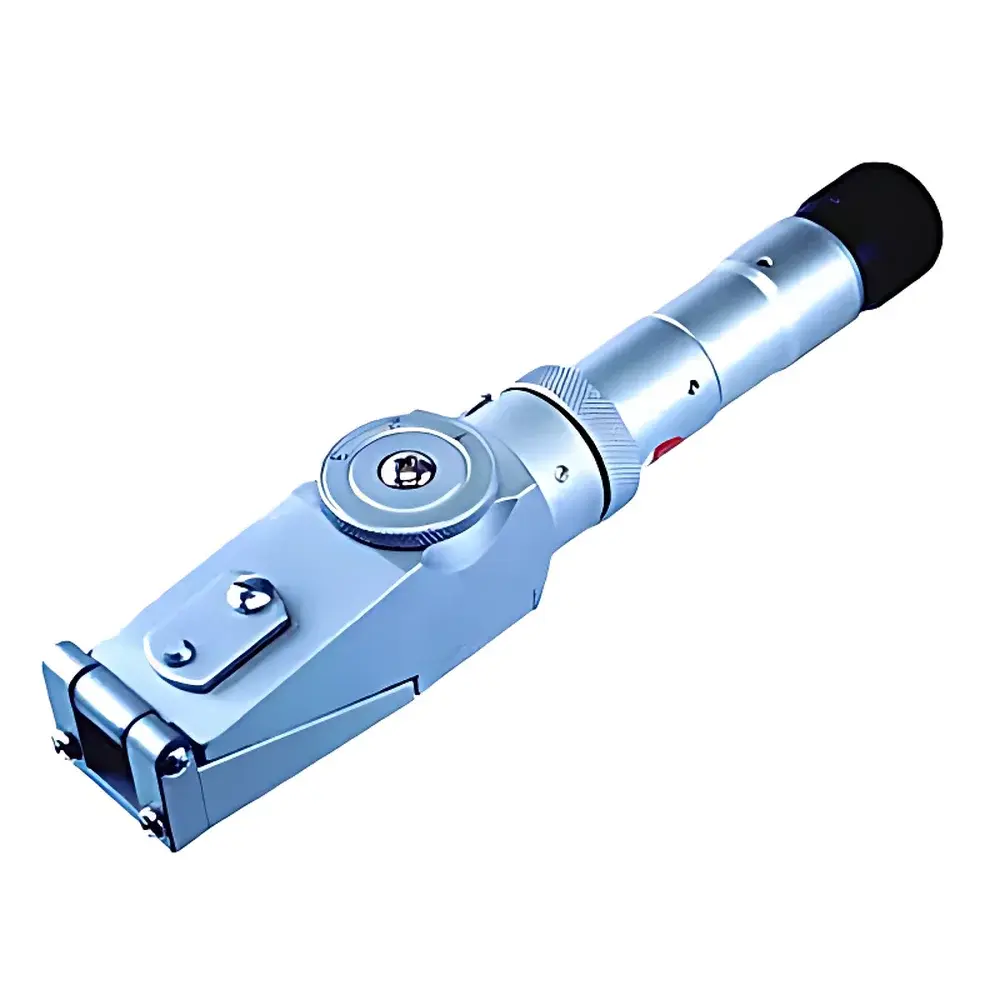
ATAGO R-5000 Portable Digital Refractometer
| Brand | ATAGO |
|---|---|
| Origin | Japan |
| Model | R-5000 |
| Type | Portable Refractometer |
| Display | Digital LCD |
| Temperature Control | None |
| Refractive Index Range | nD 1.333–1.520 (3-range manual switching) |
| Resolution | 0.001 nD |
| Accuracy | ±0.001 nD |
| Dimensions | 4 × 4 × 20 cm |
| Weight | 600 g |
| Part Number | RE-2350-92H |
Overview
The ATAGO R-5000 Portable Digital Refractometer is a field-deployable, high-precision optical instrument engineered for rapid and reliable measurement of refractive index (nD) across diverse liquid samples. Based on the principle of total internal reflection at the prism–sample interface, the R-5000 employs a high-stability Abbe-type optical system coupled with a temperature-compensated photodiode array detector. Unlike benchtop instruments requiring external thermostatic control, the R-5000 operates at ambient temperature and applies built-in temperature compensation algorithms calibrated to the standard 20 °C reference condition—enabling consistent nD readings without active thermal regulation. Its compact form factor (4 × 4 × 20 cm, 600 g) and battery-powered operation make it suitable for on-site quality checks in food processing lines, chemical distribution centers, agricultural cooperatives, and field-based research environments where portability and immediate result turnaround are critical.
Key Features
- Three manually selectable refractive index ranges (1.333–1.400, 1.400–1.470, 1.470–1.520 nD) for optimized signal-to-noise ratio across low-, medium-, and high-index matrices
- Digital LCD display with 0.001 nD resolution and ±0.001 nD stated accuracy per ATAGO calibration protocol
- High-transmittance sapphire-coated measuring prism resistant to scratching and chemical erosion from organic solvents, acids, and aqueous solutions
- Automatic zero calibration function using distilled water or air as reference; no external calibration kit required for routine verification
- Low-power consumption design supporting continuous operation for >8 hours on two AA alkaline batteries
- Ergonomic, non-slip rubberized housing rated IP54 for dust and splash resistance during industrial use
Sample Compatibility & Compliance
The R-5000 accommodates aqueous solutions, glycols, alcohols, hydrocarbon blends, fruit juices, syrups, coolants, and cleaning agents—provided samples are optically clear and free of suspended particulates or air bubbles. Viscosity limits are defined by capillary action onto the prism surface; samples up to ~500 mPa·s can be measured reliably with proper application technique. While the instrument does not incorporate active temperature control, its firmware implements polynomial-based temperature compensation referencing ISO 21148:2020 (Optics and photonics — Refractometers — Calibration and verification procedures). The device conforms to IEC 61010-1 safety standards for portable electrical measurement equipment and meets CE marking requirements for electromagnetic compatibility (EMC Directive 2014/30/EU). It is routinely deployed in GLP-compliant laboratories for raw material screening and in-process verification where traceable, operator-independent nD data support batch release decisions.
Software & Data Management
The R-5000 operates as a standalone unit with no embedded memory or USB connectivity; all measurements are displayed in real time and must be manually recorded. However, its standardized output format (nD value + range indicator) enables seamless integration into paper-based SOPs or digital logbooks compliant with FDA 21 CFR Part 11 when paired with validated electronic data capture systems. For users requiring audit trails, ATAGO recommends pairing the R-5000 with its optional RS-232 interface adapter (sold separately) and compatible terminal software such as ATAGO Data Logger v3.2, which supports timestamped export to CSV and generates calibration logs with user ID and environmental metadata.
Applications
- Concentration estimation of sucrose (Brix), sodium chloride, ethylene glycol, and propylene glycol via established nD-to-concentration correlation curves
- Verification of coolant mixture ratios in automotive and HVAC maintenance workflows
- Routine QC of pharmaceutical excipients including glycerin, propylene glycol, and polyethylene glycol solutions
- Field assessment of honey adulteration through deviation from expected nD windows per Codex Alimentarius Standard 219-2001
- Monitoring of fermentation broth clarity and sugar depletion kinetics in small-scale bioprocessing
- Pre-shipment inspection of optical coupling fluids and lens cleaning agents in precision optics manufacturing
FAQ
Does the R-5000 require periodic factory recalibration?
Yes. ATAGO recommends annual recalibration against NIST-traceable reference standards (e.g., certified nD oils SRM 1702, 1703) to maintain metrological integrity under ISO/IEC 17025 guidelines.
Can the R-5000 measure turbid or viscous samples?
No. Samples must be optically homogeneous and sufficiently fluid to form a uniform film on the prism. Suspended solids, emulsions, or highly viscous media (>500 mPa·s) will yield non-reproducible readings due to incomplete surface wetting and light scattering.
Is temperature compensation automatic or user-adjusted?
Compensation is fully automatic and embedded in firmware. The unit reads ambient sensor data and applies correction coefficients derived from ATAGO’s proprietary nD(T) database—no manual input is required.
What is the service life expectancy of the sapphire prism coating?
Under normal handling and cleaning with recommended soft lens tissue and isopropyl alcohol, the sapphire-enhanced surface maintains optical performance for ≥5,000 measurements before measurable degradation occurs.
Does the R-5000 comply with pharmacopeial standards for refractive index testing?
While not a USP apparatus per se, its measurement capability satisfies USP General Chapter <831> “Refractive Index” requirements for precision (±0.001 nD) and repeatability when operated per ATAGO’s validated SOPs and maintained within specified environmental conditions.




