
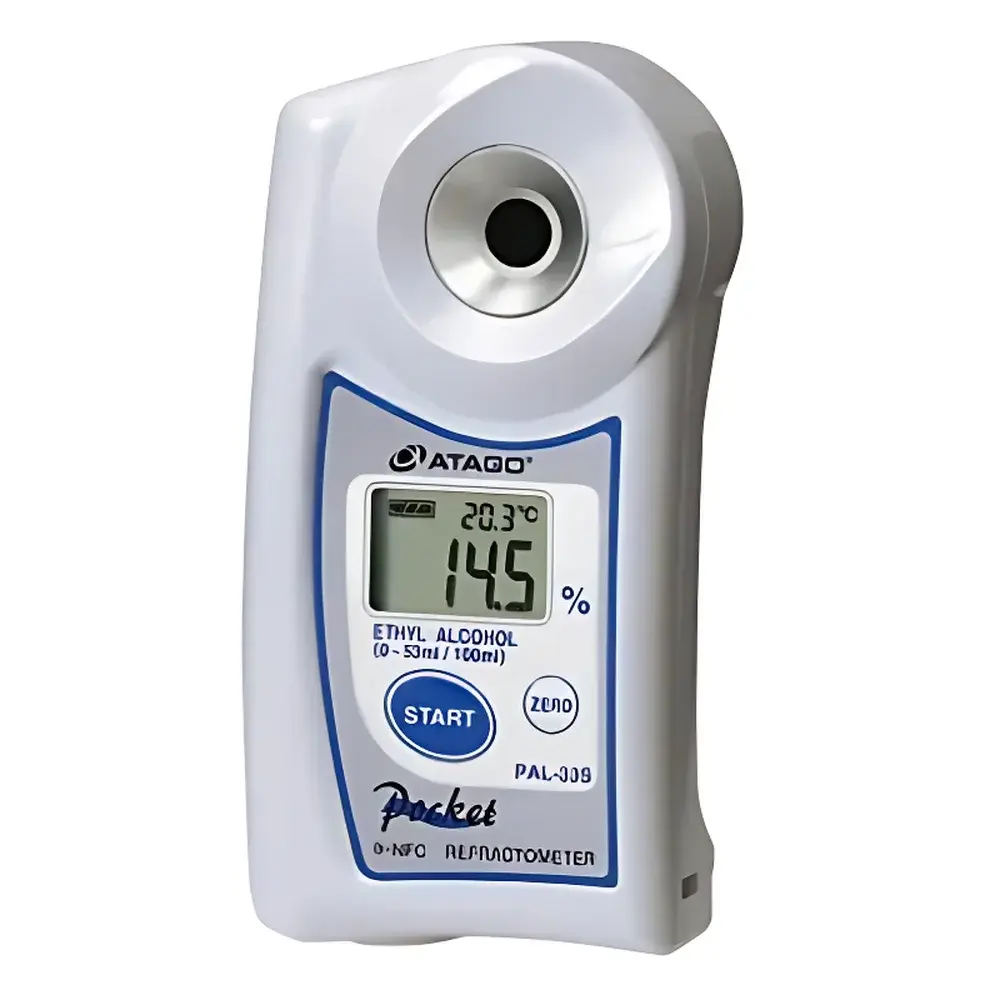
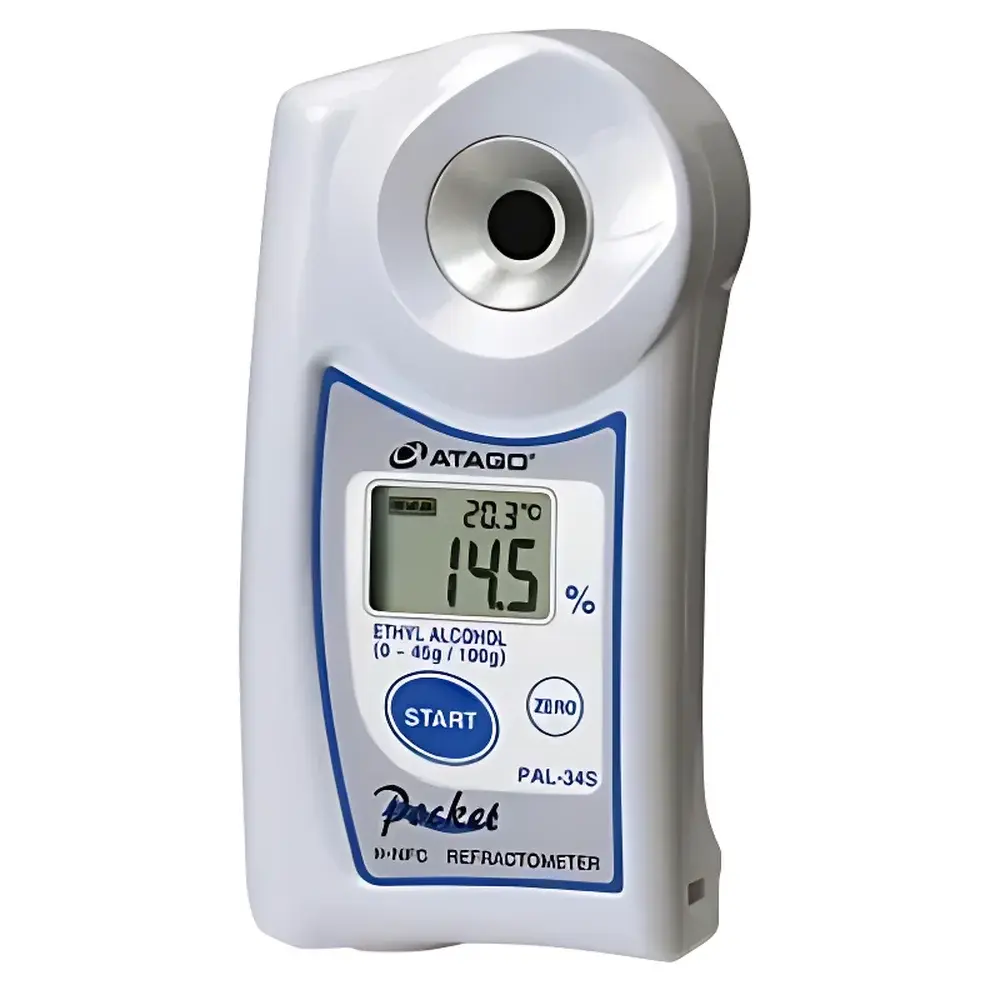
ATAGO PAL-33S and PAL-34S Digital Handheld Ethanol Refractometers
| Brand | ATAGO |
|---|---|
| Origin | Japan |
| Model | PAL-33S (v/v %, 0.0–53.0%) / PAL-34S (w/w %, 0.0–45.0%) |
| Temperature Compensation Range | PAL-33S: 5–30°C |
| PAL-34S | 10–35°C |
| Measurement Accuracy | ±1.0% |
| Display | Digital LCD |
| Temperature Control | Built-in Automatic Temperature Compensation (ATC) |
| Instrument Type | Portable Handheld Refractometer |
| Compliance | Designed for routine QC in ethanol-based production environments per ISO 21748 and ASTM D1152 guidelines |
Overview
The ATAGO PAL-33S and PAL-34S are precision digital handheld refractometers engineered specifically for rapid, on-site quantification of ethanol concentration in aqueous solutions. These instruments operate on the fundamental optical principle of critical angle refraction: as light passes from a high-refractive-index prism into a sample solution, the degree of beam deviation correlates directly with the solution’s solute concentration—here, ethanol. The PAL series integrates a temperature-compensated sapphire prism and high-stability LED light source to deliver consistent readings independent of ambient thermal fluctuations. Unlike traditional analog Abbe refractometers requiring manual scale interpretation and external thermostatic control, the PAL-33S/PAL-34S embed real-time automatic temperature compensation (ATC), eliminating operator-induced variability and enabling reliable field measurements across uncontrolled environments—from distillery floors to quality control labs and regulatory inspection sites.
Key Features
- Compact, ergonomic design weighing only 100 g—optimized for pocket carry, belt clip, or lanyard suspension without compromising structural integrity or optical alignment.
- Dual-model configuration: PAL-33S reports ethanol concentration as volume percent (mL/100 mL), calibrated per ISO 3696 Grade 3 water standards; PAL-34S reports weight percent (g/100 g), traceable to NIST-traceable ethanol reference materials.
- Integrated ATC system ensures measurement stability across defined operational ranges—5–30°C for PAL-33S and 10–35°C for PAL-34S—minimizing correction errors associated with manual temperature adjustment.
- High-contrast backlit LCD display with auto-zero function and unit toggle capability (e.g., % v/v ↔ °Brix for comparative analysis).
- Optical path sealed against dust and moisture (IP65-rated housing), supporting use in humid or splash-prone industrial settings including fermentation tanks, blending stations, and bottling lines.
- No external power supply required—operates on two AAA alkaline batteries with >10,000 measurements per set under typical usage conditions.
Sample Compatibility & Compliance
These refractometers are validated for clear, low-viscosity ethanol–water mixtures with minimal suspended solids or turbidity (<0.5 NTU). Samples must be free of air bubbles and applied uniformly across the prism surface. While not intended for highly viscous, colored, or particulate-laden samples (e.g., crude distillates or flavored spirits with extractives), they comply with standard industry practices for finished product verification in beverage alcohol, pharmaceutical solvent preparation, and fuel-grade ethanol QA/QC. Calibration is performed using distilled water (0% ethanol) and certified 20% v/v ethanol standard (NIST SRM 1811 or equivalent). Both models support documentation-ready workflows aligned with GLP and GMP principles, including user-defined calibration logging and batch-specific measurement records when paired with ATAGO’s optional RS-232 data export interface.
Software & Data Management
While the PAL-33S and PAL-34S operate as standalone instruments, their RS-232 output port enables direct connection to PCs or LIMS systems for automated data capture. When used with ATAGO’s optional LogView software (v3.2+), users can generate time-stamped measurement logs, apply statistical process control (SPC) charts, and export CSV-formatted datasets compliant with FDA 21 CFR Part 11 requirements—including electronic signature fields, audit trails, and user access controls. All firmware updates are distributed via ATAGO’s secure technical portal and verified through SHA-256 checksum validation prior to installation.
Applications
- Real-time monitoring of ethanol concentration during spirit distillation and rectification stages.
- Final product verification for alcoholic beverages (e.g., vodka, gin, neutral grain spirits) prior to bottling.
- Quality assurance of ethanol-based hand sanitizers and disinfectants per WHO Formulation I and II specifications.
- In-process checks in pharmaceutical manufacturing where ethanol serves as a solvent or extraction medium (USP and EP 2.2.46).
- Field verification of fuel ethanol blends (E10, E85) at distribution terminals and retail dispensing points.
- Educational laboratories conducting physical chemistry experiments on binary liquid phase behavior and Raoult’s law deviations.
FAQ
What is the difference between PAL-33S and PAL-34S?
The PAL-33S measures ethanol concentration as volume percent (mL ethanol per 100 mL solution), while the PAL-34S reports weight percent (g ethanol per 100 g solution). The choice depends on regulatory reporting requirements or internal SOPs.
Can these refractometers measure denatured ethanol or ethanol with additives?
Accuracy degrades significantly in presence of denaturants (e.g., methanol, isopropanol) or glycerin-based additives due to refractive index interference; use only for pure ethanol–water systems unless validated per application-specific protocols.
Is calibration required before each use?
Daily calibration with distilled water is recommended for traceability; full two-point calibration (zero + mid-range standard) is advised at start of shift or after extended storage.
Do PAL-33S and PAL-34S meet international metrological standards?
Yes—they conform to JIS K 0064 (Japanese Industrial Standard for refractometers) and are manufactured under ISO 9001-certified processes; individual units ship with factory calibration certificate traceable to NMIJ/AIST.
How often should the prism surface be cleaned?
After every measurement, using lens tissue and reagent-grade ethanol or distilled water—never abrasive cloths or acetone, which may damage the sapphire coating.





