
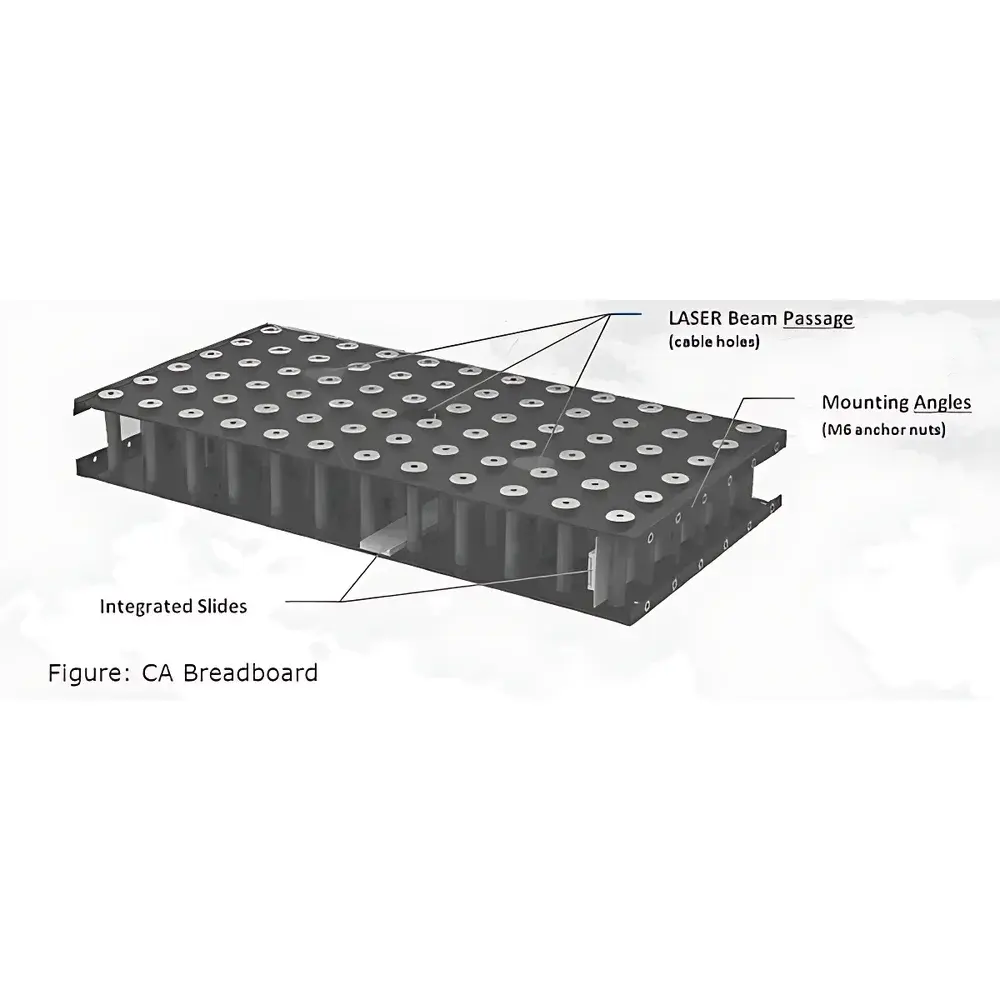
Carbon Vision CA-Series Carbon Fiber Optical Breadboard
| Brand | Carbon Vision |
|---|---|
| Origin | Germany |
| Model | CA-Version |
| Material | Carbon Fiber Reinforced Polymer (CFRP) |
| Top/Bottom Plates | CFRP shells, several mm thick |
| Core Structure | CFRP tubular lattice |
| Mounting Grid | 25 mm (top), 50 mm (bottom) |
| Standard Thickness Options | 50 mm |
| Customizable | Size, thickness, removable side walls, internal component integration |
| Thermal Expansion Coefficient | ~0.2 × 10⁻⁶ /K (≈1/10 of steel, 1/4 of aluminum) |
| Density | ~1.5 g/cm³ (75% lighter than steel) |
| Damping Ratio | Up to 60% higher than equivalent steel breadboards |
| Magnetic Permeability | Non-magnetic (μᵣ ≈ 1) |
| Environmental Tolerance | Humidity-independent |
| Stiffness Rating | Standard (suffix A) |
Overview
The Carbon Vision CA-Series Carbon Fiber Optical Breadboard is an engineered structural platform designed for ultra-stable optical and precision mechanical applications in demanding research and industrial environments. Built using monolithic carbon fiber reinforced polymer (CFRP) architecture—featuring top and bottom CFRP shell plates structurally bonded to an internal lattice of CFRP tubes—the CA-Series delivers exceptional dimensional stability, dynamic rigidity, and passive vibration attenuation without metallic mass penalties. Unlike traditional steel or aluminum breadboards, the CA-Series leverages the anisotropic mechanical properties of unidirectional and quasi-isotropic CFRP layups to achieve a stiffness-to-weight ratio exceeding 3× that of equivalent steel platforms. Its near-zero coefficient of thermal expansion (CTE ≈ 0.2 × 10⁻⁶ /K) ensures sub-micron positional stability across ambient temperature fluctuations common in laser interferometry, quantum optics, and nanometrology setups. The non-magnetic, non-corrosive, and vacuum-compatible nature of CFRP enables deployment in MRI-adjacent instrumentation, ultra-high vacuum (UHV) chambers, and cryogenic optical benches where ferromagnetic interference or outgassing must be eliminated.
Key Features
- Structural Integrity: Fully integrated CFRP monocoque design—no adhesives between core and skins—ensures long-term creep resistance and fatigue durability under static and dynamic loading.
- Thermal Stability: CTE matched closely to fused silica and low-expansion ceramics, minimizing thermal drift in multi-material optical assemblies.
- Vibration Attenuation: Inherent viscoelastic damping of the epoxy matrix combined with geometric decoupling via tubular core yields up to 60% greater loss factor than steel equivalents at 10–200 Hz—critical for lock-in detection, heterodyne interferometry, and single-photon counting systems.
- Modular Integration: Hollow interior volume permits embedded cabling, fiber routing, sensor mounting, and active cooling channels without compromising surface flatness or M6 thread integrity.
- Environmental Robustness: Immune to oxidation, galvanic corrosion, and humidity-induced swelling—validated per ISO 9022-3 for operation from 10⁻⁷ mbar vacuum to 95% RH at 25°C.
- Customization Flexibility: Available in standard sizes (e.g., 600 × 900 × 50 mm) or fully bespoke configurations—including asymmetric thickness profiles, recessed mounting zones, and removable CFRP side walls for access paneling.
Sample Compatibility & Compliance
The CA-Series complies with mechanical interface standards widely adopted in photonics laboratories, including DIN 8580-compliant flatness tolerances (≤ ±5 µm over 100 × 100 mm), ISO 2768-mK general tolerances for machined features, and ASTM E1157-20 specifications for dimensional stability under thermal cycling (−20°C to +60°C, 5-cycle protocol). Threaded inserts meet ISO 8473 M6 × 1.0 pitch tolerance class 6H. Surface finish is optimized for optical component mounting—Ra ≤ 0.8 µm on top plate—while maintaining electrical continuity across grounded variants (optional). All CFRP formulations are RoHS 2011/65/EU compliant and certified per ECSS-Q-ST-70-02C for space-grade material outgassing (CVCM ≤ 0.01%, TML ≤ 0.1%).
Software & Data Management
While the CA-Series is a passive mechanical platform, Carbon Vision provides optional digital twin documentation packages—including GD&T-aligned STEP AP242 models, finite element analysis (FEA) boundary condition files (.inp), and modal frequency response datasets—for integration into LabVIEW, MATLAB Simulink, or COMSOL Multiphysics workflows. Each unit ships with a traceable calibration certificate listing measured flatness deviation maps (via Zygo Verifire™ Interferometer), resonant mode spectra (0–1 kHz, swept-sine excitation), and mass/inertia tensor values. These datasets support GLP-compliant setup validation and are archived per ISO/IEC 17025:2017 requirements for metrological traceability.
Applications
- Quantum optics testbeds requiring magnetic field immunity and sub-nanoradian angular stability
- High-resolution interferometric metrology systems (e.g., LIGO-style cavity alignment, dispersion-compensated OCT)
- Ultrafast laser amplifier chains where thermal lensing and pump-induced drift must be minimized
- Aerospace payload qualification benches subjected to random vibration testing per MIL-STD-810H Method 514.8
- UHV-compatible atomic physics apparatus, including magneto-optical traps (MOTs) and ion trap arrays
- Multi-axis nanopositioning stages integrated with piezoelectric actuators and capacitive sensors
- Portable field-deployable spectroscopic platforms requiring shock resilience and weight reduction
FAQ
Can the CA-Series breadboard be used in ultra-high vacuum (UHV) environments?
Yes. All CFRP components are processed under controlled humidity and cured at elevated temperatures to minimize volatile organic compound (VOC) content. Outgassing rates comply with ECSS-Q-ST-70-02C and NASA SP-R-0022A specifications.
Is custom grid spacing (e.g., 12.5 mm) available on the top surface?
Standard configuration uses 25 mm M6 grid on top and 50 mm on bottom. Sub-grid patterns require CNC re-machining and are offered as a premium customization option with lead-time extension.
What is the maximum recommended load for a 600 × 900 × 50 mm CA-board?
Under central point loading with full four-edge support, the deflection limit (per ISO 10360-2) remains below 1.2 µm at 22.7 kg (50 lbs). Distributed loads up to 120 kg/m² are permissible with uniform support.
Are grounding provisions included for electrostatic discharge (ESD) protection?
Standard units are electrically insulating. Conductive CFRP variants with surface resistivity < 10⁴ Ω/sq are available upon request, compatible with ANSI/ESD S20.20 grounding protocols.
Does Carbon Vision provide finite element models for structural simulation?
Yes—validated Ansys Mechanical APDL and Abaqus input decks are supplied with each custom order, including material orthotropy definitions, interlaminar shear parameters, and thermal expansion tensors.



