
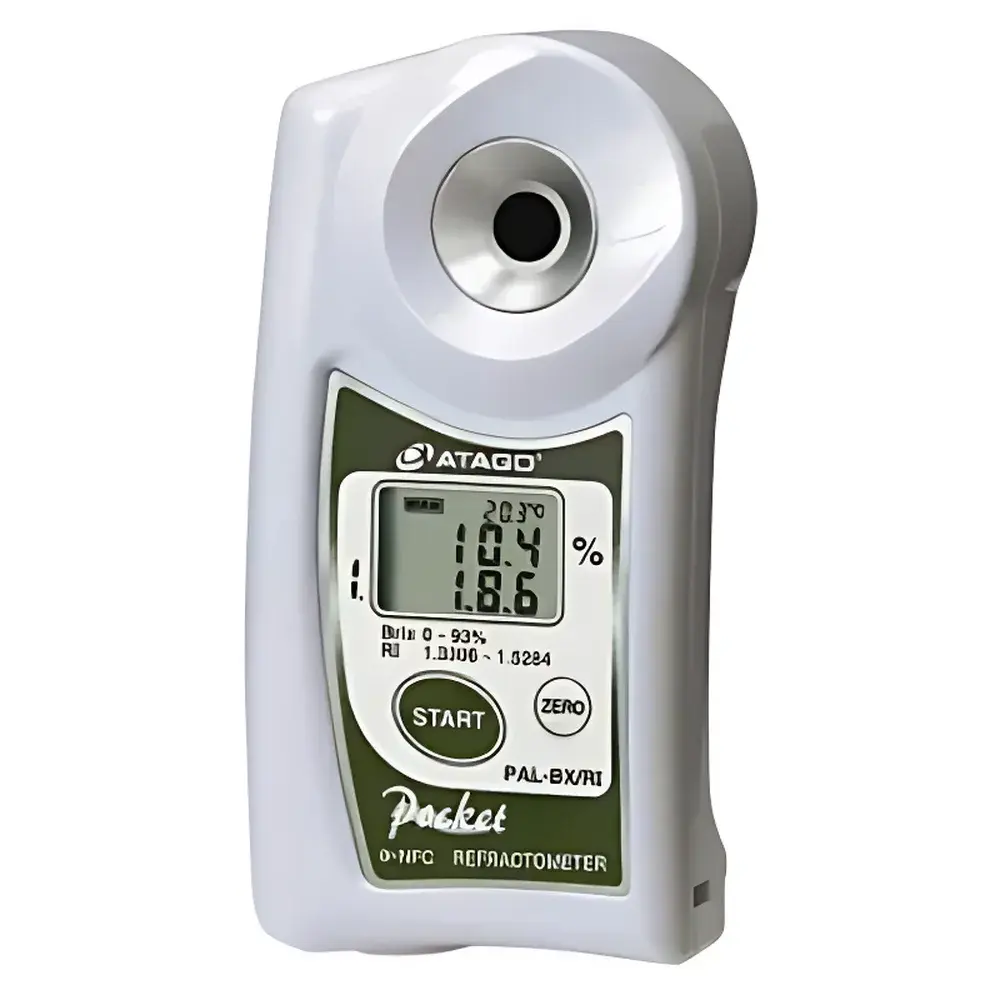
ATAGO PAL-BX/RI Portable Digital Refractometer
| Brand | ATAGO |
|---|---|
| Origin | Japan |
| Model | PAL-BX/RI (Cat. No. 3852) |
| Type | Handheld Refractometer |
| Display | Digital LCD |
| Temperature Control | None |
| Refractive Index Range | 1.3306–1.5284 |
| Brix Range | 0.0–93.0% |
| Refractive Index Resolution | 0.0001 |
| Brix Resolution | 0.1% |
| Refractive Index Accuracy | ±0.0003 (measured with water at 20°C) |
| Brix Accuracy | ±0.1% |
| Operating Temperature | 10–40°C |
| Measurement Time | 3 seconds |
| Power Supply | 2 × AAA batteries |
| IP Rating | IP65 |
| Dimensions | 55(W) × 31(D) × 109(H) mm |
| Weight | 100 g (without accessories) |
Overview
The ATAGO PAL-BX/RI Portable Digital Refractometer is a precision optical instrument engineered for simultaneous, rapid measurement of refractive index (RI) and Brix (°Bx) in liquid samples. Based on the principle of total internal reflection, it utilizes a high-stability LED light source and a sapphire prism to determine the critical angle of refraction—directly correlated to solute concentration and molecular density. Unlike benchtop or temperature-controlled units, the PAL-BX/RI operates at ambient conditions without active thermal regulation, making it ideal for field use, production line checks, and decentralized quality verification where portability, speed, and repeatability are prioritized over thermally compensated metrology. Its dual-scale calibration enables traceable correlation between RI and Brix values—particularly valuable in pharmaceutical excipient validation, chemical intermediate release testing, and formulation consistency monitoring where both parameters serve as orthogonal quality indicators.
Key Features
- Simultaneous digital readout of refractive index (1.3306–1.5284) and Brix (0.0–93.0%) on a single high-contrast LCD display
- High-resolution detection: 0.0001 RI units and 0.1% Brix, supporting fine-grained process control in concentrated solutions
- Robust optical architecture featuring a sapphire measuring prism—resistant to scratching, chemical erosion, and thermal drift
- IP65-rated enclosure ensures protection against dust ingress and low-pressure water jets, suitable for industrial environments including cleanrooms (Grade C/D) and chemical handling zones
- Three-second measurement cycle enables high-throughput sampling without operator fatigue or workflow interruption
- Low-power design powered by two standard AAA batteries (typical life > 10,000 measurements), eliminating dependency on external power sources or charging infrastructure
- Compact form factor (55 × 31 × 109 mm; 100 g) facilitates one-handed operation and integration into glovebox workflows or mobile QA carts
Sample Compatibility & Compliance
The PAL-BX/RI is validated for aqueous and polar organic solutions—including sucrose, glucose, sodium chloride, glycerol, ethylene glycol, and common pharmaceutical solvents (e.g., propylene glycol, PEG 400). It is not recommended for highly volatile, strongly acidic, or viscous (>100 mPa·s) samples due to evaporation artifacts and incomplete prism wetting. While not intrinsically compliant with ISO 21748 or ASTM D1218, its measurement uncertainty (±0.0003 RI / ±0.1% Brix at 20°C) aligns with typical acceptance criteria for in-process controls under ICH Q5, Q7, and USP . The device supports GLP documentation via manual entry of sample ID, operator, and timestamp; however, it does not generate electronic audit trails required under FDA 21 CFR Part 11.
Software & Data Management
The PAL-BX/RI operates as a standalone instrument with no onboard memory or data export capability. All measurements are displayed in real time and must be manually recorded or transcribed into LIMS, ELN, or Excel-based QC logs. Optional accessories include the ATAGO RS-232 interface cable (sold separately) and compatible PC software (PAL-PC v3.0), enabling serial output of RI/Brix pairs with configurable sampling intervals and CSV export. For regulated environments, users should implement procedural controls—such as defined calibration frequency (minimum daily with distilled water and certified sucrose standards), documented environmental monitoring (ambient temperature logged per measurement), and operator qualification records—to satisfy internal QA requirements and external audits.
Applications
- Pharmaceutical manufacturing: Verification of excipient concentration (e.g., dextrose in IV admixtures, mannitol in lyophilized formulations)
- Chemical synthesis: Monitoring reaction progress via RI shifts during esterification, hydrolysis, or polymerization
- Biotechnology: Rapid assessment of cell culture media osmolality proxies and harvest timing indicators
- Quality assurance labs: Incoming raw material screening (e.g., glycerin purity, propylene glycol grade) and batch release testing
- Research & development: Empirical correlation development between RI and HPLC-determined analyte concentrations
- Regulatory support: Supporting Annex 11-compliant workflows when paired with validated transcription protocols and secondary verification methods
FAQ
Does the PAL-BX/RI comply with FDA 21 CFR Part 11?
No—the instrument lacks electronic signature capability, audit trail generation, and secure user authentication. It may be used in Part 11-regulated settings only when integrated into a validated procedural framework that includes manual recordkeeping, calibration logs, and independent verification.
Can it measure non-aqueous solvents like acetone or ethanol?
Not reliably. Volatile solvents cause rapid prism drying and unstable readings; RI values may deviate beyond ±0.001 due to evaporation-induced surface tension changes.
What is the recommended calibration frequency?
Daily calibration using distilled water (RI = 1.3330 at 20°C) and a certified 10.0% w/w sucrose standard is advised. Additional calibration checks are required after temperature shifts >5°C or following exposure to aggressive cleaning agents.
Is temperature compensation available?
No—the unit applies no automatic temperature correction. Users must record ambient temperature and apply published RI/Brix vs. temperature correction tables (e.g., ICUMSA Methods Book, Chapter 8) when reporting data for regulatory submission.
How is traceability maintained for metrological validation?
Traceability is achieved through periodic verification against NIST-traceable refractive index standards (e.g., Cargille Labs series) and certified Brix reference materials (e.g., NIST SRM 84d), documented per ISO/IEC 17025 clause 6.6.




