
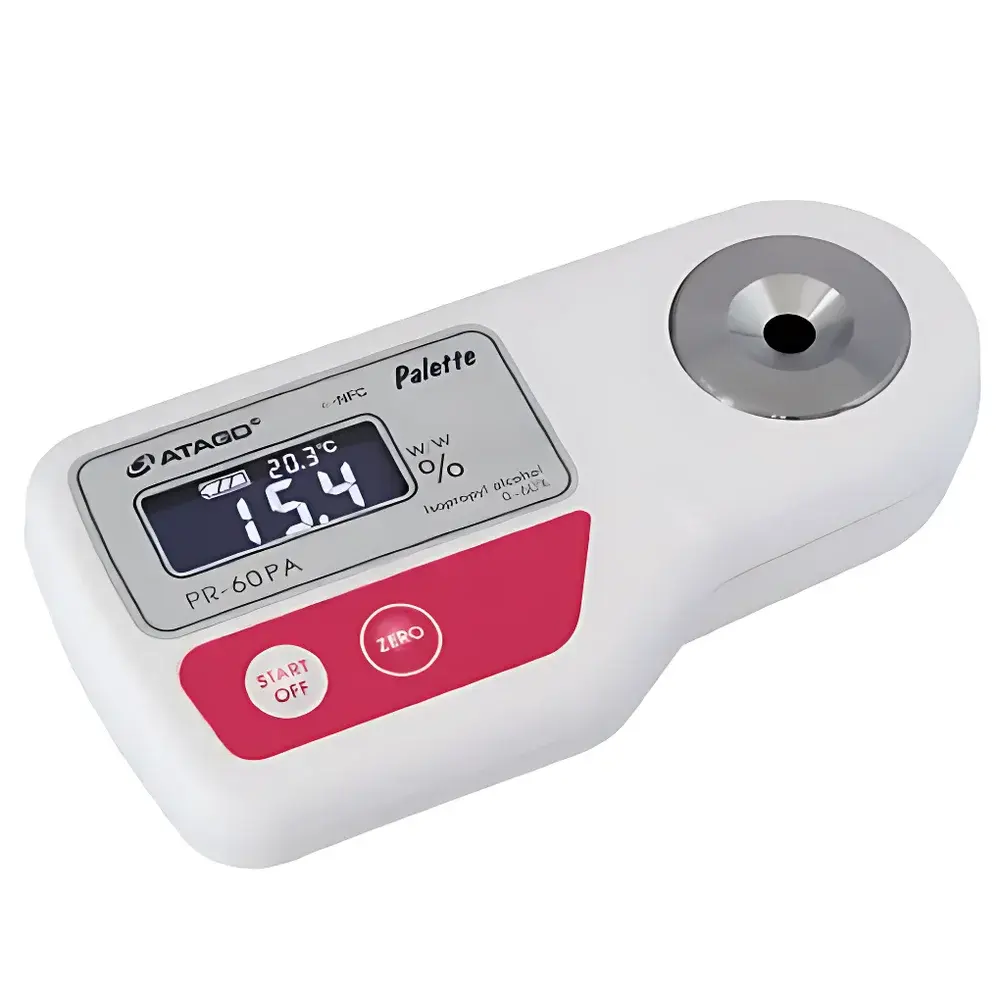
ATAGO PR-60PA Digital Refractometer for Isopropyl Alcohol (IPA) Concentration Measurement
| Brand | ATAGO |
|---|---|
| Origin | Japan |
| Product Type | Benchtop Refractometer |
| Display | Digital LCD |
| Measurement Range | 0.0–60.0% (w/w) IPA |
| Accuracy | ±0.5% (0–30.0%), ±0.8% (~40%), ±1.6% (~60%) |
| Temperature Compensation | Automatic (10–35°C) |
| Minimum Resolution | 0.1% |
| IP Rating | IP64 |
| Power Supply | 9V Alkaline Battery (006P) |
| Dimensions | 170 × 90 × 40 mm |
| Weight | 300 g (body only) |
Overview
The ATAGO PR-60PA Digital Refractometer is a precision benchtop instrument engineered specifically for the rapid, non-destructive quantification of isopropyl alcohol (IPA) concentration in aqueous solutions. It operates on the fundamental optical principle of critical angle refractometry: light passing from a high-refractive-index prism into a sample undergoes total internal reflection at a critical angle that varies linearly with the solution’s refractive index—and thus with solute concentration. By calibrating the instrument against certified IPA reference standards traceable to NIST-maintained materials, the PR-60PA delivers direct % (w/w) readouts without requiring dilution, titration, or solvent evaporation. Its design prioritizes operational robustness in regulated environments—such as pharmaceutical cleanrooms, electronics manufacturing QC labs, and ISO 17025-accredited testing facilities—where consistent, operator-independent measurements are essential for process control and documentation integrity.
Key Features
- Dedicated IPA calibration curve embedded in firmware—optimized for the refractive index vs. concentration relationship across the full 0.0–60.0% (w/w) range.
- Automatic temperature compensation (ATC) over 10–35°C using an integrated thermistor, eliminating manual correction tables and minimizing thermal drift errors.
- High-contrast digital LCD display with 0.1% resolution and real-time stability indicator for unambiguous endpoint determination.
- IP64-rated enclosure—dust-tight and protected against water splashes—ensuring reliable operation in humid lab environments or near wet-bench stations.
- Compact, ergonomic form factor (170 × 90 × 40 mm; 300 g) enabling flexible placement on fume hoods, laminar flow cabinets, or portable use in production line verification.
- Low-power consumption design powered by a single 9V alkaline battery (006P), supporting >5,000 measurements per charge under typical usage conditions.
Sample Compatibility & Compliance
The PR-60PA is validated for use with homogeneous, particle-free IPA–water mixtures, including formulations containing low concentrations of surfactants, stabilizers, or preservatives commonly found in disinfectants, electronic cleaning agents, and pharmaceutical excipient solutions. It is not intended for turbid, viscous, or highly volatile samples requiring sealed-cell measurement. The instrument complies with ISO 21527-1:2022 (refractometric methods for alcohol content), supports GLP-compliant data recording when paired with external logging systems, and meets general requirements for laboratory equipment under IEC 61010-1:2010 for electrical safety. While it does not include built-in audit trail or electronic signature functionality, its deterministic analog-to-digital conversion path ensures measurement repeatability suitable for FDA 21 CFR Part 11–aligned workflows when used within documented SOPs.
Software & Data Management
The PR-60PA operates as a standalone instrument with no onboard memory or USB/Bluetooth connectivity. All measurement data must be manually recorded or captured via external means (e.g., lab notebooks, LIMS interfaces, or optional RS-232 serial output adapters—sold separately). For laboratories requiring automated data capture, ATAGO recommends integration with third-party data acquisition software compatible with ASCII-based serial protocols. Calibration verification logs—including date, operator ID, standard lot number, and deviation values—should be maintained per ISO/IEC 17025 clause 7.7 to demonstrate metrological traceability. Factory calibration certificates (traceable to JCSS-accredited standards) are provided with each unit.
Applications
- Quality control of IPA-based disinfectants (e.g., 70–75% w/w formulations) in pharmaceutical and medical device manufacturing per USP and .
- In-process verification of cleaning solution concentration in semiconductor wafer fabrication and PCB assembly lines.
- Batch release testing of industrial solvents, paint thinners, and adhesive diluents where IPA serves as primary carrier or co-solvent.
- Stability monitoring of IPA-containing topical antiseptics and cosmetic formulations during accelerated aging studies.
- Concentration validation of automotive windshield washer fluids formulated with IPA for freeze-point depression.
- Raw material receipt inspection for IPA supplied in bulk containers prior to formulation into GMP-grade products.
FAQ
What is the recommended calibration frequency for the PR-60PA?
Calibration should be verified before each analytical session using a certified IPA standard (e.g., 10.0%, 30.0%, and 50.0% w/w). Full recalibration is required if verification deviations exceed ±0.5% at any point within the 0–30% range.
Can the PR-60PA measure ethanol or other alcohols?
No—the optical calibration curve is mathematically optimized exclusively for isopropyl alcohol–water systems. Using it for ethanol, methanol, or glycols will introduce systematic bias due to differences in partial molar refraction.
Is temperature-controlled sample handling necessary?
No—automatic temperature compensation eliminates the need for water baths or Peltier stages. However, samples must be equilibrated to ambient lab temperature (10–35°C) prior to measurement to ensure stable prism–sample thermal contact.
How is measurement uncertainty estimated for regulatory submissions?
Combined standard uncertainty (k=2) is calculated per GUM (JCGM 100:2008) incorporating repeatability (±0.2% RSD), calibration standard uncertainty (±0.15%), and ATC residual error (±0.1%), yielding an expanded uncertainty of ±0.5% for concentrations ≤30% w/w.
Does the instrument require annual factory recalibration?
While not mandatory, ATAGO recommends biennial traceable recalibration at an authorized service center to maintain alignment with JCSS reference standards and validate long-term stability of the prism and detector assembly.



