
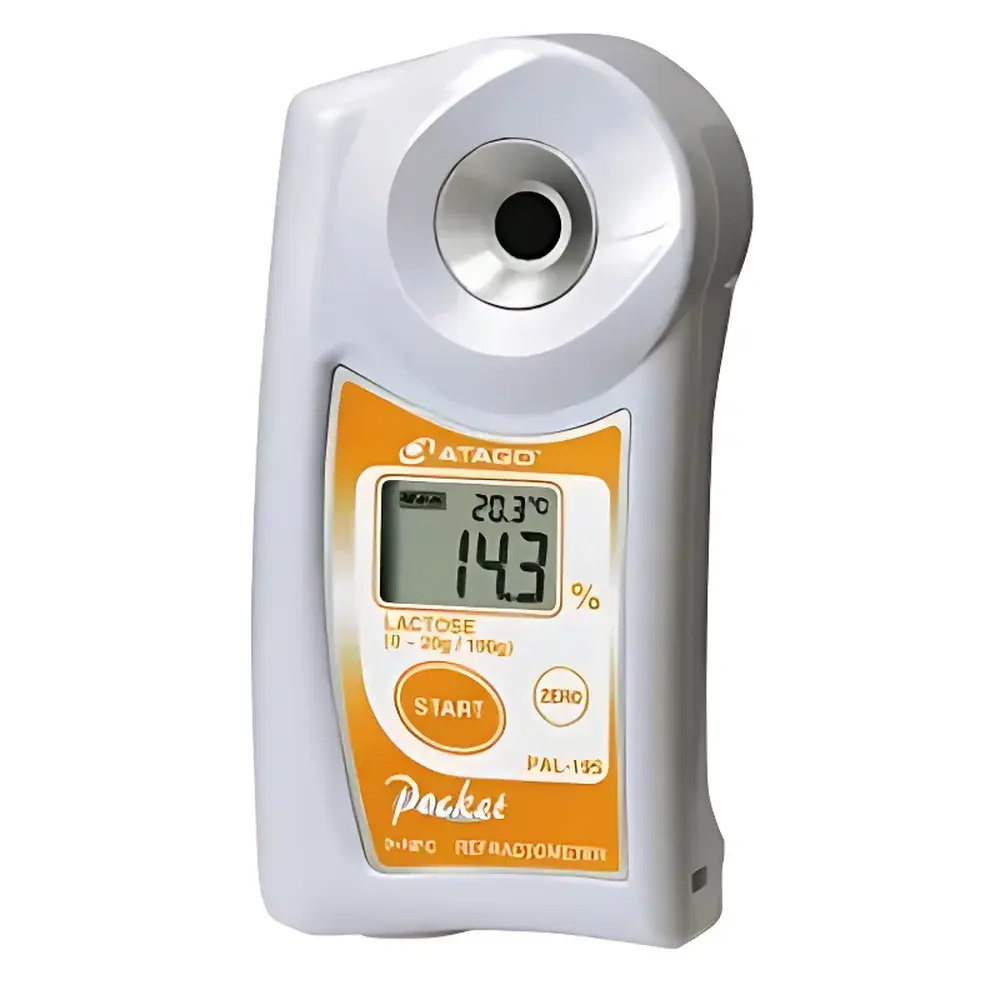
ATAGO PAL-19S Portable Digital Lactose Refractometer
| Brand | ATAGO |
|---|---|
| Origin | Japan |
| Model | PAL-19S |
| Product Type | Handheld Refractometer |
| Temperature Compensation | Automatic (ATC, 10–40°C) |
| Digital Display | Yes |
| Measurement Range | 0.0–20.0% (w/w lactose) |
| Accuracy | ±0.2% |
| Resolution | 0.1% |
| Power Supply | Two AAA batteries |
| IP Rating | IP65 |
| Dimensions | 5.5 × 3.1 × 10.9 cm |
| Weight | 100 g (instrument only) |
Overview
The ATAGO PAL-19S Portable Digital Lactose Refractometer is a compact, field-deployable optical instrument engineered for rapid, on-site quantification of lactose concentration in aqueous solutions. It operates on the fundamental principle of refractometry—measuring the refractive index (RI) of a sample and converting it to lactose mass percentage (w/w %) via a pre-calibrated polynomial algorithm optimized specifically for lactose-water systems. Unlike generic Brix refractometers, the PAL-19S employs a lactose-specific calibration curve traceable to NIST-traceable reference standards, ensuring metrological validity across the full 0.0–20.0% range. Its automatic temperature compensation (ATC) system utilizes a high-stability thermistor embedded in the prism block to correct RI readings in real time across 10–40°C, eliminating manual correction tables and minimizing thermal drift errors. Designed for routine quality control in dairy processing, infant formula production, and pharmaceutical excipient testing, the PAL-19S delivers repeatable results with ±0.2% accuracy and 0.1% resolution under ambient laboratory or production-floor conditions.
Key Features
- Optimized lactose-specific calibration: Factory-calibrated using certified lactose reference solutions; no user recalibration required for standard applications.
- Automatic temperature compensation (ATC): Compensates for sample temperature variation between 10°C and 40°C without external thermostating.
- Rugged, portable architecture: IP65-rated enclosure ensures resistance to dust ingress and low-pressure water jets—suitable for wet environments including clean-in-place (CIP) zones and packaging lines.
- Intuitive digital interface: Large LCD display with backlight enables clear readability under variable lighting conditions; single-button operation minimizes training requirements.
- Battery-powered operation: Powered by two standard AAA alkaline cells, supporting >5,000 measurements per set—ideal for mobile QC technicians and multi-site audits.
- Prism construction: High-grade sapphire-coated glass prism provides scratch resistance and long-term optical stability, critical for maintaining calibration integrity over repeated use.
Sample Compatibility & Compliance
The PAL-19S is validated for homogeneous, non-viscous aqueous lactose solutions—including skim milk ultrafiltrate, lactose monohydrate slurries (after centrifugation), and reconstituted whey permeate. It is not intended for samples containing suspended solids >5 µm, oils, or high-concentration proteins (>2% w/v), which may scatter light or adhere to the prism surface. The instrument complies with ISO 2173:2003 (fruit juice refractometric determination) methodology principles and aligns with ASTM D1218–19 for refractive index measurement protocols. While not FDA 21 CFR Part 11–compliant as a standalone device (lacking audit trail or electronic signature capability), its measurement output is suitable for inclusion in GLP/GMP documentation when paired with controlled SOPs and manual record-keeping per ICH Q7 Annex 11 guidance.
Software & Data Management
The PAL-19S operates as a self-contained, firmware-driven instrument with no onboard data logging or USB/Bluetooth connectivity. All measurements are displayed in real time and must be manually transcribed into laboratory notebooks, LIMS, or Excel-based QC records. This design prioritizes operational simplicity, regulatory transparency, and reduced validation burden—particularly advantageous in regulated environments where uncontrolled firmware updates or proprietary software dependencies are discouraged. For laboratories requiring digital data capture, ATAGO recommends pairing the PAL-19S with its optional RS-232-compatible data transfer cable (sold separately) and the free PAL-PC software, enabling timestamped export of measurement series in CSV format for traceability and statistical process control (SPC) analysis.
Applications
- Dairy ingredient manufacturing: In-process verification of lactose crystallization endpoints and final drying moisture equivalence.
- Infant formula and medical nutrition: Batch release testing of lactose content in powder blends and liquid concentrates per USP and Ph. Eur. 2.2.38.
- Whey processing facilities: Monitoring lactose recovery efficiency during nanofiltration and crystallization steps.
- Academic research labs: Rapid screening of enzymatic hydrolysis kinetics (e.g., lactase activity assays) via time-series lactose depletion monitoring.
- Contract manufacturing organizations (CMOs): Supporting audit-ready documentation for client-facing quality reports under ISO 17025-accredited testing scopes.
FAQ
Does the PAL-19S require periodic recalibration?
Yes—ATAGO recommends annual recalibration against certified lactose standards at an authorized service center or accredited metrology lab to maintain traceability to JCSS (Japan Calibration Service System).
Can the PAL-19S measure lactose in whole milk?
No—fat globules and casein micelles cause significant light scattering; use clarified or centrifuged samples only.
Is the prism surface chemically resistant to common cleaning agents?
Yes—the sapphire-coated prism withstands 70% ethanol, 1% sodium hypochlorite, and food-grade peracetic acid; avoid abrasive pads or strong acids (pH 12).
What does IP65 rating mean for daily use?
It certifies full dust-tightness and protection against water projected from a nozzle (6.3 mm diameter) at low pressure (30 kPa) from any direction—enabling safe use near rinsing stations or humidified rooms.
How does ATC affect measurement uncertainty?
ATC reduces temperature-induced uncertainty from ±0.5% (uncorrected) to within the stated ±0.2% specification across the 10–40°C operating range, provided the sample is equilibrated to ambient temperature prior to measurement.



