
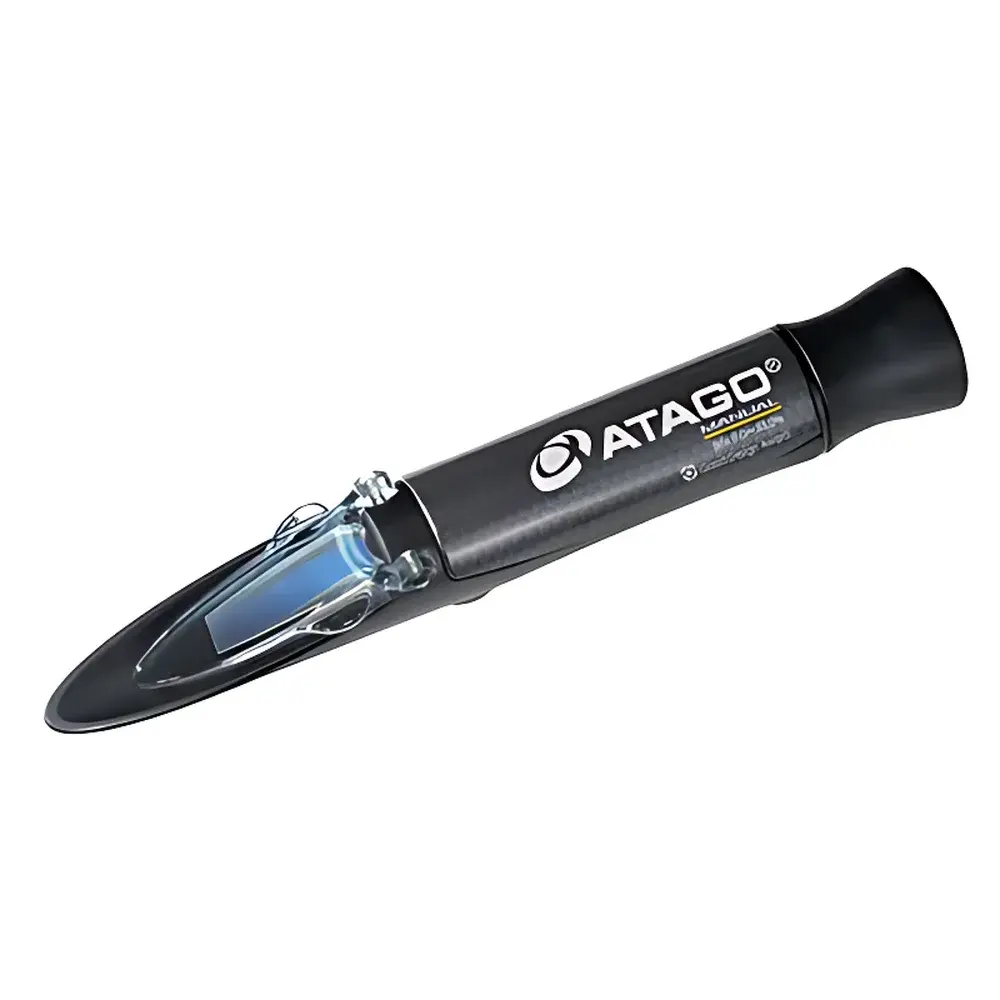
MASTER-S28M Sodium Chloride Refractometer
| Origin | Japan |
|---|---|
| Manufacturer Type | Authorized Distributor |
| Origin Category | Imported Instrument |
| Model | MASTER-S28M |
| Price | Upon Request |
| Scale Range (NaCl) | 0.0–28.0% w/w |
| Minimum Scale Division | 0.2% NaCl |
| Dimensions | 3.2 × 3.4 × 20.3 cm |
| Weight | 105 g |
| Optional Accessory | RE-2391-50M Micro-sample Prism Cover (not recommended for high-viscosity samples) |
| Consumable | RE-2391-59M Dedicated Daylight Plate |
Overview
The MASTER-S28M Sodium Chloride Refractometer is a precision handheld optical instrument engineered for rapid, on-site determination of sodium chloride concentration in aqueous saline solutions—specifically optimized for food processing applications involving pickled vegetables, salted seafood, brine tanks, and fermentation monitoring. It operates on the fundamental principle of critical angle refractometry: light passing from a high-refractive-index prism into a sample solution undergoes total internal reflection at a boundary angle inversely proportional to the solution’s refractive index, which correlates directly with NaCl mass concentration under controlled conditions. Calibrated exclusively against standardized NaCl solutions traceable to JIS Z 8013 and ISO 21748, the MASTER-S28M delivers consistent, repeatable measurements across its full 0.0–28.0% w/w range. Its compact, lightweight design (105 g) and ergonomic form factor enable extended use in humid, high-salinity environments typical of fish processing plants, pickle production lines, and quality control laboratories. Notably, this model does not incorporate automatic temperature compensation (ATC); users must manually adjust readings using the included temperature correction chart or apply external calibration offsets per ASTM D1152–22 guidelines when ambient or sample temperature deviates from 20 °C.
Key Features
- High-precision NaCl-specific scale calibrated for direct % w/w readout (0.0–28.0%, 0.2% graduation)
- Corrosion-resistant prism and housing engineered for long-term exposure to saline, acidic, and marine environments
- Optimized optical path geometry minimizing parallax error and enhancing endpoint detection clarity
- Integrated daylight plate (RE-2391-59M) enabling reliable ambient-light operation without external illumination sources
- Compact footprint (3.2 × 3.4 × 20.3 cm) and low mass (105 g) supporting one-handed operation and field portability
- Optional micro-sample prism cover (RE-2391-50M) reduces required sample volume to ≤0.3 mL—ideal for limited or high-value brine specimens
Sample Compatibility & Compliance
The MASTER-S28M is validated for homogeneous, non-turbid, low-viscosity aqueous NaCl solutions. It is routinely deployed in facilities adhering to HACCP-based food safety plans and meets functional requirements outlined in JAS (Japanese Agricultural Standard) for salted seafood grading and JIS K 0061 for saline solution analysis. While not certified to ISO/IEC 17025 for accredited testing, its calibration methodology aligns with ISO 5725 (accuracy and precision of measurement methods) and supports GLP-compliant recordkeeping when used with documented temperature correction protocols. The instrument is unsuitable for emulsions, suspensions, or viscous brines (e.g., soy-based marinades); such matrices require centrifugation or dilution prior to measurement.
Software & Data Management
As an analog optical instrument, the MASTER-S28M does not feature digital output, Bluetooth connectivity, or embedded software. All measurements are visually interpreted via ocular scale reading and manually recorded. To support audit-ready documentation, users are advised to log readings alongside contemporaneous sample temperature, calibration verification date, operator ID, and environmental conditions in accordance with FDA 21 CFR Part 11–aligned paper-based or LIMS-integrated manual entry workflows. Optional accessories—including calibrated reference standards (e.g., 5.0%, 15.0%, and 25.0% NaCl certified solutions)—facilitate daily verification and trending per internal QA procedures.
Applications
- Real-time salinity verification during vegetable pickling (cucumber, radish, cabbage) to ensure microbial stability and texture consistency
- In-process monitoring of brine concentration in frozen or dried seafood storage tanks (e.g., squid, mackerel, kelp)
- Final product release testing for salted roe, fish paste, and fermented condiments per JAS labeling thresholds
- Supplier qualification of incoming brine solutions used in thermal processing or vacuum packaging lines
- Educational demonstration of colligative properties and refractive index–concentration relationships in food science curricula
FAQ
Does the MASTER-S28M comply with ISO or ASTM standards for refractometric salt analysis?
Yes—it follows measurement principles defined in ASTM D1152–22 (Standard Test Method for Hydrochloric Acid) and JIS Z 8013 (Refractometers), with calibration traceable to national standards.
Can I measure seawater or mixed electrolyte solutions with this instrument?
No. The scale is specifically calibrated for NaCl–water systems. Seawater contains Mg²⁺, Ca²⁺, and other ions that alter refractive behavior; dedicated seawater refractometers (e.g., ATAGO PAL-SE) are required.
What is the recommended frequency for calibration verification?
Perform verification before each shift or batch using at least two certified NaCl standards bracketing expected sample concentrations.
Is the RE-2391-50M micro-sample cover compatible with all MASTER-series models?
Yes, it is mechanically and optically standardized across MASTER-S, -S28, -S28M, and -S50 refractometers.
How do I correct for temperature deviations from 20 °C?
Apply the linear correction factor provided in the user manual: ΔNaCl (%) = −0.02 × (Tsample − 20), valid between 10–30 °C.



