
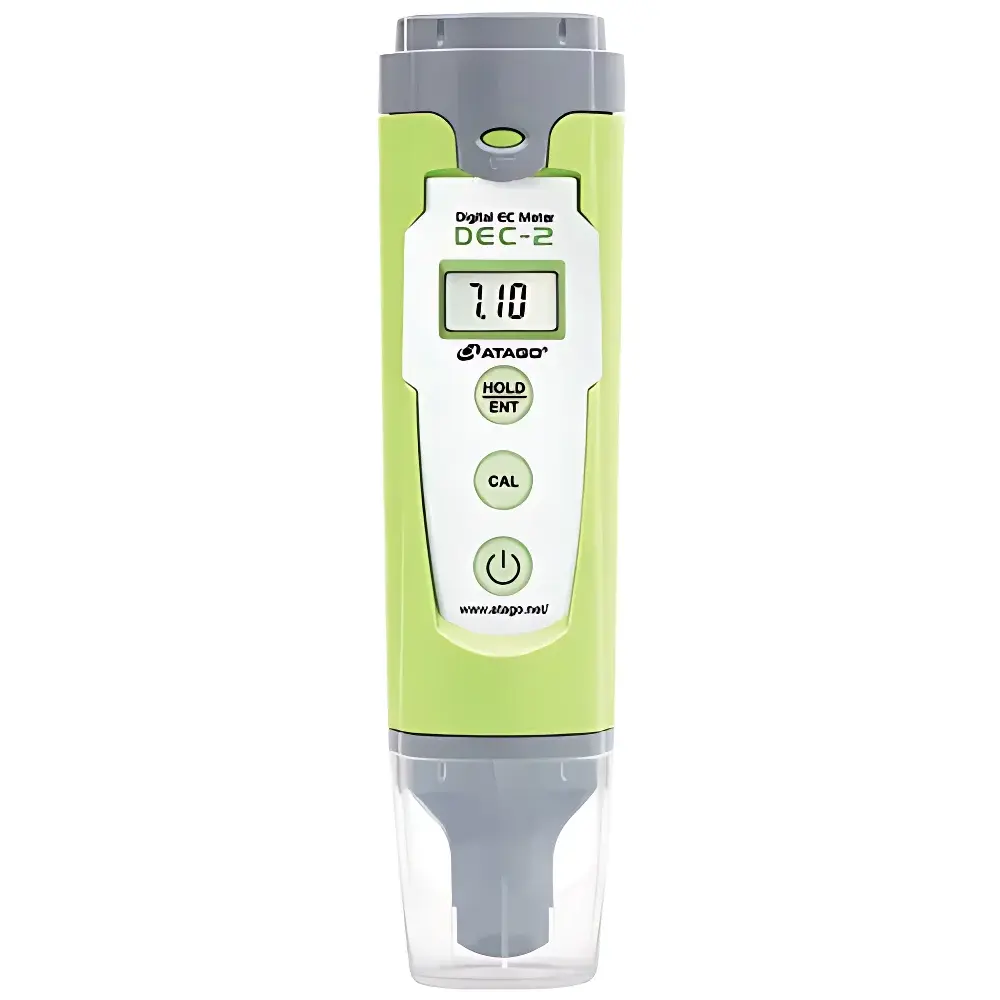
ATAGO DEC-2 Portable Digital Conductivity Pen
| Brand | ATAGO |
|---|---|
| Origin | Japan |
| Model | DEC-2 (Cat. No. 4340) |
| Instrument Type | Pocket-Sized Conductivity Pen |
| Parameter Type | Single-Parameter (Conductivity) |
| Measurement Range | 0.0 to 19.9 mS/cm |
| Resolution | 0.1 mS/cm |
| Accuracy | ±0.2 mS/cm (0.0–10.0 mS/cm), ±0.4 mS/cm (10.1–19.9 mS/cm) |
| Temperature Range | 0.0–50.0 °C with Automatic Temperature Compensation (ATC) |
| IP Rating | IP67 |
| Calibration Standard | 0.71 g/100 g NaCl solution |
| Power Source | 4 × LR44 button cells |
| Dimensions | 4.5 × 3.0 × 16.3 cm |
| Weight | 90 g (without accessories) |
Overview
The ATAGO DEC-2 Portable Digital Conductivity Pen is an engineered-in-Japan, single-parameter electrochemical instrument designed for rapid, on-site measurement of electrical conductivity in aqueous and water-miscible solutions. Based on the principle of two-electrode conductometric measurement, the DEC-2 applies a low-frequency AC voltage across its integrated stainless-steel sensing electrodes to determine solution conductivity without polarization error. Its compact pen-form factor—measuring just 4.5 × 3.0 × 16.3 cm and weighing only 90 g—enables direct immersion in process streams, field soil extracts, beverage tanks, or cleaning bath solutions without requiring external power or data logging hardware. The device incorporates automatic temperature compensation (ATC) across 0.0–50.0 °C using an embedded thermistor, ensuring stable readings under ambient laboratory, production floor, or outdoor environmental conditions. All electronics are sealed within an IP67-rated housing, permitting full submersion and high-pressure water rinsing—critical for hygiene-sensitive applications in food processing and pharmaceutical manufacturing.
Key Features
- True pocket-sized design with ergonomic grip and one-handed operation
- Two-electrode conductivity sensor with corrosion-resistant stainless-steel contacts
- Automatic temperature compensation (ATC) referenced to 25 °C, compliant with ISO 7888 and ASTM D1125 standards for conductivity reporting
- IP67 ingress protection: dust-tight and capable of withstanding immersion in 1 m of water for up to 30 minutes
- Calibration performed using a traceable 0.71 g/100 g NaCl standard solution (equivalent to ~1.41 mS/cm at 25 °C), aligning with common industrial calibration practices
- Low-power operation via four LR44 alkaline button cells (typical battery life: >10,000 measurements)
- No zero adjustment required; auto-zero function activated upon power-on
Sample Compatibility & Compliance
The DEC-2 is validated for use with low-to-moderate ionic strength aqueous solutions including potable water, brewing wort and beer, fruit juice concentrates, alkaline cleaning agents (e.g., NaOH-based CIP solutions), cutting fluids, hydroponic nutrient solutions, and soil leachates prepared per ASTM D420, ISO 11265, or USDA NRCS protocols. It is not intended for highly viscous, suspended-solids-laden, or strongly oxidizing media (e.g., concentrated HNO₃ or bleach above 5% w/w). The instrument complies with IEC 61010-1:2010 for electrical safety and meets RoHS 2011/65/EU material restrictions. While not certified for intrinsic safety (ATEX/IECEx), its low-voltage operation and sealed construction support use in non-hazardous zones per NEC Class I, Division 2 guidelines.
Software & Data Management
The DEC-2 operates as a standalone measurement tool with no onboard memory or digital interface (e.g., USB, Bluetooth, or RS-232). All readings are displayed in real time on a high-contrast LCD screen with backlight-independent visibility. For regulated environments requiring auditability, users may manually record results into paper logbooks or electronic systems compliant with FDA 21 CFR Part 11 (when paired with validated SOPs and electronic signature workflows). Though the device itself does not generate electronic records, its consistent accuracy, traceable calibration, and robust mechanical design support integration into GLP/GMP quality systems where manual transcription is formally controlled and reviewed.
Applications
- Quality control of rinse water conductivity in pharmaceutical clean-in-place (CIP) validation
- Routine monitoring of brine concentration in meat and seafood processing
- Field assessment of soil salinity using saturated paste extracts (ASTM D420)
- Verification of alkaline detergent concentration in food equipment sanitation
- Quick-check verification of deionized water purity in lab prep areas
- In-process conductivity checks during beverage blending and dilution
- Educational demonstrations of ionic strength–conductivity relationships in chemistry labs
FAQ
What calibration standard is required for the DEC-2?
The DEC-2 is factory-calibrated using a 0.71 g/100 g NaCl solution (approximately 1.41 mS/cm at 25 °C). Users should recalibrate periodically using the same standard or a NIST-traceable equivalent.
Can the DEC-2 measure total dissolved solids (TDS)?
No—the DEC-2 outputs only conductivity (mS/cm). TDS estimation requires application-specific conversion factors and is not supported by this model.
Is the sensor replaceable or serviceable?
The electrode assembly is integrated and non-user-replaceable. Should performance degrade due to fouling or coating, cleaning with mild detergent or 5% acetic acid followed by thorough rinsing restores functionality in most cases.
Does the DEC-2 meet ISO/IEC 17025 requirements for accredited testing?
While the DEC-2 itself is not a certified reference instrument, its documented accuracy, traceable calibration, and stable ATC performance allow it to serve as a field verification tool within ISO/IEC 17025-accredited laboratories when used per defined internal procedures and uncertainty budgets.





