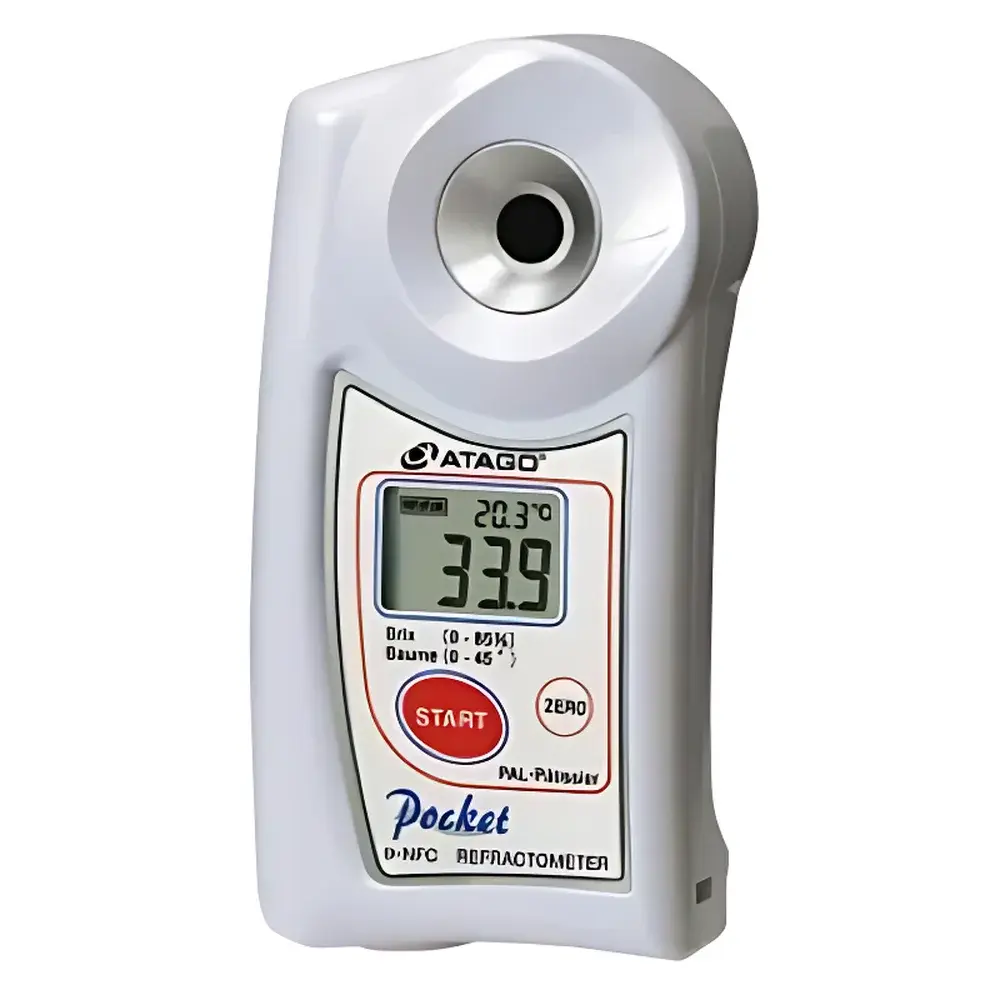
ATAGO PAL-Patissier Dual-Scale Refractometer for Brix and Baumé Measurement
| Brand | ATAGO |
|---|---|
| Origin | Japan |
| Model | PAL-Patissier |
| Instrument Type | Destructive Sampling Refractometer |
| Measurement Principle | Abbe Refraction (Optical Refractometry) |
| Brix Range | 0.0–85.0% |
| Baumé Range | 0–45° |
| Brix Resolution | 0.1% |
| Baumé Resolution | 1° |
| Brix Accuracy | ±0.2% |
| Baumé Accuracy | ±1° |
| Sample Volume | 0.3 mL |
| Measurement Time | 3 seconds |
| Temperature Compensation | Automatic (10–100°C) |
| Operating Ambient | 10–40°C |
| IP Rating | IP65 |
| Power | 2 × AAA batteries |
| Dimensions | 55(W) × 31(D) × 109(H) mm |
| Weight | 100 g (body only) |
Overview
The ATAGO PAL-Patissier is a compact, handheld dual-scale refractometer engineered specifically for precision quality control in confectionery, pastry, and jam production environments. It operates on the principle of Abbe refractometry—measuring the refractive index of aqueous sugar solutions to determine solute concentration—and delivers simultaneous readings in two industry-relevant units: Brix (% w/w sucrose equivalent) and Baumé (°Bé), a density-based scale widely used in traditional syrup, caramel, and sugar boiling processes. Unlike laboratory-grade benchtop refractometers, the PAL-Patissier is optimized for rapid, on-site decision-making during active cooking, boiling, or finishing stages—where real-time feedback on sugar concentration directly impacts texture, crystallization behavior, and shelf stability. Its optical architecture features high-stability prisms, temperature-compensated optics, and a robust aluminum housing designed for repeated exposure to heat, steam, and viscous residues without calibration drift.
Key Features
- Dual-scale optical readout: Simultaneous Brix (0.0–85.0%) and Baumé (0–45°) measurement—eliminating manual conversion and reducing operator error in sugar boiling workflows.
- Automatic temperature compensation (ATC): Compensates across 10–100°C sample temperature range using built-in thermistor; ensures traceable accuracy without external thermostating.
- Minimal sample requirement: Only 0.3 mL required per measurement—critical when working with small-batch preparations or high-value formulations.
- Rapid analysis: Stable reading achieved in ≤3 seconds—enabling continuous monitoring during dynamic thermal processing such as caramelization or pectin gelation.
- IP65-rated enclosure: Dust-tight and protected against low-pressure water jets—supports safe operation near steam kettles, immersion in warm rinse water, and routine sanitation protocols.
- Thermally stable prism surface: Designed for direct contact with hot syrups up to 100°C; no cooling delay required between measurements.
- Calibration verification port: Integrated reference window allows quick validation with distilled water or certified sucrose standards (e.g., NIST-traceable 10% w/w solution).
Sample Compatibility & Compliance
The PAL-Patissier is validated for use with clear to moderately turbid aqueous sugar solutions—including fruit purees, cooked jams, invert sugar syrups, glucose-fructose blends, and honey-based preparations. While not intended for highly suspended or opaque matrices (e.g., nut pastes or chocolate emulsions), its optical design tolerates minor particulate load common in unfiltered fruit reductions. The instrument complies with ISO 2173:2003 (fruit juice and related products), AOAC Official Method 932.12 (refractometric determination of soluble solids), and supports GLP-aligned documentation when paired with ATAGO’s optional data logging accessories. Its destructive sampling method aligns with standard QC practices for finished product release testing in artisanal and industrial bakeries subject to HACCP and FDA Food Safety Modernization Act (FSMA) requirements.
Software & Data Management
As a standalone optical instrument, the PAL-Patissier does not incorporate onboard memory or digital connectivity. However, it integrates seamlessly into regulated manufacturing environments via external documentation workflows. Users may record measurements manually in paper-based batch records or input values into LIMS or MES systems following 21 CFR Part 11-compliant electronic data capture procedures. For traceability, ATAGO provides calibration certificates (NIST-traceable where applicable) and recommends quarterly verification using certified reference standards. Optional accessories—including the PAL-Print adapter and RS-232 interface kit—enable ASCII output to printers or PCs for audit-ready reporting, supporting compliance with GMP Annex 11 and EU GMP Chapter 4 documentation expectations.
Applications
- Monitoring sugar concentration during jam and marmalade cooking to achieve target gel point and prevent over-boiling.
- Verifying syrup density in caramel, fondant, and sugar paste preparation—critical for controlling crystallinity and mouthfeel.
- Batch-to-batch consistency control in fruit compote, coulis, and reduction-based sauces.
- QC screening of incoming fruit concentrates or inverted sugar prior to formulation.
- Training and process validation in culinary education programs where quantitative understanding of sugar behavior is essential.
- Supporting R&D trials involving alternative sweeteners (e.g., erythritol, allulose) when calibrated against sucrose-equivalent Brix references.
FAQ
Is the PAL-Patissier suitable for measuring non-sucrose solutions like honey or agave syrup?
Yes—though Brix readings represent sucrose-equivalent concentration, the instrument provides consistent relative quantification for routine QC. For regulatory labeling or nutritional claims, confirm correlation with HPLC or enzymatic assays.
Does automatic temperature compensation eliminate the need for sample cooling?
Yes—the ATC system corrects for refractive index variation across 10–100°C; hot samples may be measured directly after brief prism stabilization (≤2 sec).
How often should the instrument be recalibrated?
ATAGO recommends daily verification with distilled water before first use and after extended idle periods; full recalibration is required if verification fails or after physical impact.
Can the PAL-Patissier be used in humid or steam-rich environments?
Yes—its IP65 rating ensures reliable operation in commercial kitchens, bakery production floors, and confectionery workshops with ambient humidity >80% RH.
What maintenance is required for long-term optical accuracy?
Wipe the prism surface with lens tissue and ethanol after each use; avoid abrasive cleaners. Store in supplied protective case with desiccant to prevent moisture-induced haze on optical surfaces.