
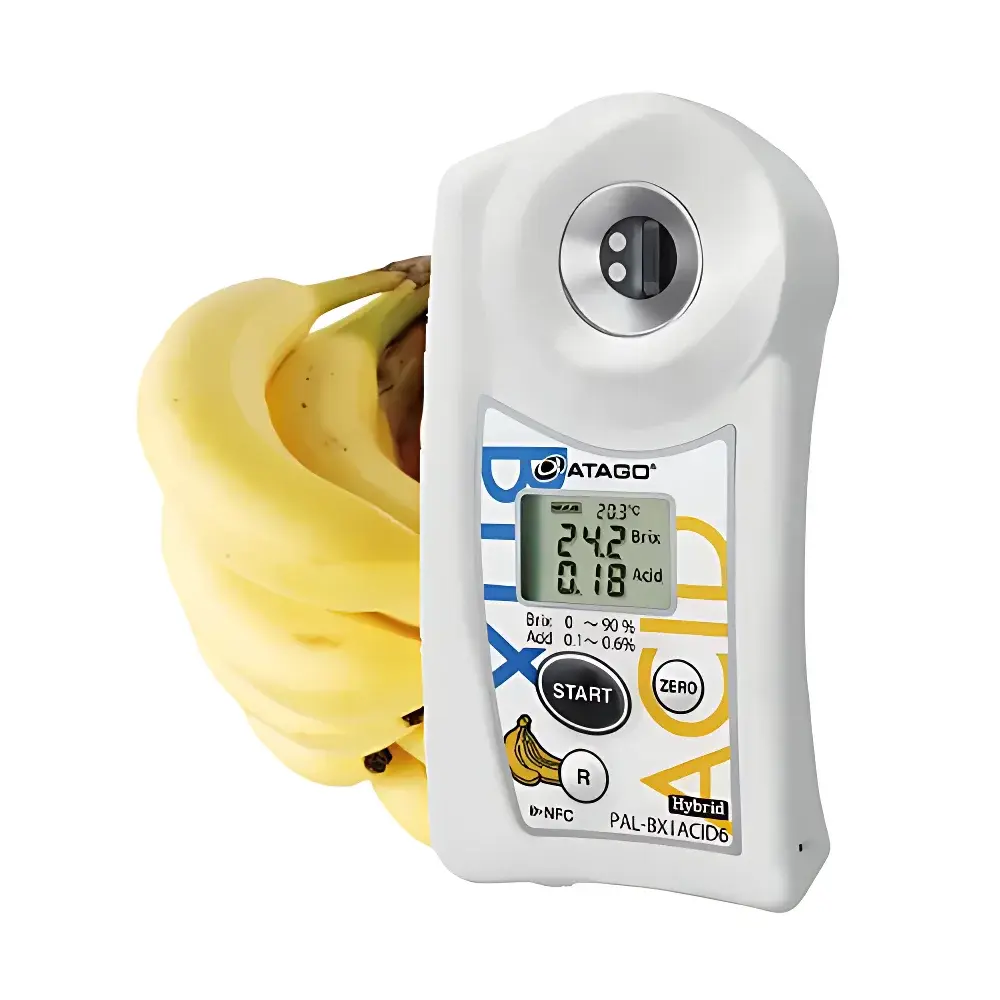
ATAGO PAL-BX/ACID 6 Banana-Specific Brix and Titratable Acidity Refractometer
| Brand | ATAGO |
|---|---|
| Origin | Japan |
| Model | PAL-BX/ACID 6 |
| Product Type | Handheld Digital Refractometer |
| Temperature Compensation Range | 10–40 °C |
| Brix Measurement Range | 0.0–60.0 % |
| Acid Measurement Range | 0.10–0.60 % (as total titratable acidity, expressed as malic acid equivalent) |
| Brix Accuracy | ±0.2 % |
| Acid Accuracy | ±0.10 % (within 0.10–1.00 % range) |
| Brix Resolution | 0.1 % |
| Acid Resolution | 0.01 % (0.00–9.99 %), 0.1 % (≥10.0 %) |
| Sugar-Acid Ratio Display | Yes (via dedicated R key) |
| IP Rating | IP65 |
| Power | 2 × AAA alkaline batteries |
| Dimensions | 5.5 × 3.1 × 10.9 cm |
| Weight | 100 g (instrument only) |
Overview
The ATAGO PAL-BX/ACID 6 is a purpose-engineered handheld digital refractometer designed specifically for rapid, on-site assessment of sugar-acid balance in bananas and banana-derived products. It operates on the principle of critical-angle refractometry, measuring the refractive index of aqueous solutions to determine soluble solids content (reported as Brix %), while integrating an empirical optical-acid correlation algorithm calibrated against titratable acidity expressed as malic acid equivalents. Unlike general-purpose refractometers, the PAL-BX/ACID 6 embeds a proprietary OFFSET curve correction function—enabling traceable alignment with reference titration data or laboratory-grade pH-metric acid quantification—thereby supporting method equivalence validation under GLP-aligned workflows. Its compact architecture, robust IP65-rated enclosure, and battery-powered operation make it suitable for field use in orchards, packing houses, cold storage facilities, and QC labs where real-time ripeness evaluation and postharvest quality monitoring are essential.
Key Features
- Dedicated dual-parameter measurement: Simultaneous Brix (0.0–60.0 %) and titratable acidity (0.10–0.60 % as malic acid) in a single instrument
- One-touch sugar-acid ratio calculation: Pressing the “R” key automatically computes and displays the ratio (Brix ÷ Acid), eliminating manual calculation errors
- OFFSET calibration curve function: Allows numerical offset adjustment to harmonize results with standardized titration protocols (e.g., AOAC 942.15 or ISO 750:1998), supporting inter-method comparability
- Automatic temperature compensation (ATC): Compensates refractive index readings across 10–40 °C using an integrated thermistor, ensuring metrological consistency without external thermostating
- High-resolution digital display: 0.1 % Brix resolution; 0.01 % acid resolution (0.00–9.99 % range); intuitive multi-scale sugar-acid ratio formatting (0.00 to ≥100)
- IP65 ingress protection: Dust-tight and resistant to low-pressure water jets—suitable for humid, wet, or dusty agricultural environments
Sample Compatibility & Compliance
The PAL-BX/ACID 6 is validated for use with clarified banana pulp extracts, filtered banana juice, and homogenized banana puree suspensions. For acid measurement, samples must be diluted at a precise 1:50 (w/v) ratio using distilled or deionized water—consistent with standard fruit acid extraction procedures outlined in ISO 750 and AOAC Official Method 942.15. The device does not require reagents, consumables, or sample digestion, reducing analytical cost per test by >90% compared to conventional titrimetric methods. While not FDA 21 CFR Part 11 compliant (as it lacks audit trail or electronic signature functionality), its measurement repeatability (≤±0.2 % Brix, ≤±0.10 % Acid) meets internal QC thresholds for routine process control in GMP-adjacent agri-food operations. Traceability is supported via user-recorded offset values and documented dilution protocols.
Software & Data Management
The PAL-BX/ACID 6 operates as a standalone instrument with no embedded memory, wireless connectivity, or PC interface. All measurements are displayed in real time and must be manually recorded. This design prioritizes operational simplicity, battery longevity (>10,000 measurements per set), and resistance to electromagnetic interference in industrial settings. For laboratories requiring data integration, users may pair the instrument with external digital loggers or LIMS via manual entry—using the unit’s stable output format and clearly defined uncertainty intervals (±0.2 % Brix, ±0.10 % Acid). Offset values applied during calibration are retained until reset, enabling consistent batch-to-batch comparisons without recalibration between shifts.
Applications
- Ripeness staging: Correlating rising Brix and declining acid levels with ethylene evolution and starch-to-sugar conversion kinetics
- Harvest timing optimization: Supporting decision-making based on target sugar-acid ratio thresholds (e.g., 35–50 for dessert bananas)
- Postharvest quality grading: Enforcing specification compliance for export shipments under UNECE FFV-28 or ASEAN Banana Standards
- Processing line monitoring: Verifying consistency of banana puree, concentrate, or baby food formulations prior to thermal treatment
- Varietal screening programs: Quantifying phenotypic expression of sugar metabolism and organic acid accumulation across germplasm collections
- Research applications: Providing rapid, non-destructive proxies for metabolic profiling in controlled-environment studies
FAQ
What acid form does the PAL-BX/ACID 6 report?
It reports total titratable acidity (TTA) calibrated and displayed as malic acid equivalents—consistent with standard banana acidity reporting conventions in horticultural science.
Is sample filtration required before measurement?
Yes. For reliable Brix and acid readings, samples must be clarified by centrifugation (≥3,000 × g, 5 min) followed by filtration through a 0.45 µm membrane to remove particulates that scatter light and distort refractive index detection.
Can the instrument measure other fruits?
While optimized for banana matrix characteristics (pH ~5.0–5.8, typical acid profile), it may yield biased acid results for fruits with markedly different organic acid composition (e.g., citric-dominant citrus or tartaric-dominant grapes) unless independently re-offset.
How often should the prism surface be cleaned?
After every 3–5 measurements—or immediately after testing viscous or pulpy samples—to prevent residue buildup that affects optical coupling and measurement reproducibility.
Does the device comply with ISO/IEC 17025 requirements?
It is not accredited as a testing laboratory instrument, but its stated accuracy, ATC performance, and offset traceability support use as a verified reference tool within ISO/IEC 17025-compliant laboratories when operated under documented SOPs.




