
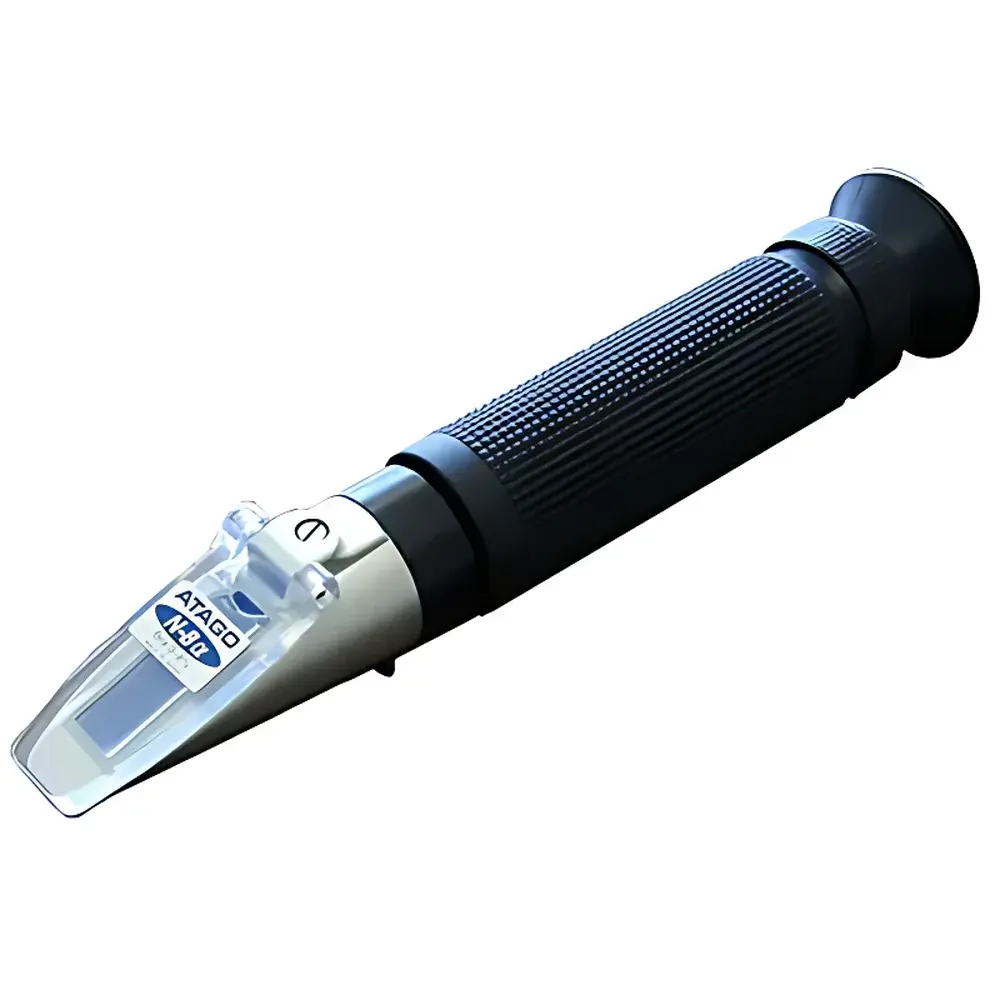
N-8α Alpha Handheld Refractometer for Low-Concentration Water-Soluble Cutting Fluids
| Origin | Japan |
|---|---|
| Manufacturer Type | Authorized Distributor |
| Origin Category | Imported |
| Model | N-8α |
| Price | Upon Request |
| Scale Range | 0.0–8.0 % Brix |
| Minimum Scale Division | 0.1 % Brix |
| Dimensions | 4 × 4 × 21 cm |
| Weight | 260 g |
| Dedicated Accessory | RE-2360-51L Daylight Plate with Calibration Screw |
Overview
The N-8α Alpha Handheld Refractometer is an optical precision instrument engineered for rapid, field-deployable concentration measurement of low-conductivity aqueous solutions—particularly water-soluble cutting fluids, coolant emulsions, and industrial lubricants diluted 10× to 100×. It operates on the fundamental principle of total internal reflection at the prism–sample interface, where the critical angle of refraction correlates directly with the solution’s refractive index and, by calibration, its Brix concentration. Unlike general-purpose handheld refractometers with broad 0–32 % Brix ranges, the N-8α features a narrow, high-resolution optical scale optimized specifically for sub-10 % Brix applications—enabling enhanced angular discrimination and improved visual contrast in low-refractive-index matrices. Its design prioritizes repeatability under variable ambient lighting conditions, leveraging a custom daylight plate (RE-2360-51L) that integrates a calibrated screw-adjustment mechanism to compensate for thermal drift and ensure consistent zero alignment across temperature gradients from 10 °C to 30 °C.
Key Features
- Optimized optical system with high-transmittance BK7 prism and anti-reflective coating for superior brightness and edge definition in low-Brix readings
- Dedicated 0.0–8.0 % Brix scale with 0.1 % Brix minimum division—providing 8× finer resolution than standard 0–32 % instruments within the critical low-concentration range
- Compact ergonomic form factor (4 × 4 × 21 cm; 260 g) designed for one-handed operation in machine shop, QC lab, or on-site maintenance environments
- Integrated daylight plate (RE-2360-51L) with precision-calibrated adjustment screw for real-time zero-point verification and thermal compensation
- Corrosion-resistant aluminum alloy housing with anodized surface finish—engineered to withstand exposure to water-based coolants, mild solvents, and shop-floor humidity
- No battery or electronics required: fully mechanical, ISO 21530-compliant optical measurement system ensuring long-term stability and minimal calibration drift
Sample Compatibility & Compliance
The N-8α is validated for use with transparent, non-viscous, aqueous-based working fluids including semi-synthetic and synthetic metalworking coolants, water-glycol heat transfer fluids, and low-concentration alkaline cleaning agents. It is not suitable for opaque suspensions, highly viscous oils (>50 cSt), or solutions containing suspended solids or air bubbles. The instrument complies with JIS Z 8806:2017 (Refractometers – Methods of Testing) and supports traceable calibration per ISO/IEC 17025 requirements when used with NIST-traceable sucrose reference standards. While not certified for regulated pharmaceutical or food-grade release testing, it meets GLP documentation expectations for in-process concentration monitoring in manufacturing environments governed by ISO 9001 and IATF 16949 quality management systems.
Software & Data Management
As a purely optical, analog measurement device, the N-8α does not incorporate digital sensors, firmware, or data output interfaces. All readings are visually interpreted via the eyepiece scale and manually recorded. This architecture eliminates software validation burdens and ensures full compatibility with FDA 21 CFR Part 11 Annex 11 principles—no electronic records, audit trails, or user access controls are required or supported. For laboratories requiring digital archiving, users may pair the N-8α with standardized paper logbooks or integrate manual entries into LIMS platforms using defined SOPs (e.g., SOP-QC-REF-003). Calibration verification logs—including date, operator ID, reference standard lot number, and observed deviation—must be retained for minimum of two years per ISO 10012 guidelines.
Applications
- Routine concentration verification of water-miscible cutting fluids prior to tank replenishment in CNC machining cells
- On-the-spot dilution ratio validation during coolant mixing to prevent over-concentration (risk of residue buildup) or under-concentration (risk of tool wear and microbial growth)
- Field inspection of heat treatment quenchants and electroplating rinse baths where Brix serves as a surrogate for glycol or surfactant content
- Preventive maintenance checks for evaporative concentration drift in central coolant circulation systems
- Educational demonstration of refractive index–concentration relationships in materials science and industrial chemistry curricula
FAQ
What is the recommended calibration frequency for the N-8α in continuous production use?
Calibration verification using a certified 0.0 % and 4.0 % Brix sucrose standard is required before each shift or every 4 hours of cumulative use—whichever occurs first—per JIS Z 8806 Section 6.2.
Can the N-8α measure ethylene glycol–water mixtures?
Yes, provided the final mixture falls within the 0.0–8.0 % Brix range and remains optically clear; however, dedicated glycol refractometers with temperature-compensated scales are preferred for HVAC or automotive antifreeze applications.
Is the RE-2360-51L daylight plate interchangeable with other N-series models?
No—the RE-2360-51L is mechanically and optically tuned exclusively for the N-8α’s prism geometry and focal length; substitution with RE-2360-50 or RE-2360-52 will result in parallax error and scale misalignment.
Does the N-8α require temperature correction when used at 35 °C?
The instrument’s optical scale is temperature-compensated only between 10–30 °C per JIS specification; readings taken above 30 °C require manual correction using published Brix–temperature coefficient tables for the specific fluid matrix.
How should the prism surface be cleaned after measuring oily coolant samples?
Wipe gently with lens tissue moistened with isopropyl alcohol (≥99 %), followed by dry tissue; avoid acetone or chlorinated solvents which may degrade the prism’s anti-reflective coating.





