
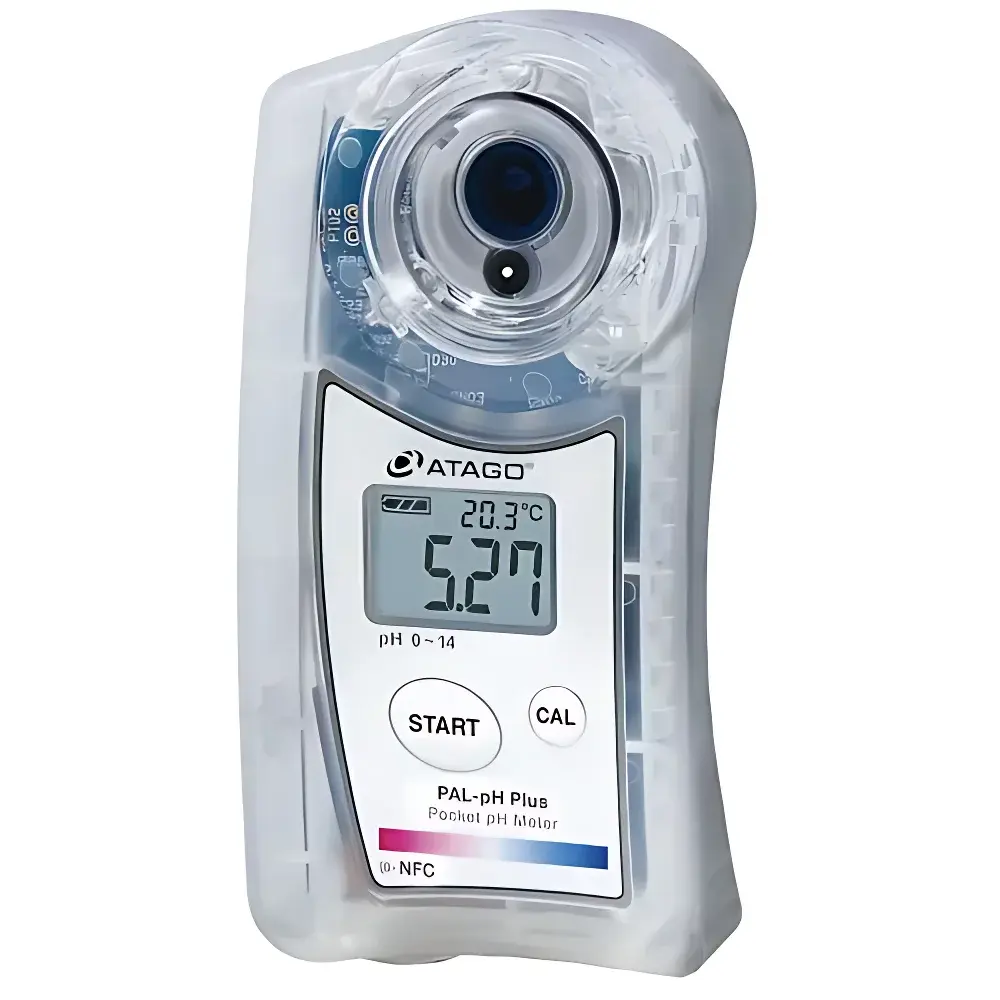
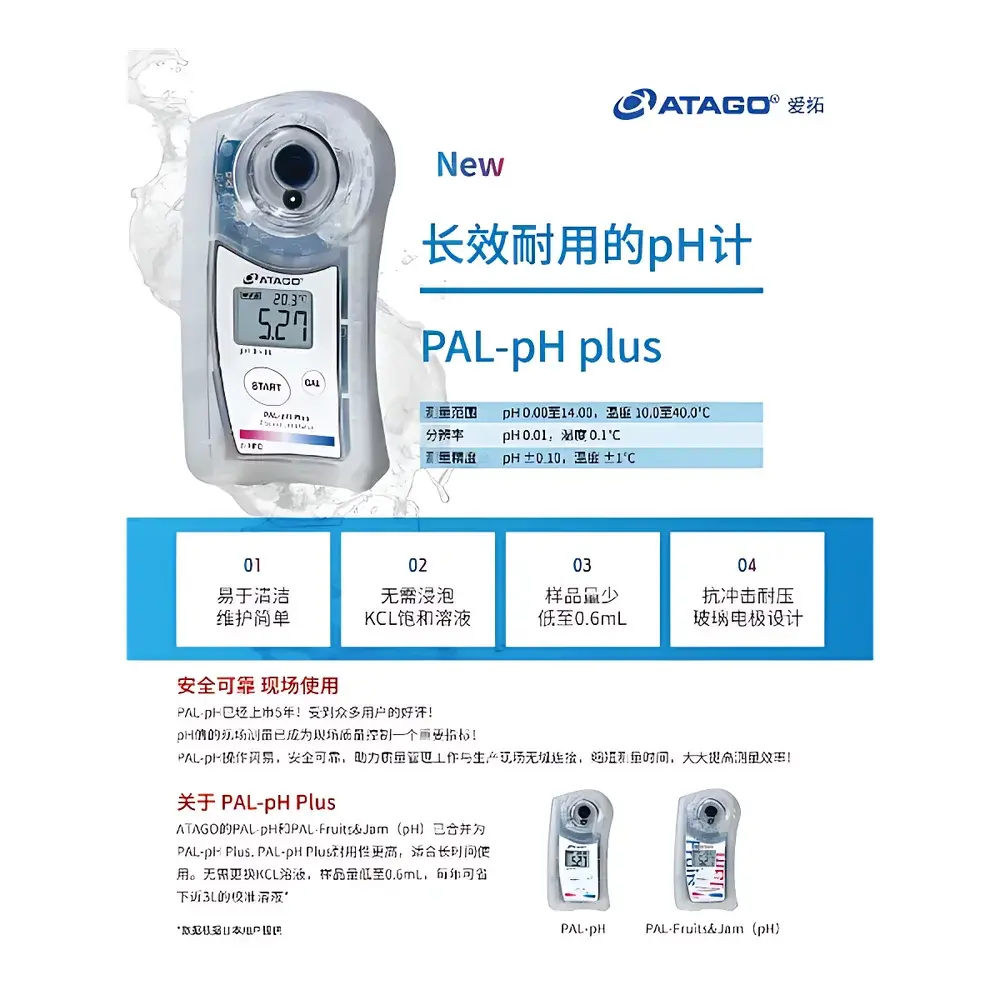
ATAGO PAL-pH Plus Portable Digital pH Meter with Low-Volume Sample Capability and KCl-Free Electrode
| Brand | ATAGO |
|---|---|
| Origin | Japan |
| Model | PAL-pH Plus |
| Instrument Type | Portable |
| Parameter Type | Single (pH) |
| Measurement Range | 0.00–14.00 pH |
| Resolution | 0.01 pH |
| Accuracy | ±0.10 pH |
| Precision | ±0.1 pH |
| Minimum Sample Volume | 0.6 mL |
| Electrode Design | Smooth-surface, impact-resistant glass electrode |
| Calibration | Automatic 1–3 point calibration (standard buffers: pH 4.01, 7.00, 10.01) |
| Compliance | Designed for GLP-compliant workflows |
Overview
The ATAGO PAL-pH Plus is a precision-engineered portable digital pH meter designed for laboratories, quality control environments, and field applications requiring reliable, rapid, and low-volume pH measurements. Unlike conventional pH meters dependent on continuous KCl electrolyte saturation, the PAL-pH Plus integrates a proprietary low-maintenance glass electrode that eliminates the need for storage in saturated KCl solution—reducing contamination risk, minimizing electrode drift, and extending service life. Its measurement principle follows the standard potentiometric method based on the Nernst equation, where the potential difference between the reference and sensing electrodes is converted into a pH value with high reproducibility. The instrument operates within the full aqueous pH scale (0.00–14.00), delivering resolution of 0.01 pH units and certified accuracy of ±0.10 pH under ISO 8655-4 and ASTM E70-22 conditions. Its compact, ergonomic housing meets IP65 ingress protection standards, ensuring operational integrity in humid or splash-prone settings such as food processing lines or environmental sampling sites.
Key Features
- Ultra-low sample requirement: Measures accurately with only 0.6 mL of sample—ideal for precious biological fluids, micro-batch formulations, or limited-volume reaction monitoring.
- KCl-free electrode architecture: Patented reference junction and gel-filled electrolyte system eliminate daily soaking, reduce maintenance intervals, and prevent KCl crystallization-induced clogging.
- Robust sensor design: Smooth-surface, chemically resistant glass membrane withstands repeated contact with high-acidity matrices (e.g., fruit juices, pickling brines, fermentation broths) without surface etching or hysteresis.
- Intuitive one-hand operation: Large backlit LCD display, tactile button interface, and auto-power-off function support efficient use in glove-compatible or sterile environments.
- Calibration flexibility: Supports 1-, 2-, or 3-point calibration using internationally traceable NIST-certified buffer solutions (pH 4.01, 7.00, 10.01); calibration data stored internally with timestamp and buffer ID.
- Temperature compensation: Integrated ATC (Automatic Temperature Compensation) via built-in thermistor ensures accurate pH readings across 0–50 °C without external probes.
Sample Compatibility & Compliance
The PAL-pH Plus demonstrates broad compatibility with aqueous and semi-aqueous samples encountered in regulated and research settings—including cell culture media, pharmaceutical buffers, dairy emulsions, wastewater effluents, and acidic fruit extracts. Its electrode design minimizes sodium error below pH 2.0 and exhibits stable response in low-ionic-strength solutions (≥10 µS/cm). The instrument conforms to key regulatory expectations for analytical instrumentation: calibration records meet ALCOA+ principles (Attributable, Legible, Contemporaneous, Original, Accurate); firmware supports secure user access levels (Operator/Supervisor); and when connected to ATAGO’s optional DataLink software, it generates 21 CFR Part 11–compliant audit trails—including electronic signatures, calibration history, and measurement metadata. It is routinely deployed in facilities operating under ISO/IEC 17025, USP , and EU GMP Annex 11 frameworks.
Software & Data Management
While the PAL-pH Plus functions autonomously as a standalone meter, its RS-232 output enables seamless integration with ATAGO’s DataLink PC application (Windows-compatible). This software allows batch export of measurement logs (CSV/TXT), graphical trend analysis over time, automated report generation with lab header fields (sample ID, operator, location), and synchronization of calibration certificates. All exported files retain embedded timestamps, instrument serial number, and firmware version—ensuring full traceability for internal audits or regulatory submissions. No cloud dependency or subscription model is required; data remains fully under user control on local infrastructure.
Applications
- Food & Beverage QA/QC: Monitoring pH during cheese ripening, yogurt fermentation, beverage carbonation, and acidified vegetable preservation—where rapid turnaround and minimal sample waste are critical.
- Biopharmaceutical Process Development: Verifying pH stability of monoclonal antibody formulations, viral vector buffers, and lyophilized excipient blends prior to fill-finish.
- Environmental Field Testing: On-site assessment of surface water, leachate, and soil extract pH in compliance with EPA Method 9040C and ISO 10523.
- Academic Research Labs: Teaching electrochemical fundamentals, conducting enzyme kinetics studies, or screening pH-dependent solubility profiles of novel APIs.
- Chemical Manufacturing: In-process control of neutralization reactions, catalyst activation steps, and wastewater pretreatment systems.
FAQ
Does the PAL-pH Plus require regular KCl refilling or soaking?
No—the electrode uses a sealed, gel-based reference system and does not require immersion in KCl solution before or after use.
Can it measure highly viscous or particulate-laden samples?
Yes, provided the sample is homogenized and free of abrasive solids; the smooth electrode surface resists fouling and allows gentle rinsing with deionized water.
Is temperature compensation automatic or manual?
Automatic Temperature Compensation (ATC) is enabled by default using the integrated thermistor; no separate probe is needed.
How many calibration points can be stored in memory?
Up to three calibration events (with date/time stamp and buffer IDs) are retained internally even after power cycling.
What is the recommended recalibration frequency for GLP environments?
Per ISO/IEC 17025:2017 Clause 7.7, recalibration is advised before each analytical session or at least once per shift when used continuously.
Related Products







