
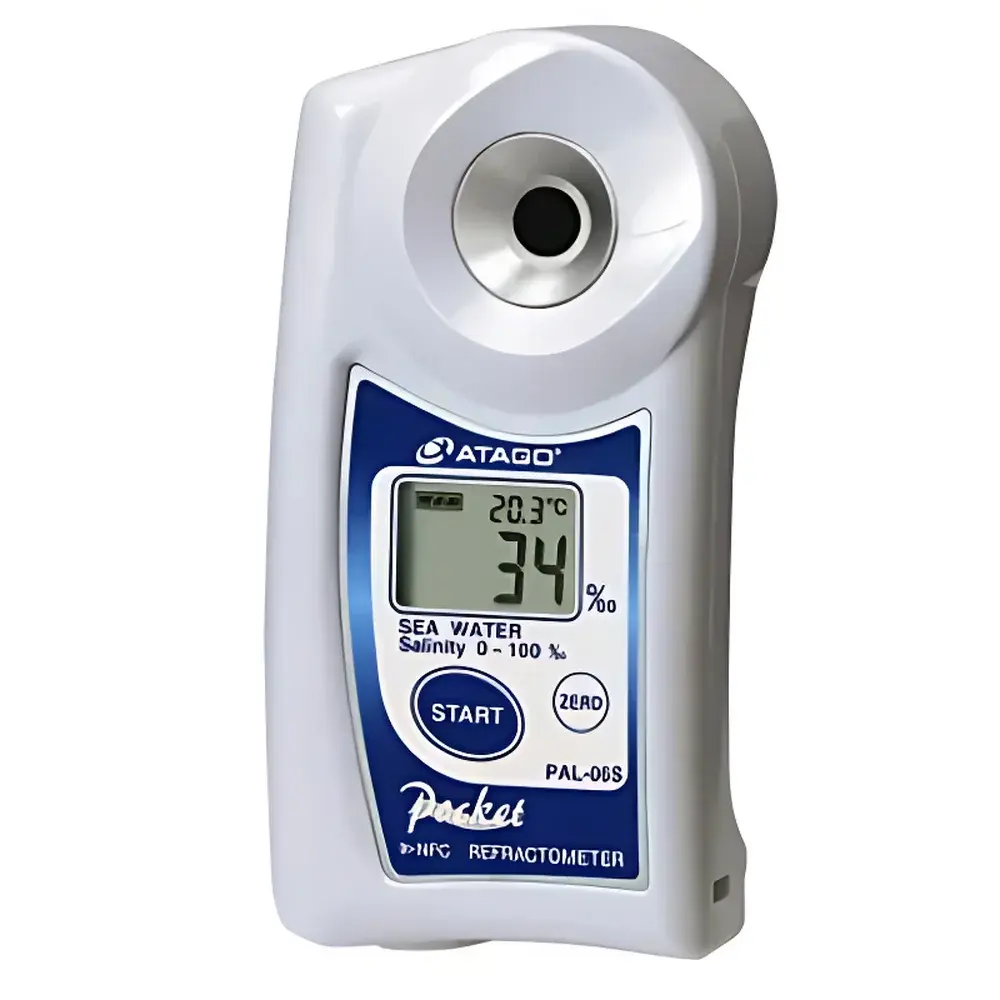
ATAGO PAL-06S Seawater Salinometer (‰)
| Brand | ATAGO |
|---|---|
| Origin | Japan |
| Model | PAL-06S Seawater Salinometer (‰) |
| Measurement Range | 0–100 ‰ (g/100 g) |
| Accuracy | ±2 ‰ |
| Temperature Compensation | Automatic (ATC), 10–40 °C |
| Response Time | ≤3 seconds |
| Display | Digital LCD |
| Principle | Refractometry |
Overview
The ATAGO PAL-06S Seawater Salinometer is a handheld, optical refractometer engineered for rapid, field-deployable quantification of salinity in aqueous salt solutions. It operates on the fundamental principle of refractive index measurement: as dissolved sodium chloride (and other ionic species) increases in solution, the refractive index rises predictably and linearly within defined concentration and temperature bounds. The instrument correlates this optical property to mass-based salinity expressed in parts per thousand (‰, g/100 g), calibrated specifically for seawater and high-salinity brines. Unlike conductivity-based meters—whose readings are sensitive to ion composition—the PAL-06S provides consistent results across NaCl-dominant matrices including natural seawater, artificial marine aquarium water, de-icing brines, and food-grade salt solutions. Its compact, rugged housing and absence of consumables or external power requirements make it suitable for routine QC checks aboard research vessels, coastal monitoring stations, aquaculture facilities, and industrial brine preparation lines.
Key Features
- Optical refractometry platform with precision Abbe-type prism and LED illumination for stable, drift-free measurements
- Digital LCD display with automatic backlighting for readability under variable ambient lighting conditions
- Automatic Temperature Compensation (ATC) across 10–40 °C using integrated thermistor, eliminating manual correction and reducing operator error
- Measurement range of 0–100 ‰ (g/100 g) with stated accuracy of ±2 ‰, validated against NIST-traceable NaCl reference standards
- Single-drop sample requirement (approx. 0.3 mL); minimal sample volume reduces waste and enables analysis of precious or limited-volume specimens
- Robust anodized aluminum body rated IP65 for dust and water resistance; designed for repeated handling in humid, saline environments
- No batteries required for basic operation—powered solely by ambient light via photodiode circuitry (optional CR2032 battery powers backlight and data hold function)
Sample Compatibility & Compliance
The PAL-06S is optimized for transparent, non-turbid, non-viscous aqueous solutions where NaCl constitutes the dominant solute. It delivers reliable results for natural seawater (typically 33–37 ‰), hypersaline lagoons (>40 ‰), road de-icing brines (20–25 ‰), and pickling or fermentation brines. It is not intended for use with emulsions, suspensions, glycerol-based antifreezes, or highly colored solutions (e.g., concentrated algal extracts), which may scatter light and compromise refractive index correlation. While not certified to ISO/IEC 17025, the device conforms to the optical measurement principles outlined in ASTM D1141 (Standard Practice for the Preparation of Substitute Ocean Water) and supports GLP-aligned documentation when paired with ATAGO’s optional data logging accessories. Calibration verification using certified 0 ‰ and 35 ‰ NaCl standards is recommended before each daily use per laboratory quality control protocols.
Software & Data Management
The PAL-06S operates as a standalone analog-optical instrument without embedded firmware or wireless connectivity. However, its digital output can be manually recorded into LIMS or Excel-based tracking systems. For traceable workflows, ATAGO offers the PAL-06S-DC version (sold separately), which includes a USB interface and proprietary LogMaster software for time-stamped data export, calibration history archiving, and statistical process control (SPC) chart generation. All exported data comply with audit trail requirements under FDA 21 CFR Part 11 when used with validated software configurations and user access controls. No cloud synchronization or remote diagnostics are supported—data sovereignty and network isolation are preserved by design.
Applications
- Oceanographic fieldwork: real-time salinity profiling during CTD casts or surface sampling
- Aquaculture management: monitoring salinity stability in shrimp hatcheries, oyster nurseries, and recirculating aquaculture systems (RAS)
- Marine aquarium maintenance: verifying synthetic seawater preparation and top-off water compatibility
- Winter road operations: verifying concentration of CaCl₂ or NaCl brines prior to anti-icing application
- Food processing QA: validating brine strength for cheese curing, vegetable fermentation, and meat preservation
- Environmental remediation: assessing halide contamination in groundwater or effluent streams near coastal industrial sites
FAQ
Does the PAL-06S measure electrical conductivity or total dissolved solids (TDS)?
No. It measures refractive index and converts it to mass-based salinity (‰). Conductivity and TDS require separate instrumentation.
Can it be used for freshwater with very low salinity (<1 ‰)?
Yes, but resolution is reduced below 2 ‰; for sub-ppm chloride detection, ion-selective electrodes or titration methods are recommended.
Is calibration performed with distilled water only?
Zero-point calibration uses distilled or deionized water at ambient temperature; span calibration requires a certified NaCl standard matching expected use range (e.g., 35 ‰ for marine work).
How often should the prism surface be cleaned?
After every sample—using lens tissue and reagent-grade ethanol or isopropanol—to prevent salt crystallization and optical degradation.
Does ATC compensate for all ionic compositions equally?
ATC corrects for temperature-induced refractive index shifts in NaCl–H₂O systems. Significant deviations occur with KCl-, MgCl₂-, or CaCl₂-rich solutions; consult ATAGO’s application notes for correction factors.




