
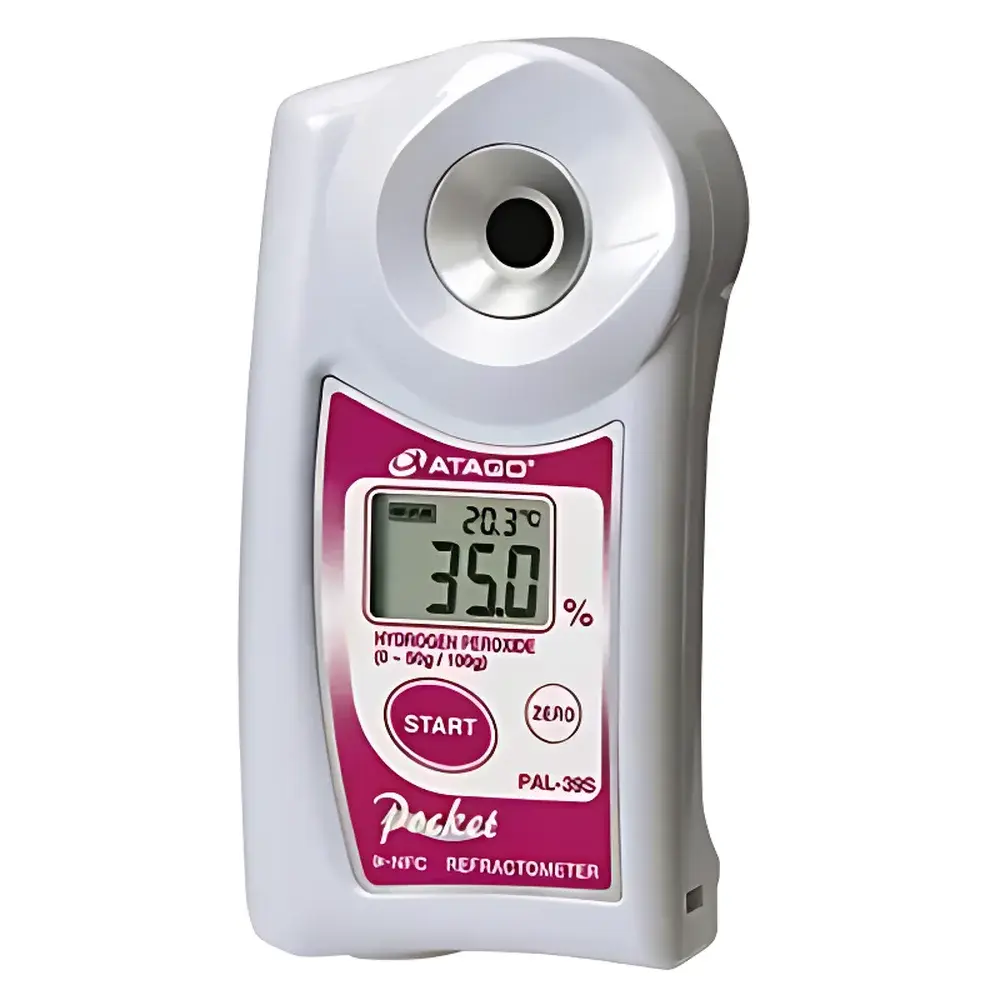
ATAGO PAL-39S Digital Handheld Refractometer for Hydrogen Peroxide Concentration Measurement
| Brand | ATAGO |
|---|---|
| Origin | Japan |
| Model | PAL-39S |
| Product Type | Portable Refractometer |
| Temperature Control | Yes (Automatic Temperature Compensation) |
| Digital Display | Yes |
| Measurement Range | 0.0 to 50.0% H₂O₂ (w/w) |
| Resolution | 0.2% |
| Accuracy | ±0.6% |
| Sample Volume | 0.3 mL |
| Measurement Time | 3 seconds |
| Operating Ambient Temperature | 10–35°C |
| Measured Sample Temperature Range | 10–75°C |
| Power Supply | 2 × AAA batteries |
| IP Rating | IP65 |
| Dimensions | 55(W) × 31(D) × 109(H) mm |
| Weight | 100 g (instrument only) |
Overview
The ATAGO PAL-39S is a precision-engineered handheld digital refractometer specifically calibrated for the rapid, on-site quantification of hydrogen peroxide (H₂O₂) concentration in aqueous solutions. It operates on the fundamental optical principle of critical-angle refractometry: light passing through a sample undergoes refraction at the prism-sample interface, and the resulting critical angle correlates directly with the solution’s refractive index. Since H₂O₂ exhibits a well-characterized, linear relationship between refractive index and mass concentration (w/w %) across the 0.0–50.0% range, the PAL-39S employs factory-calibrated algorithms to convert measured refractive index into displayed H₂O₂ concentration—without chemical reagents or consumables. Designed for industrial hygiene and process control environments, it delivers traceable, repeatable measurements in under three seconds, enabling real-time verification of disinfectant strength, rinse validation, and cleaning-in-place (CIP) solution integrity.
Key Features
- Optical measurement principle ensures non-destructive, reagent-free analysis—no titration, no colorimetric kits, no calibration drift from chemical degradation.
- Integrated automatic temperature compensation (ATC) over 10–75°C sample temperature range, referencing the standard 20°C calibration point per ISO 21748 and ASTM D1218 guidelines.
- Rugged, IP65-rated enclosure with sealed optical path—resistant to dust ingress and low-pressure water jets, suitable for humid, washdown-intensive food processing zones.
- Minimal sample requirement of just 0.3 mL enables testing of limited-volume samples (e.g., swab eluates, rinse water aliquots) without dilution or waste.
- High-contrast LCD with backlight ensures legibility under variable lighting conditions—from ambient plant floor illumination to low-light storage areas.
- Battery-powered operation (2 × AAA) supports continuous field use for >5,000 measurements per set; auto-power-off preserves battery life during idle periods.
Sample Compatibility & Compliance
The PAL-39S is validated for direct measurement of H₂O₂ in purified water, deionized water, and low-viscosity aqueous matrices commonly encountered in food safety and pharmaceutical manufacturing. It is routinely deployed for verifying residual H₂O₂ levels post-sanitization of packaging materials (e.g., PET bottles, aseptic cartons), conveyor belts, fill nozzles, and sterile transfer hoods. While not intended for highly turbid, viscous, or strongly colored solutions (e.g., undiluted bleach concentrates or protein-laden rinsates), its performance meets the practical accuracy requirements outlined in FDA Food Code Annex 3–301.12 for sanitizer concentration verification and aligns with ISO 15190:2022 recommendations for point-of-use instrument suitability in laboratory-adjacent quality control workflows.
Software & Data Management
As a standalone optical instrument, the PAL-39S does not incorporate onboard data logging or Bluetooth/Wi-Fi connectivity. However, its design facilitates seamless integration into structured quality management systems: measurement results are visually confirmed and manually transcribed into electronic batch records (EBRs) or paper-based logbooks compliant with 21 CFR Part 11 when paired with appropriate procedural controls (e.g., dual-operator verification, timestamped entries). The device’s stable calibration and documented metrological traceability to NIST-traceable refractive index standards support audit readiness for GLP, GMP, and SQF-certified facilities. Calibration verification using certified H₂O₂ reference standards (e.g., 5.0%, 15.0%, 30.0% w/w) is recommended prior to each shift or after exposure to extreme thermal cycling.
Applications
- Verification of H₂O₂ concentration in sterilant solutions used in aseptic filling lines and packaging sterilization tunnels.
- Routine monitoring of H₂O₂ residuals on food contact surfaces following vapor-phase or liquid-phase sanitization cycles.
- Concentration control of H₂O₂-based cleaning agents in CIP systems for dairy, beverage, and ready-to-eat production lines.
- Process validation support for H₂O₂ dilution stations—ensuring accurate preparation of working-strength disinfectants from bulk stock solutions.
- Cross-application utility in metalworking fluid management: monitoring dilution ratios of cutting oils, forming lubricants, and rust inhibitors where refractive index correlates with concentrate concentration.
FAQ
Does the PAL-39S require periodic recalibration by the user?
No—its optical system is factory-calibrated and sealed. Users perform daily verification using ATAGO’s certified H₂O₂ standard solutions (sold separately); full recalibration is performed only by authorized ATAGO service centers.
Can the PAL-39S measure H₂O₂ in ethanol-based solutions?
No. The calibration curve is specific to aqueous H₂O₂ systems. Ethanol or other organic solvents alter the refractive index–concentration relationship and invalidate readings.
Is the instrument compliant with ISO/IEC 17025 requirements for testing laboratories?
While the PAL-39S itself is not accredited, its metrological characteristics (accuracy, resolution, ATC performance) and documented calibration traceability enable laboratories to establish method validation per ISO/IEC 17025:2017 Clause 7.2.2 when incorporated into a validated SOP.
What maintenance is required to ensure long-term optical accuracy?
Wipe the sapphire prism surface with lens tissue and isopropyl alcohol after each use; avoid abrasive cleaners or excessive pressure. Store in the supplied protective case with desiccant to prevent moisture-induced haze.
How does automatic temperature compensation (ATC) function in practice?
An integrated thermistor continuously monitors sample temperature at the prism interface and applies a proprietary correction algorithm derived from empirical H₂O₂ refractive index vs. temperature data—eliminating manual correction tables and reducing operator error.





