
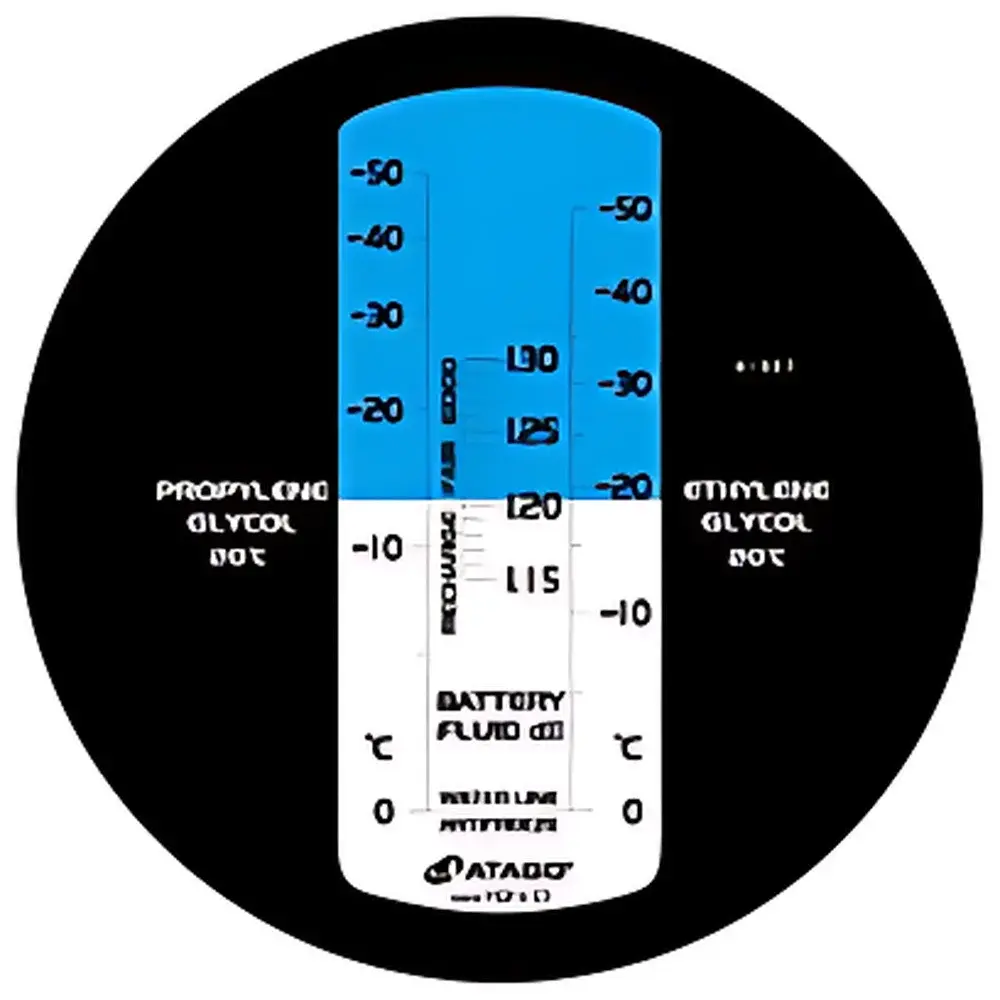
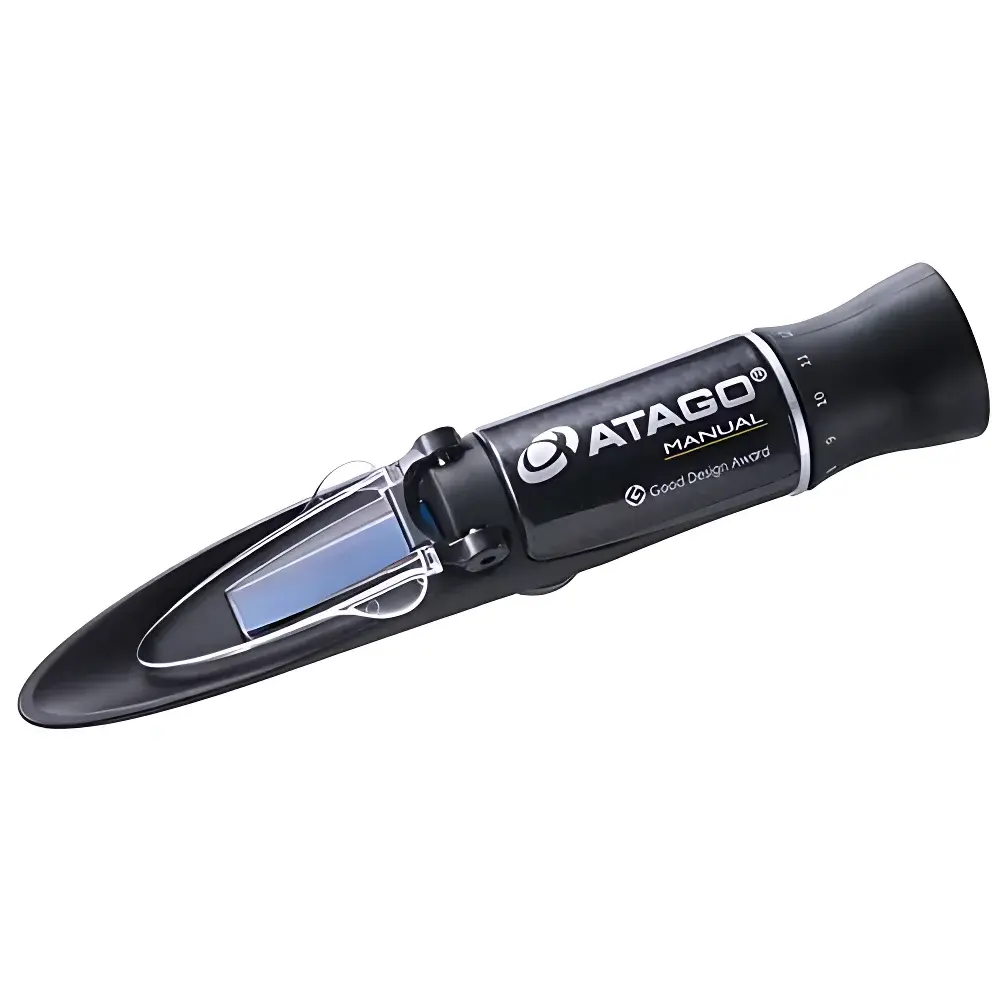
ATAGO MASTER-BC Analog Handheld Refractometer for Battery Electrolyte, Ethylene Glycol & Propylene Glycol Freeze Point Measurement
| Brand | ATAGO |
|---|---|
| Origin | Japan |
| Model | MASTER-BC |
| Type | Analog (Scale-Reading) Handheld Refractometer |
| Measurement Range | Battery Electrolyte Density (d₂₀/₂₀): 1.150–1.300 |
| Ethylene Glycol Freeze Point | 0 to –50 °C |
| Propylene Glycol Freeze Point | 0 to –50 °C |
| Resolution | ±5 °C (EG/PG), ±0.01 (Electrolyte Density) |
| Dimensions | 3.2 × 3.4 × 16.8 cm |
| Weight | 90 g |
Overview
The ATAGO MASTER-BC is a precision-engineered analog handheld refractometer designed specifically for rapid, field-deployable assessment of battery electrolyte concentration and antifreeze solutions used in automotive, industrial, and energy storage applications. Operating on the fundamental principle of total internal reflection, the instrument measures the refractive index of transparent liquid samples—directly correlating to solute concentration via empirically calibrated scales. Unlike digital or temperature-compensated models, the MASTER-BC employs optical Abbe-type optics with fixed, engraved dual-scale dials optimized for two critical operational parameters: (1) specific gravity of sulfuric acid-based battery electrolyte (d₂₀/₂₀ from 1.150 to 1.300), and (2) freeze point depression of ethylene glycol (EG) and propylene glycol (PG) aqueous solutions across a validated range of 0 °C to –50 °C. Its scale-based readout requires no batteries or electronic components, ensuring operational reliability in harsh environments—including engine bays, battery service bays, cold storage facilities, and mobile maintenance units—where electromagnetic interference, dust, or moisture may compromise digital instrumentation.
Key Features
- Optically calibrated dual-scale eyepiece with high-contrast etched graduations for simultaneous visual interpretation of battery electrolyte density and glycol freeze point
- Compact, ergonomic aluminum-alloy body (90 g) engineered for one-handed operation and long-term mechanical stability
- No power source required—fully passive optical measurement system compliant with intrinsic safety requirements in hazardous locations
- Temperature-independent scale design optimized for ambient use between 10 °C and 30 °C; consistent performance without active temperature compensation circuitry
- Robust prism assembly featuring BK7 optical glass with anti-scratch coating and integrated sample well for controlled 0.1–0.2 mL volume application
- Factory-calibrated using NIST-traceable reference standards; calibration verification possible with distilled water (RI = 1.3330 at 20 °C)
Sample Compatibility & Compliance
The MASTER-BC is validated for use with clear, non-turbid, non-viscous aqueous solutions including sulfuric acid electrolytes (15–40 wt% H₂SO₄), ethylene glycol/water mixtures (up to 60 vol%), and propylene glycol/water formulations (up to 60 vol%). It is not suitable for opaque, suspended-particle-laden, highly viscous, or volatile organic solvents. While the device itself carries no CE, UKCA, or FDA certification (as it is a Class I passive optical instrument under MDR 2017/745 and IEC 61010-1), its measurement methodology aligns with ASTM D1120 (Standard Test Method for Freeze Point of Engine Coolants), SAE J1087 (Coolant Concentration Testing), and ISO 21780:2020 (Road Vehicles — Coolant Specifications). Users performing quality control in regulated environments (e.g., OEM service centers, battery recycling facilities, or Tier-1 automotive suppliers) may incorporate MASTER-BC readings into documented test procedures compliant with ISO/IEC 17025:2017 when paired with defined sampling protocols and operator training records.
Software & Data Management
As a purely analog optical instrument, the MASTER-BC does not feature embedded software, data logging, Bluetooth connectivity, or computer interface capabilities. All measurements are recorded manually by the operator into paper-based logbooks, LIMS entries, or electronic maintenance management systems (CMMS). This architecture eliminates concerns related to firmware validation, cybersecurity vulnerabilities, or 21 CFR Part 11 electronic record integrity—making it inherently compatible with GLP and GMP documentation workflows where handwritten entries with dated, signed, and witnessed annotations are standard practice. For laboratories requiring traceable digital archiving, users may integrate the MASTER-BC into broader QA systems by photographing scale readings with timestamped, geo-tagged mobile devices—provided such practices are pre-approved in internal SOPs.
Applications
- Routine verification of lead-acid battery state-of-charge and sulfation risk through electrolyte density profiling across cell banks
- Field validation of coolant mixture ratios in automotive, heavy-duty truck, and rail traction systems prior to winter deployment
- Preventive maintenance screening of HVAC chiller glycol loops to ensure minimum freeze protection thresholds are maintained
- Quality assurance checks during antifreeze blending operations in chemical distribution centers and coolant packaging lines
- Educational demonstrations of colligative properties (freezing point depression) in university physics and chemistry laboratories
- On-site diagnostics for solar thermal system fluid integrity and freeze protection compliance in distributed energy installations
FAQ
Does the MASTER-BC require periodic recalibration?
Yes—annual verification against certified reference fluids (e.g., distilled water for RI baseline, or certified EG standard solutions) is recommended per ATAGO’s technical bulletin TB-REF-02. Recalibration must be performed by authorized service centers using optical alignment jigs and certified light sources.
Can it measure methanol or glycerol-based antifreezes?
No—the engraved scales are empirically derived only for ethylene glycol and propylene glycol aqueous systems. Methanol and glycerol exhibit different refractive index–concentration relationships and will yield inaccurate freeze point estimates.
Is the instrument suitable for use with lithium-ion battery electrolytes?
No—commercial Li-ion electrolytes (e.g., LiPF₆ in EC/DMC) are organic solvent blends with low refractive index contrast and high volatility; they are incompatible with the MASTER-BC’s optical design and safety specifications.
What is the typical measurement repeatability under controlled conditions?
When operated by trained personnel using standardized droplet application and focus technique, the MASTER-BC demonstrates ±0.002 RI units repeatability (equivalent to ±0.01 d₂₀/₂₀ or ±2 °C freeze point uncertainty) across three consecutive readings.
How should the prism surface be cleaned between measurements?
Use lint-free optical tissue moistened with distilled water or isopropyl alcohol (≥99%), followed by immediate drying with a second dry tissue. Avoid abrasive cleaners, acetone, or ultrasonic baths which may damage the prism coating.





