
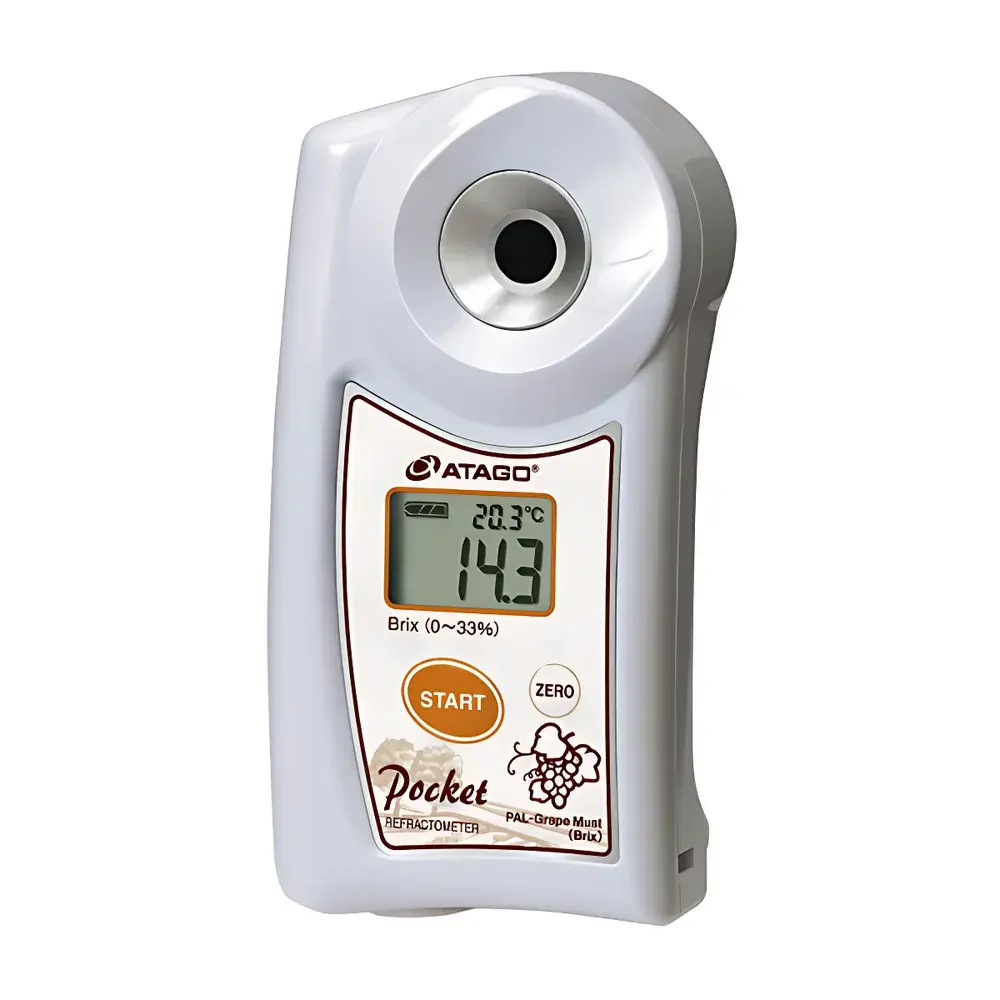
ATAGO PAL-Grape Must Digital Portable Refractometer for Grape Must Brix Measurement
| Brand | ATAGO |
|---|---|
| Origin | Japan |
| Model | PAL-Grape Must |
| Measurement Range | 0.0–33.0% Brix |
| Resolution | 0.1% Brix |
| Accuracy | ±0.2% Brix |
| Temperature Compensation Range | 10–40°C (Automatic) |
| Measurement Time | 3 seconds |
| Power Supply | 2 × AAA batteries |
| IP Rating | IP65 |
| Dimensions | 55(W) × 31(D) × 109(H) mm |
| Weight | 100 g (body only) |
Overview
The ATAGO PAL-Grape Must is a compact, handheld digital refractometer engineered specifically for rapid and reliable Brix measurement of grape must—unfermented grape juice prior to alcoholic fermentation. It operates on the principle of optical refraction: when light passes through a liquid sample placed on the sapphire-coated prism, the degree of light bending correlates directly with dissolved solids concentration, expressed as % Brix (sucrose-equivalent weight/weight). Unlike laboratory-grade benchtop refractometers, the PAL-Grape Must integrates automatic temperature compensation (ATC) across 10–40°C, eliminating manual correction and ensuring field-deployable accuracy under variable ambient conditions. Its design targets winemaking workflows—from vineyard sampling during véraison to must evaluation at receiving stations—where speed, repeatability, and ruggedness are critical. The instrument conforms to standard refractometric methodology per ISO 2173:2003 (fruit and vegetable products — determination of soluble solids content — refractometric method), and supports routine quality control in accordance with winery HACCP plans and ISO 22000-aligned production protocols.
Key Features
- Optimized optical path with high-stability sapphire prism for long-term calibration integrity and resistance to scratching or chemical etching from acidic grape must.
- ELI (Enhanced Light Immunity) system actively filters ambient light interference, enabling stable readings even under direct sunlight or fluorescent lighting—critical for outdoor vineyard use.
- One-touch START operation with 3-second measurement cycle; results display simultaneously as Brix value and sample temperature.
- IP65-rated enclosure ensures full protection against dust ingress and low-pressure water jets—enabling safe rinsing of the prism with distilled water post-measurement without disassembly.
- Zero calibration using distilled or deionized water completed in ≤3 seconds; no proprietary calibration solutions required.
- Low-power consumption design with auto-off after 3 minutes of inactivity; powered by two standard AAA batteries (approx. 10,000 measurements per set).
Sample Compatibility & Compliance
The PAL-Grape Must is validated for direct measurement of clarified or turbid grape must—including varieties such as Cabernet Sauvignon, Chardonnay, and Pinot Noir—without filtration or dilution. Its 0.0–33.0% Brix range covers typical must concentrations from early harvest (18–22% Brix) to overripe or late-harvest fruit (up to 30%+ Brix). While optimized for grape must, it remains applicable to other fruit juices (e.g., apple, pear, peach) and sugar-containing liquids where Brix serves as a proxy for soluble solids. The device meets CE marking requirements for portable optical instrumentation and complies with IEC 61010-1 for electrical safety. Its measurement traceability aligns with national metrological standards maintained by Japan’s National Metrology Institute (NMIJ), and its performance is verified per ATAGO’s internal QA protocol QM-RF-002 (Refractometer Verification Standard).
Software & Data Management
The PAL-Grape Must is a standalone, firmware-based instrument with no Bluetooth, USB, or cloud connectivity. All operations—including zero calibration, measurement initiation, and unit display—are managed via a single tactile START button and an integrated LCD. While it does not generate digital logs or export data, its consistent repeatability (CV < 0.15% within-run, n = 10) supports manual entry into electronic lab notebooks (ELNs) or LIMS systems compliant with 21 CFR Part 11 when paired with documented SOPs. For traceability, users may record instrument ID (engraved on housing), calibration date, operator initials, and environmental conditions alongside each reading—practices aligned with GLP and GMP documentation expectations for raw material acceptance testing.
Applications
- Vineyard maturity assessment: Real-time Brix monitoring during pre-harvest sampling to determine optimal picking windows.
- Must intake verification: Rapid screening of incoming grape lots at winery crush pads to confirm contractual sugar specifications.
- Fermentation readiness evaluation: Pre-yeast inoculation Brix checks to estimate potential alcohol yield (using standard conversion factors, e.g., 1°Brix ≈ 0.55% v/v ethanol).
- Quality assurance in juice concentrate production and fruit processing facilities handling grape-derived intermediates.
- Educational use in enology and food science laboratories for teaching fundamental principles of refractometry and sugar quantification.
FAQ
Is the PAL-Grape Must suitable for measuring fermented wine?
No. This instrument is calibrated exclusively for unfermented grape must. Ethanol, CO₂, and microbial activity alter refractive index behavior, invalidating Brix-to-sugar correlation in fermented samples.
Can I use tap water for zero calibration?
No. Only distilled or deionized water (conductivity < 5 µS/cm) must be used to ensure accurate baseline establishment.
Does the device require annual recalibration by an authorized service center?
ATAGO recommends verification against NIST-traceable sucrose standards every 12 months or after 5,000 measurements—whichever occurs first—to maintain measurement confidence.
What does the IP65 rating mean in practical field use?
It certifies complete dust-tightness and resistance to water projected from a nozzle (6.3 mm) at low pressure (30 kPa) from any direction—allowing safe cleaning of the prism surface with a gentle stream of distilled water without risk of internal damage.
How does automatic temperature compensation (ATC) function?
An integrated thermistor continuously monitors sample temperature at the prism interface and applies a polynomial correction algorithm derived from the known temperature-Brix relationship of aqueous sucrose solutions, referenced to 20°C per ISO 2173.





