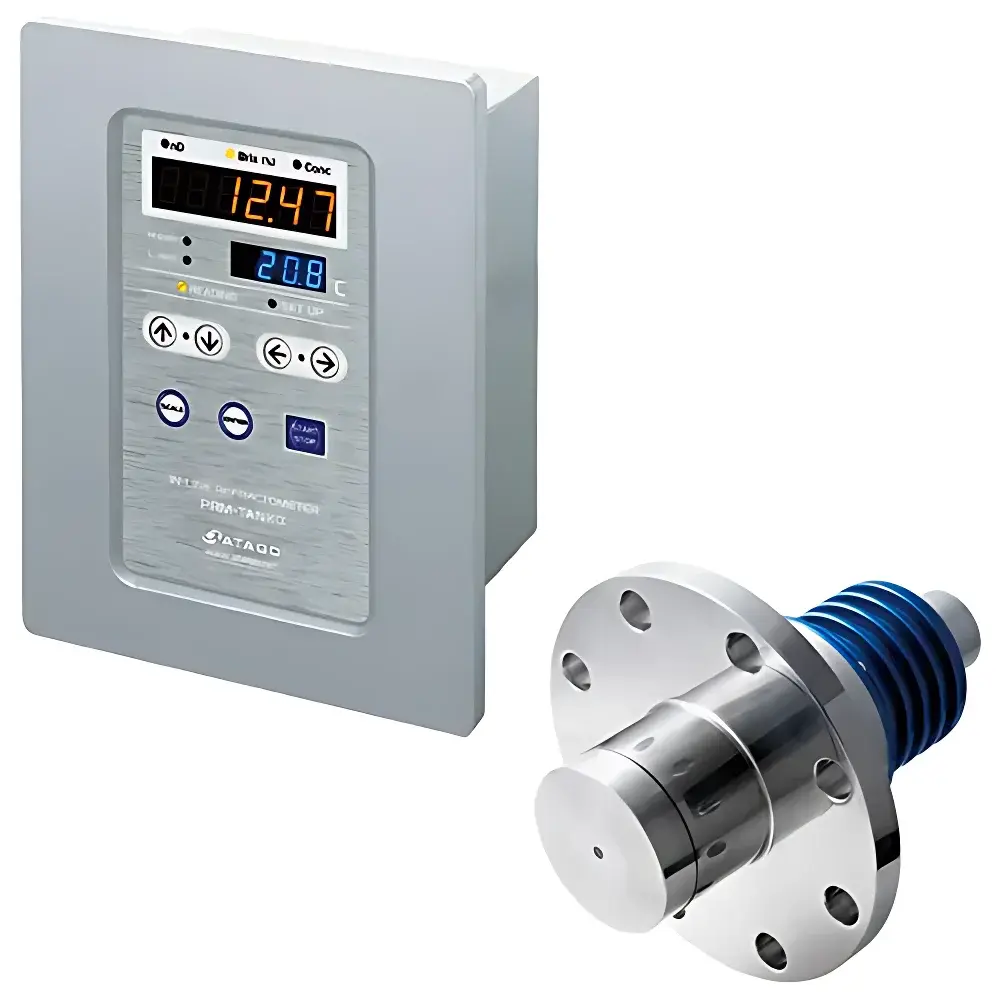
ATAGO PRM-TANKα Online Refractometer (In-Line Wall-Mounted for Refractive Index & Brix Measurement)
| Brand | ATAGO |
|---|---|
| Origin | Japan |
| Model | PRM-TANKα |
| Measuring Range | nD 1.31700–1.51000 |
| Resolution | nD 0.0001 or 0.00001 (selectable), Brix 0.1 or 0.01% (selectable) |
| Accuracy | ±0.0001 nD, ±0.1% Brix |
| Operating Temperature | 5–100°C |
| Light Source | LED |
| Output | Alarm (open-collector), RS-232C, 4–20 mA analog |
| Power Supply | AC 100–240 V, 50/60 Hz |
| Power Consumption | 30 VA |
| Pressure Rating | 1.0 MPa (measuring section) |
| Prism Material | Synthetic Sapphire |
| Sealing Materials | FEP/PTFE O-rings, SUS316 prism stage |
| Ingress Protection | IP66/IP67 (sensor), IP65 (display unit) |
| Standard Cable Length | 15 m (extendable up to 200 m) |
| Dimensions & Weight | Sensor 25 × 29.73 × 25 cm / 12.3 kg, Display Unit 19.2 × 10 × 24 cm / 3.3 kg |
Overview
The ATAGO PRM-TANKα Online Refractometer is an industrial-grade, wall-mounted process refractometer engineered for continuous, non-invasive measurement of refractive index (nD) and Brix concentration in liquid streams within tanks, reactors, mixers, fermenters, extractors, condensers, and filtration vessels. Based on the fundamental optical principle of critical angle refraction, the instrument employs a high-stability LED light source and a synthetic sapphire prism interface mounted directly onto the vessel wall—eliminating the need for flow cells, bypass loops, or intrusive sampling. This design ensures real-time, in-situ monitoring without disrupting process integrity, minimizing maintenance downtime and avoiding cross-contamination risks. The PRM-TANKα operates across a wide temperature range (5–100°C) and withstands process pressures up to 1.0 MPa, making it suitable for demanding applications in food & beverage, pharmaceutical, chemical, and bio-processing industries where regulatory compliance, repeatability, and long-term stability are mission-critical.
Key Features
- Wall-mounted sapphire prism sensor with zero-flow-path configuration—enables direct installation on stainless steel or glass vessel walls without process interruption.
- High-precision optical detection with selectable resolution: refractive index to 0.00001 nD and Brix to 0.01%, supporting both routine QC and high-fidelity process optimization.
- Robust mechanical architecture: pressure-rated (1.0 MPa), IP66/IP67-rated sensing head, and chemically inert wetted materials—including synthetic sapphire prism, FEP/PTFE sealing elements, and SUS316 contact surfaces—ensuring compatibility with aggressive solvents, acids, alkalis, and high-solids slurries.
- Integrated dual-output interface: isolated 4–20 mA analog signal for PLC/DCS integration and RS-232C serial communication for configuration, data logging, and remote diagnostics.
- Configurable alarm outputs (open-collector) with independent upper/lower limit thresholds—supporting automated shutdown, valve actuation, or batch termination protocols per SOP-defined setpoints.
- Modular design with 15 m standard interconnect cable (field-extendable to 200 m), allowing physical separation of the explosion-safe display unit from hazardous or high-temperature zones.
Sample Compatibility & Compliance
The PRM-TANKα is validated for homogeneous aqueous solutions, syrups, wort, mash, fermentation broths, fruit juices, dairy concentrates, and cleaning-in-place (CIP) rinse waters. It is not intended for opaque suspensions, emulsions with unstable droplet size distribution, or highly viscous media (>10,000 cP) without prior validation. The instrument complies with IEC 60529 (IP ratings), IEC 61000-6-2/6-3 (EMC immunity/emission), and meets mechanical safety requirements per ISO 13857. While not intrinsically safe certified, its low-power LED optics and galvanically isolated outputs support use in Zone 2/Class I, Div 2 environments when installed per local electrical codes. For regulated environments, the device supports audit-ready operation when paired with compliant SCADA or MES systems—data traceability, user access control, and change history can be implemented at the host system level per FDA 21 CFR Part 11 and EU Annex 11 expectations.
Software & Data Management
The PRM-TANKα operates autonomously with embedded firmware; no proprietary PC software is required for basic operation. Configuration—including measurement units (nD, %Brix, or custom concentration curves), temperature compensation algorithms (linear or polynomial), alarm thresholds, and output scaling—is performed via front-panel keypad or RS-232 command protocol (ATAGO’s documented ASCII command set). All configuration changes are stored in non-volatile memory with timestamped event logging. Raw analog outputs feed directly into DCS historian databases (e.g., DeltaV, Siemens Desigo, Yokogawa CENTUM VP), enabling trend analysis, SPC charting, and correlation with other process variables (pH, temperature, conductivity). Optional calibration certificate documentation (traceable to NIST or JCSS standards) is available upon request and includes as-found/as-left data, uncertainty budgets, and environmental conditions during verification.
Applications
- Fermentation monitoring: Real-time tracking of sugar depletion and ethanol accumulation in beer, wine, and bioethanol production.
- Extraction & concentration: Control of juice evaporation endpoints, herbal extract density, and syrup brix stabilization in thermal concentrators.
- Pharmaceutical manufacturing: In-process verification of buffer preparation, API crystallization mother liquor concentration, and cleaning solution strength during CIP validation.
- Food processing: Consistency control in jam, ketchup, and sauce blending; inline verification of brine concentration in pickling lines.
- Chemical synthesis: Monitoring of reaction mixture density shifts during esterification, polymerization, or neutralization steps.
- Wastewater treatment: Estimating organic load (as soluble solids) in anaerobic digester influent or membrane bioreactor permeate streams.
FAQ
Can the PRM-TANKα be installed on insulated or lined tanks?
Yes—provided the liner material is optically transparent (e.g., glass-lined steel or clear fluoropolymer) and bonded without air gaps. Installation requires verification of refractive index mismatch between liner and process fluid to avoid signal attenuation.
Is temperature compensation automatic or configurable?
The instrument applies real-time, built-in temperature compensation using a Pt100 RTD sensor embedded in the prism housing. Users may select between factory-default polynomial algorithms or input custom coefficients for non-aqueous systems.
What maintenance is required for long-term accuracy?
No routine recalibration is needed under stable operating conditions. However, periodic prism cleaning with deionized water and lint-free wipes is recommended after exposure to sticky or particulate-laden fluids. A full verification against certified reference standards is advised annually or after mechanical shock.
Does the device support Modbus or Profibus communication?
No—the native protocol is RS-232C ASCII. Modbus RTU or TCP conversion requires an external protocol gateway configured by the system integrator.
Can the PRM-TANKα measure alcohol content directly?
Not natively—it reports refractive index and Brix. Alcohol concentration must be derived via secondary correlation models (e.g., OIML-based tables or lab-validated regression equations) implemented in the host control system.