
ATAGO PAL-pH Micro-volume pH Meter
| Brand | ATAGO |
|---|---|
| Origin | Japan |
| Model | PAL-pH |
| Instrument Type | Portable |
| Parameter Type | Single-parameter (pH) |
| Measurement Range | 0.00–14.00 pH |
| Resolution | 0.01 pH |
| Accuracy | ±0.10 pH |
| Precision | ±0.1 pH |
| Sample Volume | 0.6 mL |
| Electrode Type | Flat-surface glass electrode with integrated reference |
| Temperature Compensation Range | 10.0–40.0 °C |
| Power Supply | 2 × AAA alkaline batteries |
| Dimensions | 5.5 × 3.1 × 10.9 cm |
| Weight | 100 g (main unit only) |
| Catalog No. | 4311 |
Overview
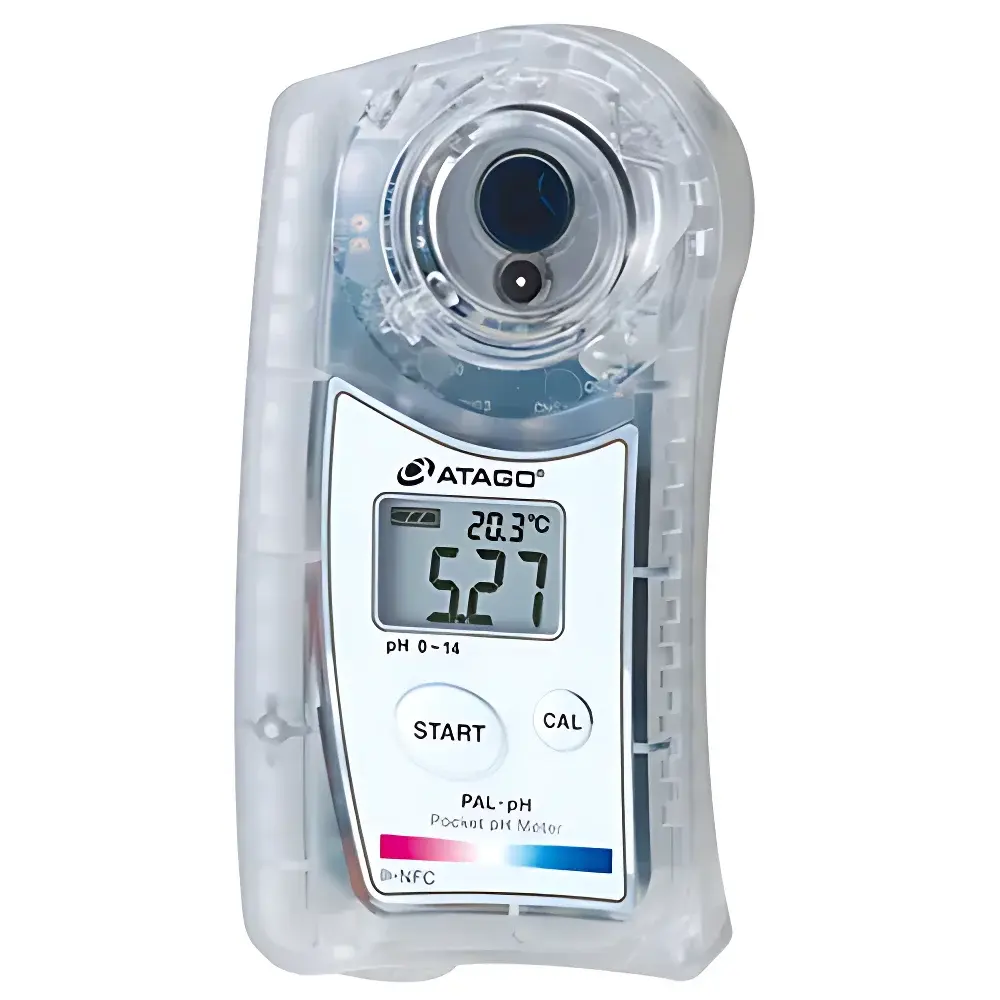
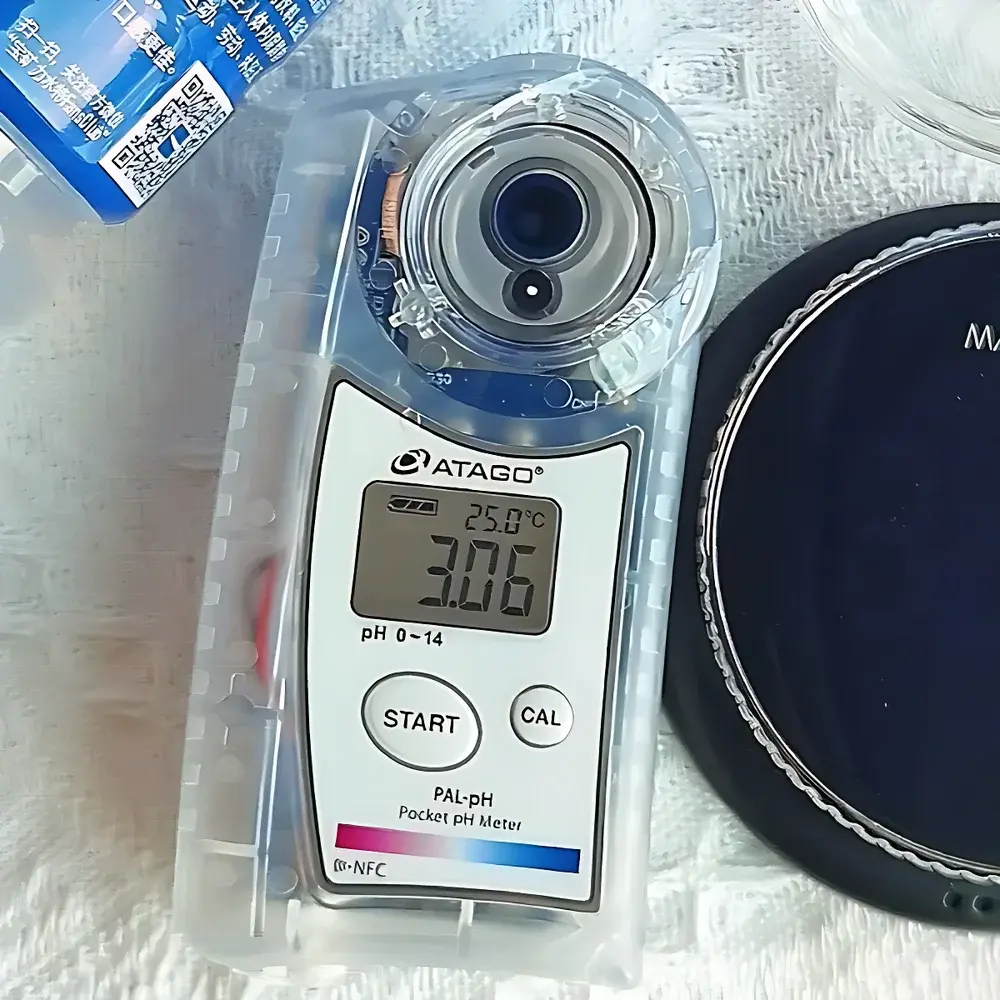
The ATAGO PAL-pH is a precision-engineered, handheld micro-volume pH meter designed for laboratories and field applications where sample conservation, rapid measurement, and operational robustness are critical. Unlike conventional pH meters relying on fragile spherical glass electrodes, the PAL-pH integrates a proprietary flat-surface glass electrode—mechanically reinforced to withstand up to 5 kg of static load—eliminating susceptibility to chipping or cracking during routine handling or cleaning. This architecture enables reliable electrochemical potential measurement via the Nernst equation while maintaining high reproducibility across repeated measurements. The instrument operates on a standard two-point calibration protocol using included pH 4.01, 6.86, and 9.18 buffer solutions, and features automatic temperature compensation (ATC) within 10.0–40.0 °C to correct for thermal drift in liquid junction potential and electrode response slope. Its compact form factor (5.5 × 3.1 × 10.9 cm, 100 g) and dual AAA battery operation support extended portability without compromising metrological integrity.
Key Features
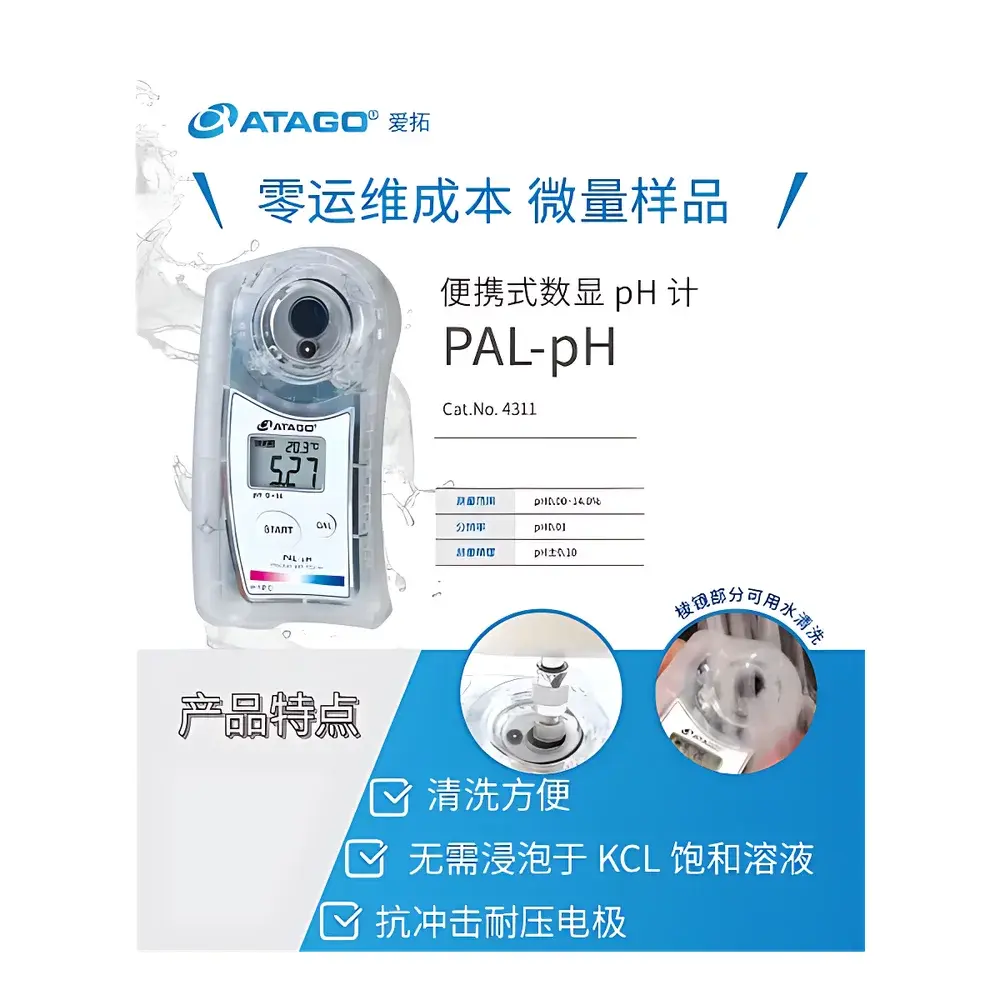
- Flat-surface glass electrode with integrated solid-state reference system—no external KCl filling solution required, eliminating maintenance downtime and electrolyte leakage risks.
- Ultra-low sample requirement: only 0.6 mL per measurement, minimizing reagent consumption and enabling analysis of precious or volume-limited biological, pharmaceutical, or clinical specimens.
- No pre-soaking needed: electrode activation requires only 20 minutes in deionized water prior to first use—streamlining startup procedures in regulated environments.
- High mechanical durability: flat electrode geometry resists physical damage during wiping, rinsing, or contact with container walls—extending service life beyond conventional bulb-type sensors.
- Onboard ATC with thermistor-based sensing ensures real-time correction of pH readings across physiologically and industrially relevant temperature ranges (10.0–40.0 °C).
- Calibration verification log accessible via front-panel interface supports GLP-compliant recordkeeping in QA/QC workflows.
Sample Compatibility & Compliance
The PAL-pH is validated for aqueous and mildly buffered solutions typical in life science, food, environmental, and pharmaceutical applications—including cell culture media, fermentation broths, urine, serum dilutions, beverage concentrates, and wastewater effluents. It complies with ISO 3696 (Grade 3 water specifications for calibration), ASTM E70 (Standard Test Method for pH of Aqueous Solutions with the Glass Electrode), and supports alignment with FDA 21 CFR Part 11 requirements when used in conjunction with documented calibration logs and user-accessible audit trails. While not intrinsically certified for hazardous area use, its sealed housing meets IP65-rated ingress protection against dust and low-pressure water jets—suitable for cleanroom-adjacent or production-floor deployment.
Software & Data Management
The PAL-pH operates as a standalone instrument with no embedded Bluetooth or USB connectivity; data output is limited to real-time LCD display (0.01-pH resolution, ±0.10-pH accuracy). However, its calibration history, date/time stamping (manual entry), and buffer recognition logic facilitate manual transcription into LIMS or ELN systems. For laboratories requiring electronic records, integration is achieved via standardized manual logging protocols aligned with ISO/IEC 17025 documentation frameworks. Firmware updates are not field-upgradable; device performance remains stable over its operational lifetime under normal storage and usage conditions.
Applications
- Biomedical research: Monitoring pH stability in small-volume enzyme assays, microdialysate samples, and organoid culture media where evaporation or contamination must be minimized.
- Pharmaceutical QC: Verifying pH of ophthalmic solutions, injectables, and lyophilized reconstitution buffers per USP and EP 2.2.3 guidelines.
- Food & beverage R&D: Tracking acidification kinetics in yogurt starter cultures or vinegar maturation using sub-milliliter aliquots.
- Environmental testing: Field-deployable screening of surface water, leachates, or soil extracts where transport of large sample volumes is impractical.
- Academic teaching labs: Demonstrating fundamental electrochemistry principles with reduced consumable costs and enhanced student safety due to minimal chemical exposure.
FAQ
Does the PAL-pH require electrode soaking before initial use?
No. Activation is performed by immersing the flat electrode in deionized water for 20 minutes—no saturated KCl storage solution is necessary.
Can the PAL-pH measure non-aqueous or high-viscosity samples?
It is optimized for aqueous solutions with conductivity ≥200 µS/cm. Measurements in organic solvents, oils, or glycerol-rich matrices are not recommended due to unstable junction potentials and slow response times.
Is the instrument compliant with Good Laboratory Practice (GLP) documentation standards?
Yes—when used with controlled calibration procedures, dated buffer logs, and traceable operator entries, it satisfies core GLP data integrity expectations for non-automated instruments.
What is the expected service life of the integrated electrode?
Under typical laboratory use (≤10 measurements/day, proper rinsing with DI water between samples), the electrode maintains specification compliance for ≥24 months.
How often should calibration be performed?
ATAGO recommends daily two-point calibration for routine QC work; single-point verification is acceptable for stable process monitoring when drift is empirically confirmed to remain within ±0.05 pH over 8-hour shifts.




