
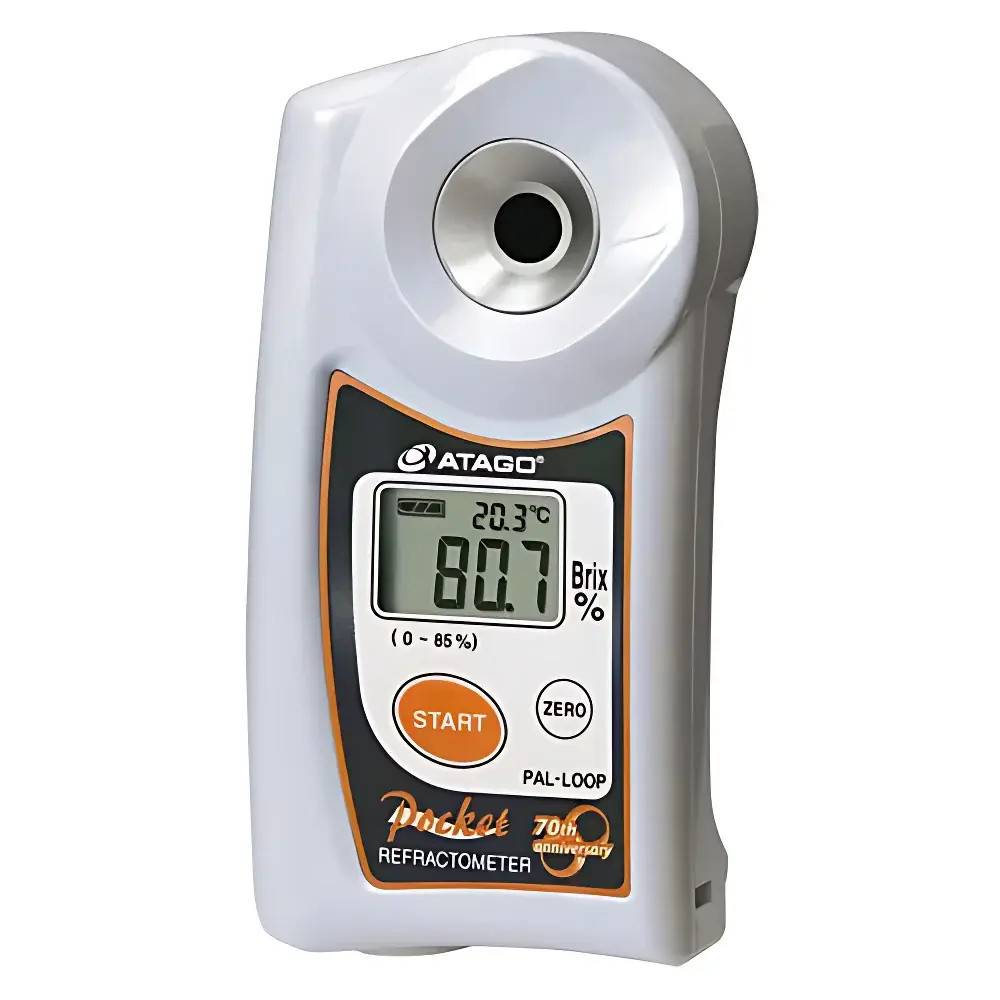
ATAGO PAL-LOOP Continuous-Mode Digital Handheld Refractometer
| Brand | ATAGO |
|---|---|
| Origin | Japan |
| Model | PAL-LOOP |
| Measurement Range | Brix 0.0–85.0% |
| Resolution | 0.1% Brix |
| Accuracy | ±0.2% Brix |
| Measurement Time | 3 s (Standard Mode), 1 s (Continuous Mode) |
| Temperature Compensation | Automatic, 10–75°C |
| Operating Ambient | 10–40°C |
| IP Rating | IP65 |
| Power | 2 × AAA batteries |
| Dimensions | 55(W) × 31(D) × 109(H) mm |
| Weight | 100 g (host only) |
| Measurement Modes | Standard (single-shot) and Continuous (real-time streaming) |
Overview
The ATAGO PAL-LOOP Continuous-Mode Digital Handheld Refractometer is an optical instrument engineered for rapid, repeatable, and field-deployable refractive index-based concentration analysis in industrial and laboratory environments. It operates on the principle of critical angle measurement of total internal reflection at the prism-sample interface, converting refractive index into Brix (% w/w sucrose equivalent) using a calibrated polynomial algorithm traceable to NIST-referenced sucrose standards. Unlike traditional handheld refractometers limited to single-point measurements, the PAL-LOOP integrates real-time analog-to-digital conversion and embedded microprocessor control to enable continuous sampling at 1 Hz frequency—ideal for monitoring dynamic processes such as inline blending, batch homogenization, or evaporative concentration. Its compact form factor, IP65-rated enclosure, and battery-powered operation support use in production floors, cold rooms, cleanrooms, and mobile quality control stations without external power or PC dependency.
Key Features
- Two operational modes: Standard mode for discrete sample verification and Continuous mode for time-series Brix tracking with live display refresh every second
- Automatic temperature compensation (ATC) across 10–75°C, utilizing a high-stability thermistor integrated within the sapphire prism assembly to minimize thermal drift
- Optical system based on a precision-ground sapphire prism (refractive index >1.76) ensuring long-term calibration stability and resistance to chemical abrasion from acidic, alkaline, or solvent-based samples
- High-contrast LCD with backlight for readability under variable lighting conditions, including low-illumination factory settings
- Robust mechanical architecture compliant with IEC 60529 IP65: dust-tight and protected against water jets from any direction—suitable for washdown environments
- No external software or drivers required; all firmware, calibration, and mode switching managed via intuitive tactile button interface
Sample Compatibility & Compliance
The PAL-LOOP accommodates aqueous solutions and miscible organic mixtures where refractive index correlates linearly or predictably with solute concentration—including fruit juices, soft drinks, syrups, soy sauce, vinegar, glycol-based antifreeze, metalworking coolants, and alkaline cleaning agents. It is not intended for strongly scattering, highly viscous (>1000 mPa·s), or heterogeneous suspensions without prior filtration. While not certified for regulated GMP manufacturing, its measurement repeatability (≤±0.1% Brix intra-unit CV) and documented calibration traceability align with routine QC requirements under ISO 21748 and ASTM D1218 guidelines for refractometric analysis. The device supports GLP-compliant documentation when paired with external logging via optional RS-232 output (available on PAL-LOOP-RS variant).
Software & Data Management
The base PAL-LOOP model operates autonomously without connectivity; however, data recording is enabled through manual transcription or optional serial interface modules. For traceable workflows, users may integrate the unit with third-party SCADA or LIMS platforms via ASCII protocol over RS-232 (baud rate 9600, 8N1). Firmware updates and custom calibration curve loading require ATAGO’s proprietary WinCT-Refracto software (Windows-only), which supports multi-point validation reports, user-defined tolerance bands, and export to CSV/Excel formats. Audit trails, electronic signatures, and 21 CFR Part 11 compliance are achievable only when deployed within validated IT infrastructure—not inherent to the standalone instrument.
Applications
- Real-time Brix monitoring during juice concentration and evaporation stages in beverage processing lines
- Quick verification of sugar content in confectionery syrups and dairy-based desserts pre-packaging
- Concentration control of cutting fluids and quenching oils in CNC machining facilities
- Routine QC checks for glycol concentration in HVAC antifreeze loops and automotive coolant systems
- Field-based assessment of ripeness in orchard harvesting operations using portable fruit sap sampling
- Lab-scale formulation development for emulsions, sauces, and functional beverages requiring tight Brix tolerances
FAQ
Does the PAL-LOOP require recalibration before each use?
No—factory calibration remains stable for 12 months under normal operating conditions. Users should verify calibration daily using distilled water (0.0% Brix) and a certified 10.0% sucrose standard before critical measurements.
Can the PAL-LOOP measure non-sugar solutes like sodium chloride or ethylene glycol?
It reports values in % Brix units only. For non-sucrose solutes, users must apply empirically derived conversion factors or use ATAGO’s dedicated models (e.g., MASTER-Salinity for NaCl, PAL-Coolant for glycols).
Is temperature compensation active during continuous measurement mode?
Yes—ATC is continuously applied in both Standard and Continuous modes, ensuring accuracy across the full 10–75°C sample temperature range.
What maintenance is required for long-term reliability?
Wipe the sapphire prism with lens tissue and isopropyl alcohol after each use; avoid abrasive cleaners. Store with protective cap in a dry, ambient-temperature environment. Battery replacement is recommended every 6–12 months depending on usage frequency.
Is the PAL-LOOP compliant with FDA or EU regulatory frameworks?
The instrument itself carries CE marking (2014/30/EU EMC Directive) but is not classified as a medical device or in vitro diagnostic. Its use in regulated industries depends on site-specific validation per ISO/IEC 17025 or internal SOPs.




