
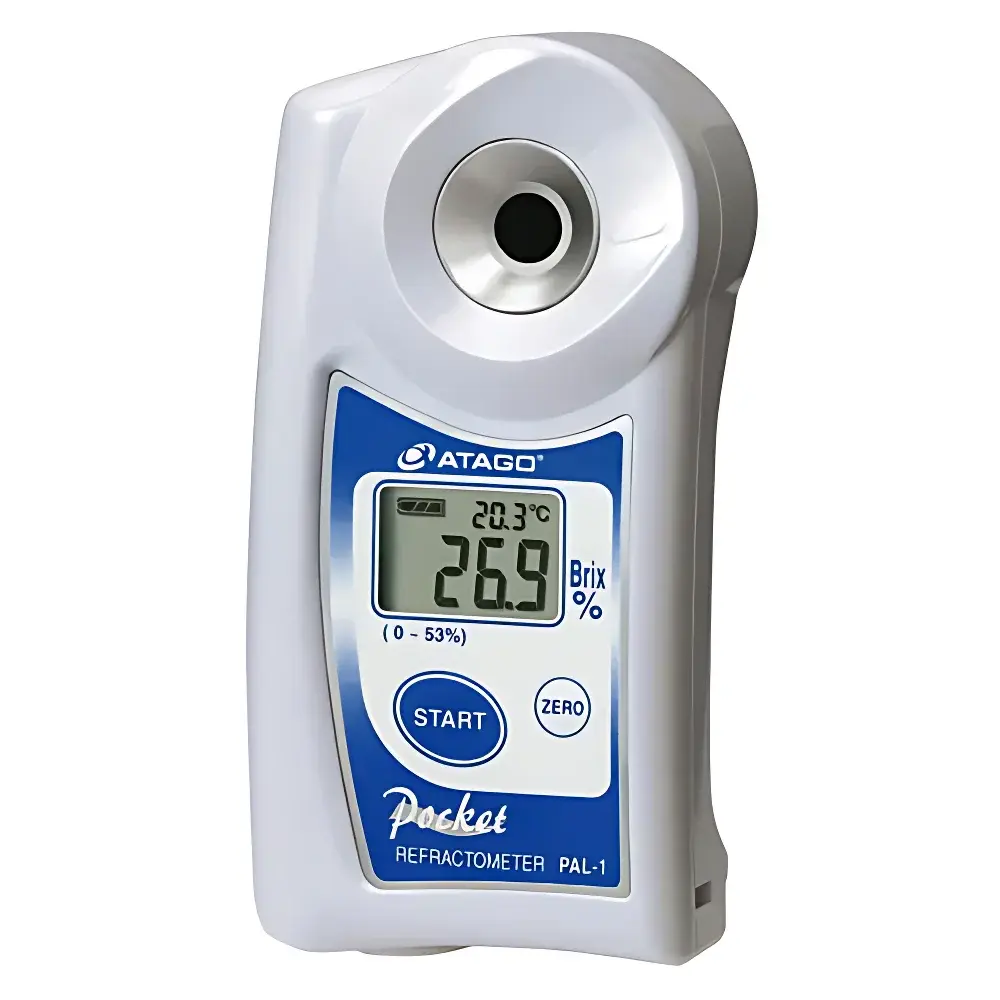
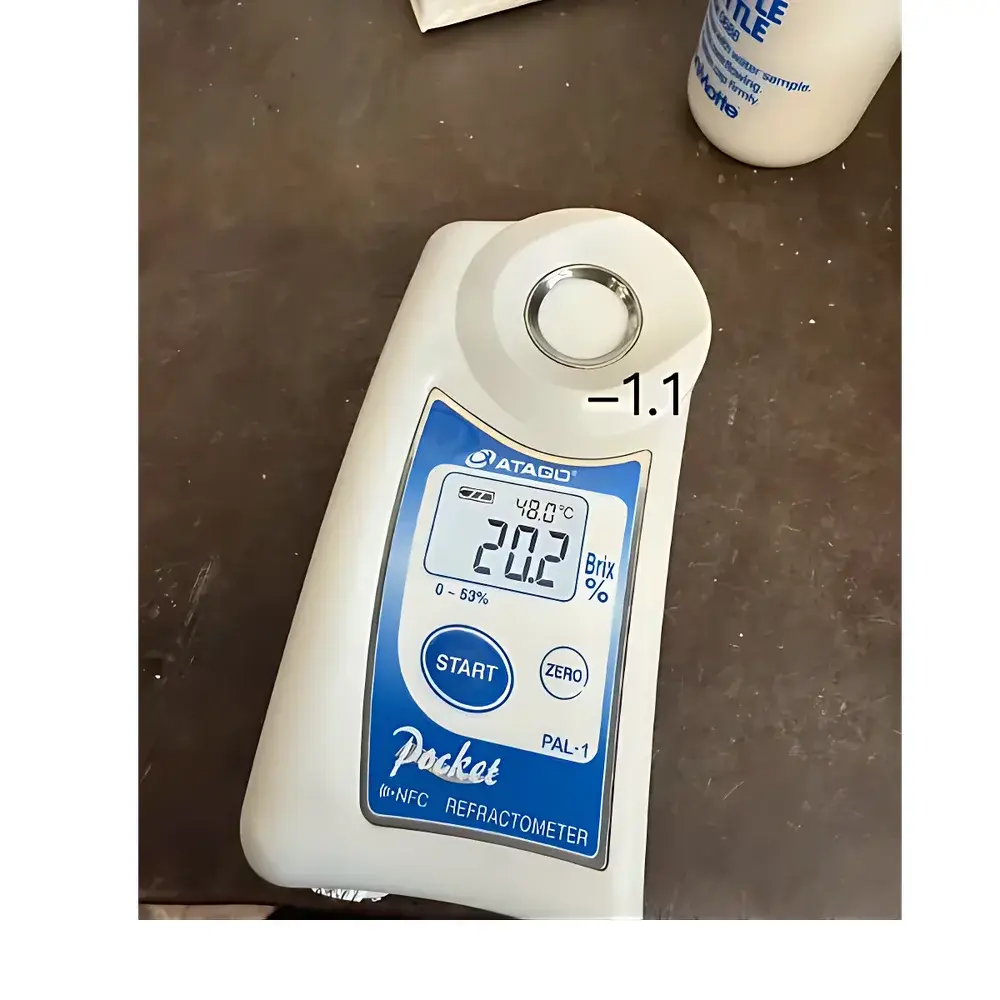
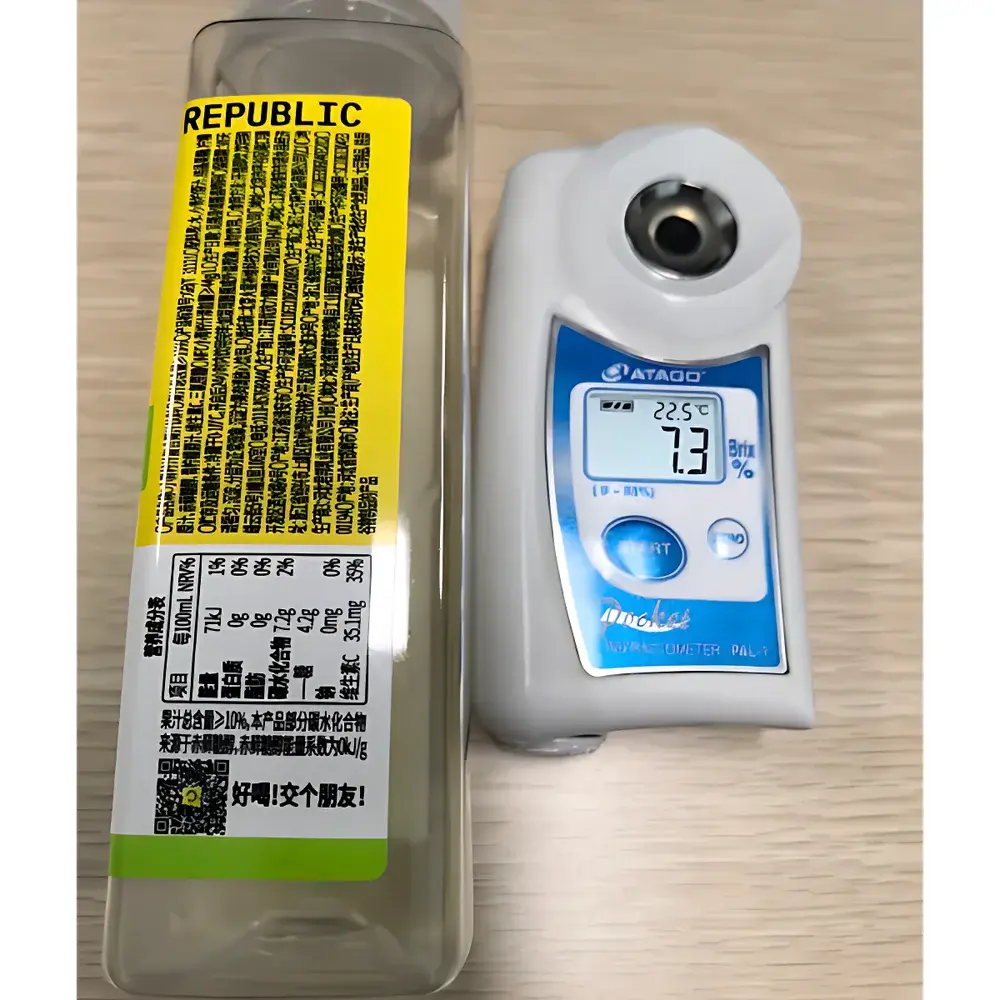
ATAGO PAL-1 Portable Digital Refractometer for Liquid Soluble Solids (Brix)
| Brand | ATAGO |
|---|---|
| Origin | Japan |
| Model | PAL-1 |
| Measurement Range | 0.0–53.0% Brix |
| Accuracy | ±0.2% Brix |
| Resolution | 0.1% Brix |
| Temperature Compensation | Automatic (ATC, 10–100°C) |
| Display | Digital LCD |
| Protection Rating | IP65 |
| Power | 2 × AAA batteries |
| Dimensions | 5.5 × 3.1 × 10.9 cm |
| Weight | 100 g (instrument only) |
| Sample Compatibility | Aqueous solutions with refractive index correlation to soluble solids concentration |
| Compliance | HACCP-aligned design, suitable for GLP-supported environments |
Overview
The ATAGO PAL-1 Portable Digital Refractometer is an optical measurement instrument engineered for rapid, field-deployable quantification of soluble solids concentration—expressed as Brix (% w/w)—in liquid samples. It operates on the fundamental principle of critical-angle refractometry: incident light passes through a high-precision sapphire prism in contact with the sample; changes in the sample’s refractive index—directly correlated to dissolved solute concentration—are detected by a linear photodiode array and converted into a digital Brix reading via factory-calibrated algorithms. With measurement completion in under three seconds and no requirement for external power sources or temperature stabilization equipment, the PAL-1 delivers consistent, operator-independent results across variable ambient conditions. Its compact architecture, robust mechanical design, and absence of moving parts ensure long-term stability and minimal maintenance—critical attributes for routine use in production lines, field agriculture, quality control laboratories, and mobile inspection units.
Key Features
- High-speed digital measurement: Full Brix readout within ≤3 seconds after sample application
- Automatic Temperature Compensation (ATC): Real-time correction across 10–100°C sample temperature range using integrated thermistor, eliminating manual correction tables
- Digital LCD display with 0.1% Brix resolution and ±0.2% Brix accuracy (traceable to NIST-traceable sucrose standards)
- IP65-rated enclosure: Dust-tight and protected against low-pressure water jets—enabling reliable operation in humid, washdown, or outdoor environments
- ELI (External Light Interference) suppression system: Optical shielding and ambient-light-rejecting sensor design ensures stable readings under direct sunlight or fluorescent lighting
- Lightweight portable form factor (100 g) with ergonomic grip and one-handed operation—optimized for extended field use
- No calibration fluids required beyond standard sucrose reference solutions; single-point calibration supported via ATAGO’s certified calibration kit (optional)
Sample Compatibility & Compliance
The PAL-1 is validated for aqueous solutions where refractive index exhibits a monotonic, reproducible relationship with total soluble solids—including sucrose, glucose, fructose, sodium chloride, glycols, and common industrial coolants. It is not intended for strongly scattering, highly viscous (>100 mPa·s), or volatile organic solvent-based samples without prior validation. The instrument conforms to operational requirements aligned with HACCP principles and supports Good Manufacturing Practice (GMP) and Good Laboratory Practice (GLP) workflows through documented calibration traceability, operator identification logging (via companion mobile app), and audit-ready data export. While not FDA 21 CFR Part 11–certified as a standalone device, its data output—when captured via ATAGO’s official Bluetooth/NFC-enabled software—is compatible with validated LIMS and electronic batch record systems under client-defined procedural controls.
Software & Data Management
Data acquisition and traceability are enabled via optional wireless connectivity (NFC or Bluetooth 4.2 LE) to iOS and Android platforms using ATAGO’s free “Refractometer Assistant” application. This software permits timestamped measurement logging, sample ID annotation, batch grouping, statistical summary generation (mean, SD, min/max), and CSV export compliant with ISO/IEC 17025 documentation requirements. All stored records include embedded metadata: instrument serial number, ambient temperature, measurement time, and user-defined tags—facilitating full chain-of-custody compliance in regulated environments. Firmware updates and calibration verification reports are distributed directly through the application, ensuring continuous alignment with ATAGO’s latest metrological specifications.
Applications
- Agriculture & Horticulture: Rapid assessment of fruit ripeness (e.g., mango, grape, citrus) via Brix profiling to determine optimal harvest timing and post-harvest grading
- Food & Beverage Processing: In-line monitoring of juice concentration, syrup density, jam consistency, dairy whey solids, and beverage formulation consistency
- Aquaculture & Fisheries: Salinity and nutrient solution verification in hatchery tanks and recirculating aquaculture systems (RAS)
- Industrial Maintenance: Coolant concentration verification in metalworking fluids, antifreeze/glycol dilution checks in HVAC and automotive systems
- Pharmaceutical Excipients: Quick verification of sugar-based excipient solutions during oral liquid formulation development
- Research & Education: Teaching tool for optical property–composition relationships in physical chemistry and food science curricula
FAQ
What does “ATC” mean in the PAL-1 specification?
ATC stands for Automatic Temperature Compensation—a built-in thermistor continuously measures sample temperature and applies real-time correction to the refractive index reading based on the known thermal coefficient of the calibration medium (typically aqueous sucrose).
Can the PAL-1 measure non-sugar solutions such as saltwater or ethylene glycol?
Yes—provided the user selects the appropriate scale mode (e.g., NaCl % or Glycol %) and validates linearity against reference standards; factory default is Brix, but multi-scale firmware versions are available.
Is cleaning required between measurements?
Yes—residual sample must be removed from the prism surface using lens tissue and distilled water or recommended cleaning solvent; residual film causes drift and measurement error.
Does the PAL-1 require annual recalibration?
Calibration frequency depends on usage intensity and regulatory context; ATAGO recommends verification before each shift in production environments and formal recalibration every 6–12 months using certified reference standards.
How is measurement uncertainty determined for the PAL-1?
Total uncertainty includes contributions from instrument repeatability (±0.1% Brix), temperature compensation fidelity (±0.05% Brix), and operator technique (±0.05% Brix), yielding a combined expanded uncertainty of ±0.2% Brix (k=2) under controlled conditions.




