
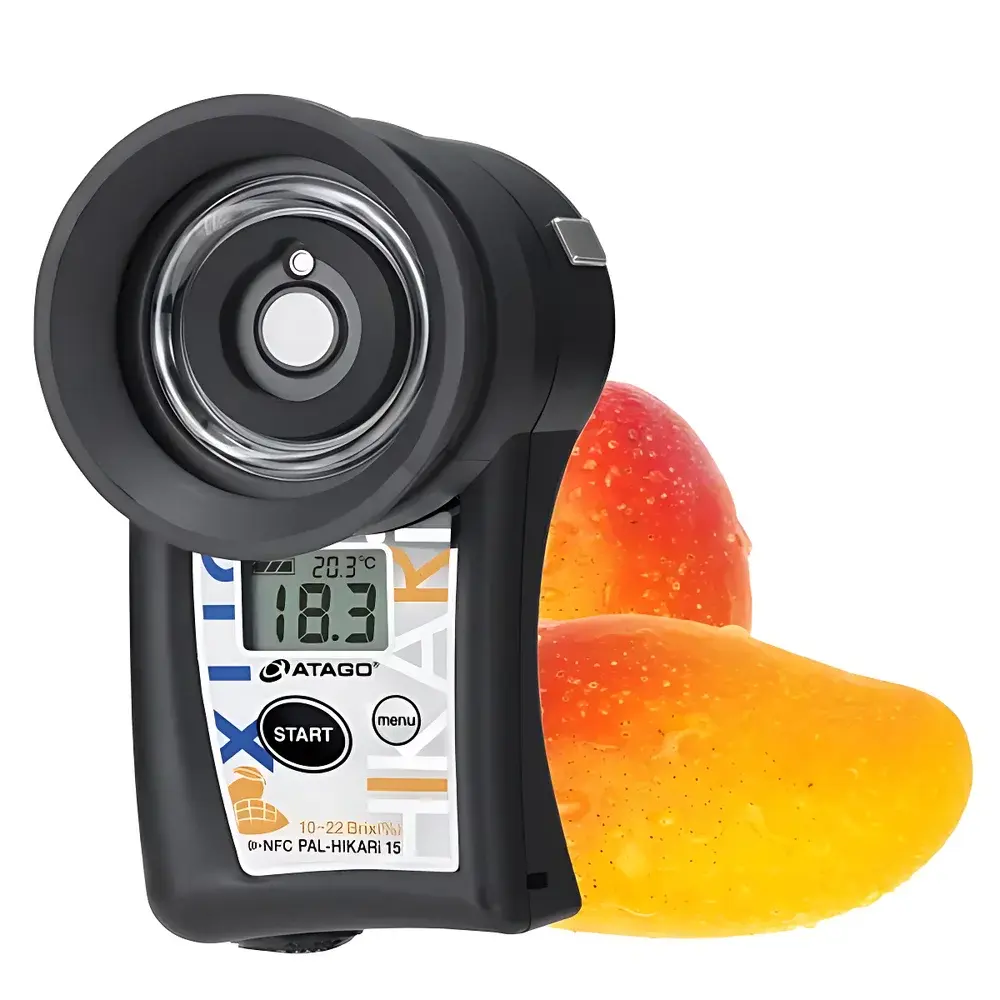
ATAGO PAL-HIKARi 15 Non-Destructive Mango Saccharimeter
| Brand | ATAGO |
|---|---|
| Origin | Japan |
| Model | PAL-HIKARi 15 (Mango) |
| Instrument Type | Non-Destructive |
| Measurement Principle | Near-Infrared (NIR) Absorption Spectroscopy |
| Measuring Range | 10.0–22.0 °Brix |
| Accuracy | ±1.5 °Brix (varies with mango cultivar and ambient conditions) |
| Resolution | 0.1 °Brix |
| Automatic Temperature Compensation | 10.0–35.0 °C |
| IP Rating | IP64 |
| Power Supply | Two AAA alkaline batteries |
| Dimensions (L×W×H) | 6.1 × 4.4 × 11.5 cm |
| Weight | 120 g (instrument only) |
Overview
The ATAGO PAL-HIKARi 15 Non-Destructive Mango Saccharimeter is a handheld, portable optical instrument engineered for rapid, in-situ quantification of soluble solids content (SSC), expressed as degrees Brix (°Brix), directly on intact mango fruit. Unlike conventional refractometers requiring juice extraction or destructive sampling, the PAL-HIKARi 15 employs near-infrared (NIR) absorption spectroscopy at optimized wavelengths to penetrate the epidermis and assess sugar concentration non-invasively. This principle relies on the characteristic absorption bands of C–H and O–H bonds in sucrose, glucose, and fructose within the 700–1100 nm spectral region. The device is calibrated specifically for mango cultivars—including Keitt, Tommy Atkins, Kent, and Chaunsa—accounting for skin thickness, chlorophyll interference, and typical flesh density variations. Its optical architecture incorporates a stabilized LED light source, precision photodetector array, and embedded spectral filtering to ensure measurement repeatability under field or packinghouse conditions.
Key Features
- True non-destructive operation: no fruit harvesting, skin puncture, or tissue removal required—enabling longitudinal monitoring of ripening on the tree or post-harvest shelf-life tracking;
- Cultivar-specific calibration: factory pre-calibrated for major commercial mango varieties, minimizing cross-variety bias in Brix estimation;
- Integrated automatic temperature compensation (ATC): dynamically corrects readings across 10.0–35.0 °C ambient range, critical for tropical orchard deployment;
- Rugged industrial design: IP64-rated enclosure resists dust ingress and water splashing, suitable for humid greenhouse, field, or wet packing-line environments;
- Low-power operation: powered by two standard AAA alkaline batteries, supporting >5,000 measurements per set under typical usage;
- Ergonomic form factor: compact dimensions (6.1 × 4.4 × 11.5 cm) and 120 g mass enable one-handed operation during orchard scouting or quality audits.
Sample Compatibility & Compliance
The PAL-HIKARi 15 is validated exclusively for intact, mature mango fruits with smooth, unblemished skin surfaces and minimal surface moisture. It is not intended for use on immature fruit, cracked or sunburned specimens, or fruits coated with waxes, pesticides, or post-harvest films that attenuate NIR transmission. While not certified to ISO 2173 (fruit juice Brix determination) due to its non-extractive methodology, the instrument aligns with Good Agricultural Practice (GAP) and Good Manufacturing Practice (GMP) frameworks for harvest timing decisions and lot segregation. Its measurement protocol supports traceable internal quality control documentation when paired with ATAGO’s optional data logging accessories compliant with FDA 21 CFR Part 11 audit trail requirements.
Software & Data Management
The PAL-HIKARi 15 operates as a standalone instrument with no onboard memory or Bluetooth connectivity. However, it is fully compatible with ATAGO’s optional PAL-Log software suite (Windows-based) via USB-C interface adapter (sold separately). PAL-Log enables batch export of timestamped Brix values, statistical summary generation (mean, SD, min/max per lot), and CSV/Excel-compatible reporting. All exported datasets retain instrument serial number, measurement date/time, and user-defined lot ID—facilitating integration into LIMS or ERP systems used by export-certified packhouses. Firmware updates are distributed through ATAGO’s global technical support portal and require no hardware modification.
Applications
- Orchard maturity assessment: determining optimal harvest windows based on real-time SSC trends across canopy zones;
- Post-harvest quality grading: sorting mango lots by sugar content prior to ripening treatment or cold storage;
- Varietal breeding programs: high-throughput phenotyping of sugar accumulation kinetics without compromising fruit integrity;
- Export compliance verification: pre-shipment checks aligned with destination market Brix thresholds (e.g., EU Regulation (EC) No 1221/2008 for mango imports);
- Research applications: correlating non-destructive Brix with ethylene evolution, firmness decay, or volatile organic compound profiles in controlled atmosphere studies.
FAQ
Can the PAL-HIKARi 15 be used on fruits other than mangoes?
No—the optical calibration and algorithm are optimized exclusively for mango skin morphology and spectral response; using it on apples, citrus, or grapes will yield unreliable results.
Does surface moisture affect measurement accuracy?
Yes—excess condensation or rainwater must be gently blotted before measurement; residual moisture causes scattering and erroneous low-Brix readings.
Is periodic recalibration required?
ATAGO recommends annual verification against NIST-traceable sucrose reference standards (10.0, 15.0, and 20.0 °Brix) using the optional PAL-Check calibration kit.
What is the minimum fruit size for reliable measurement?
Fruit diameter should exceed 6 cm to ensure full coverage of the 12 mm measurement aperture and avoid edge effects.
How does ambient lighting impact performance?
The built-in NIR source dominates ambient visible/NIR contributions; measurements remain stable under direct sunlight, shaded orchard conditions, or indoor warehouse lighting.




