
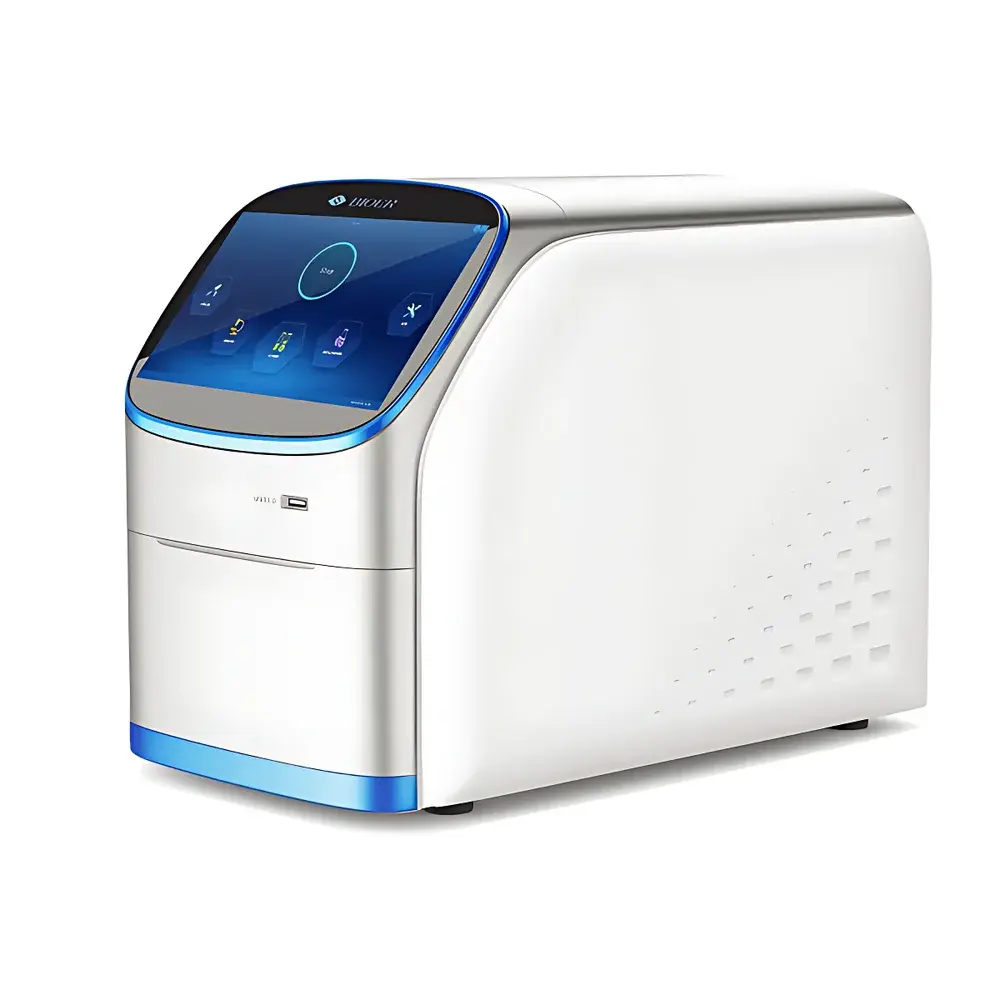
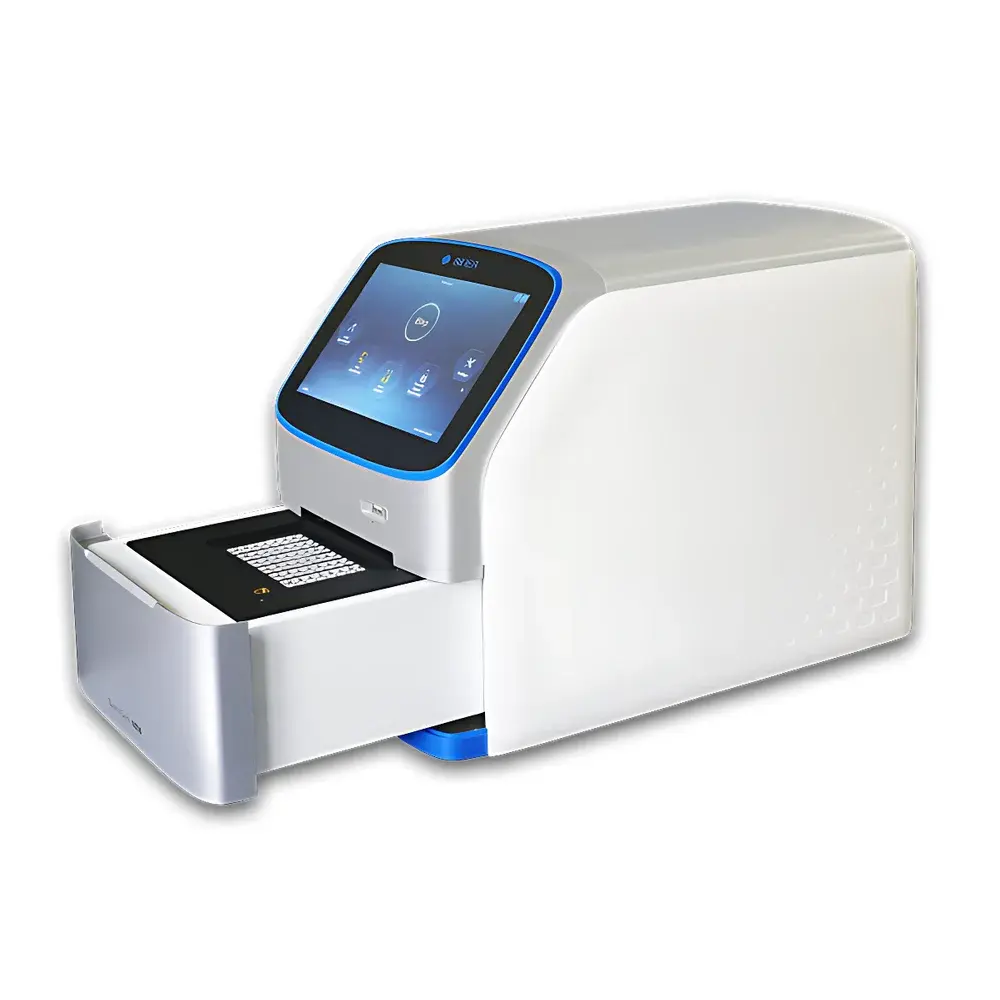
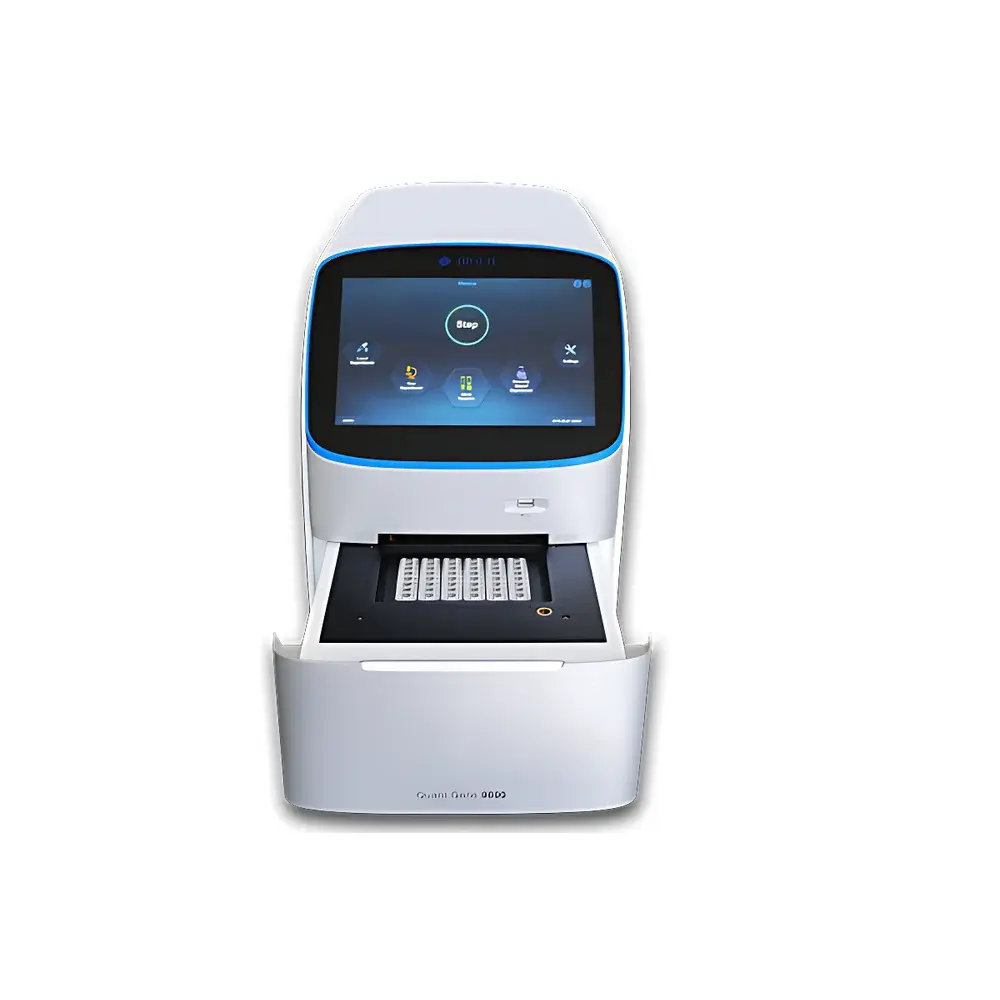
Bioer FQD-96C Real-Time Fluorescent Quantitative PCR System
| Brand | Bioer |
|---|---|
| Origin | Zhejiang, China |
| Model | FQD-96C |
| Instrument Type | Real-Time Fluorescent Quantitative PCR System |
| Sample Throughput | 96-well |
| Heating Rate | 6.5°C/s |
| Temperature Accuracy | ±0.1°C |
| Well-to-Well Temperature Uniformity | ±0.2°C |
| Detection Channels | 6 |
| Excitation Source | Arrayed Planar LED Light Source |
| Optical Detection | Top-reading, calibration-free, bundled high-end imported optical fiber bundle |
| Thermal Control Architecture | 6-zone independent Peltier-based temperature control |
| Input Power | AC 100–240 V, 50/60 Hz, 1000 W |
| Dimensions (L×W×H) | 490 × 290 × 391 mm |
| Net Weight | 28 kg |
| Compatible Consumables | 0.2 mL 96-well plates, 0.2 mL single tubes, 0.2 mL 8-tube strips (transparent, white, frosted) |
Overview
The Bioer FQD-96C Real-Time Fluorescent Quantitative PCR System is a precision-engineered thermal cycler designed for high-fidelity nucleic acid quantification using SYBR Green, hydrolysis probe (TaqMan), molecular beacon, and other fluorescence-based chemistries. It operates on the principle of real-time monitoring of amplicon accumulation during exponential amplification via synchronized thermal cycling and synchronous optical detection. The system integrates thermoelectric (Peltier) heating/cooling modules with six independently controlled thermal zones—enabling exceptional spatial temperature uniformity (±0.2°C across all 96 wells) and temporal accuracy (±0.1°C setpoint deviation). Its rapid 6.5°C/s heating rate minimizes cycle time without compromising denaturation or annealing fidelity, supporting high-throughput gene expression profiling, pathogen load quantification, genotyping, and miRNA analysis in both research and clinical laboratory environments.
Key Features
- Six-zone independent Peltier thermal control architecture ensures minimal inter-well thermal variance—critical for reproducible Cq determination across multi-sample assays.
- Top-reading optical module with factory-aligned, calibration-free detection geometry; eliminates routine optical recalibration and reduces operator-dependent variability.
- High-intensity planar LED array excitation source delivers uniform illumination across all 96 positions, minimizing edge effects and enhancing signal-to-noise ratio.
- Bundled high-purity imported optical fiber bundle enables efficient light transmission from sample to detector—reducing photonic loss and improving low-abundance target sensitivity.
- Motorized, auto-ejecting sample chamber facilitates ergonomic loading/unloading and prevents accidental thermal exposure during plate insertion.
- SOAK mode maintains user-defined low-temperature storage (e.g., 4°C or 10°C) post-run—preserving reagent integrity and enabling seamless integration into cold-chain workflows.
- Full touchscreen interface (≥7-inch capacitive display) supports standalone operation; also compatible with Windows 7/8.1/10 via USB or Ethernet for remote method deployment and data export.
Sample Compatibility & Compliance
The FQD-96C accepts standard 0.2 mL PCR consumables—including 96-well plates, individual tubes, and 8-tube strips—in transparent, white, and frosted configurations. White and frosted tubes enhance fluorescence collection efficiency for low-copy targets, while transparent formats support melt-curve analysis. The system complies with ISO/IEC 17025 general requirements for competence of testing and calibration laboratories. Its software architecture supports audit trail logging and user-access controls aligned with GLP and clinical laboratory quality management frameworks. While not pre-certified under FDA 21 CFR Part 11, the platform’s data export functionality (CSV, Excel, RDML) and timestamped run logs facilitate compliance-ready documentation for regulated environments.
Software & Data Management
Control and analysis are managed through Bioer’s proprietary QuantStudio-compatible software suite, supporting absolute and relative quantification, melting curve analysis, SNP genotyping, and multiplate comparative ΔΔCt workflows. Raw fluorescence data (Rn values), baseline-subtracted curves, and amplification efficiency calculations are generated in accordance with MIQE guidelines. Data files include embedded metadata (user ID, instrument serial number, date/time stamp, protocol version), ensuring traceability. Export options include RDML v1.2 format for cross-platform interoperability with third-party analysis tools (e.g., qBase+, LinRegPCR). Network connectivity enables centralized instrument monitoring and scheduled firmware updates without local PC dependency.
Applications
- Quantitative viral/bacterial load measurement in clinical diagnostics (e.g., SARS-CoV-2, HBV, HCV, CMV).
- Differential gene expression analysis in pharmacological and toxicological studies.
- Validation of CRISPR editing efficiency and off-target assessment via digital droplet reference standards.
- Food safety testing for pathogenic DNA markers (e.g., Listeria monocytogenes, Salmonella spp.).
- Environmental microbiology—quantification of functional genes in wastewater or soil metagenomes.
- Quality control of oligonucleotide synthesis and plasmid prep batches via copy-number verification.
FAQ
Is the FQD-96C validated for diagnostic use under CLIA or CE-IVD regulations?
No—this instrument is designated for research use only (RUO). Clinical application requires additional validation per local regulatory requirements and assay-specific verification.
Can the system perform high-resolution melt (HRM) analysis?
Yes—its precise thermal ramping control (0.01–0.5°C/s adjustable) and stable endpoint hold enable robust HRM profiling for SNP discrimination and methylation screening.
Does the software support automatic baseline and threshold setting?
Yes—algorithms apply adaptive baseline correction and auto-threshold assignment based on standard deviation of early-cycle noise, with manual override capability.
What is the minimum detectable fluorescence signal change?
The system achieves ≥1.5-fold dynamic range over background with standard FAM-labeled probes under optimized conditions; exact LOD depends on chemistry, master mix, and template quality.
Is remote monitoring supported via cloud or mobile app?
Local network monitoring is supported via browser-based dashboard; cloud synchronization and iOS/Android apps are not natively integrated but may be enabled via third-party API extensions.




