
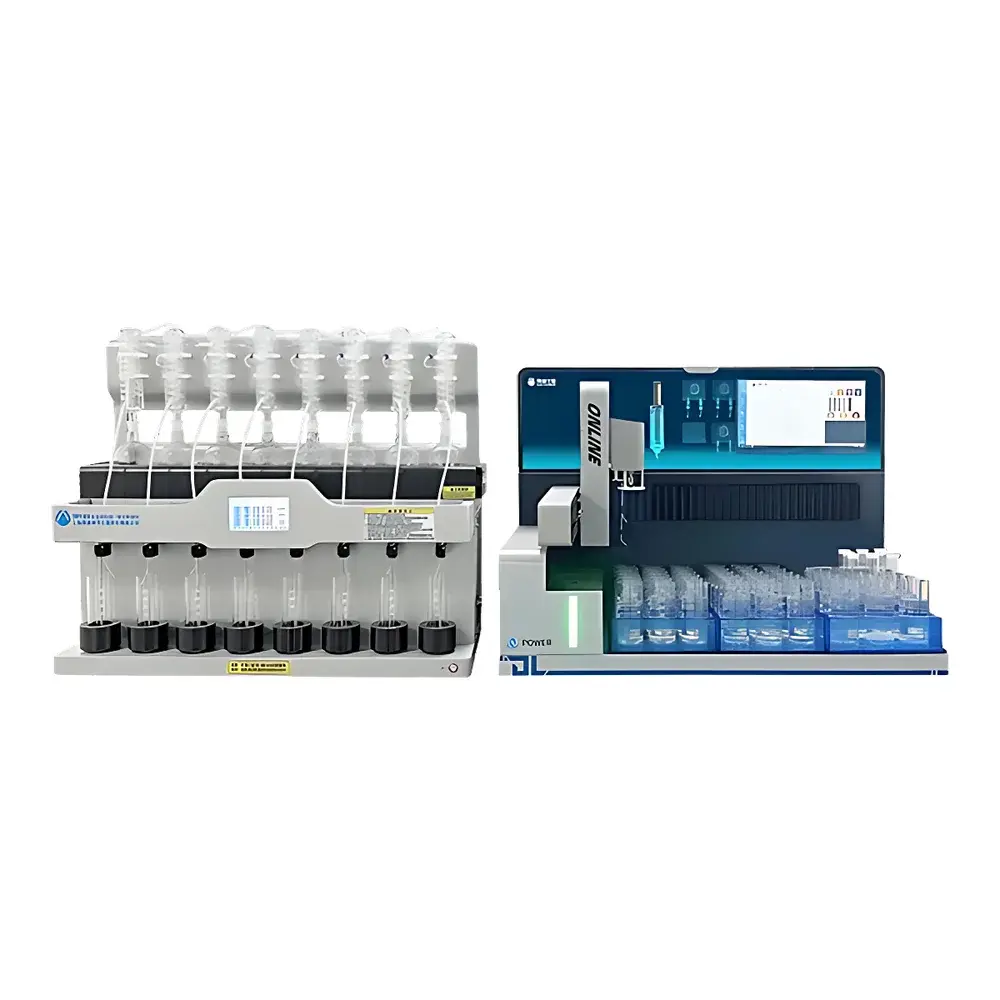
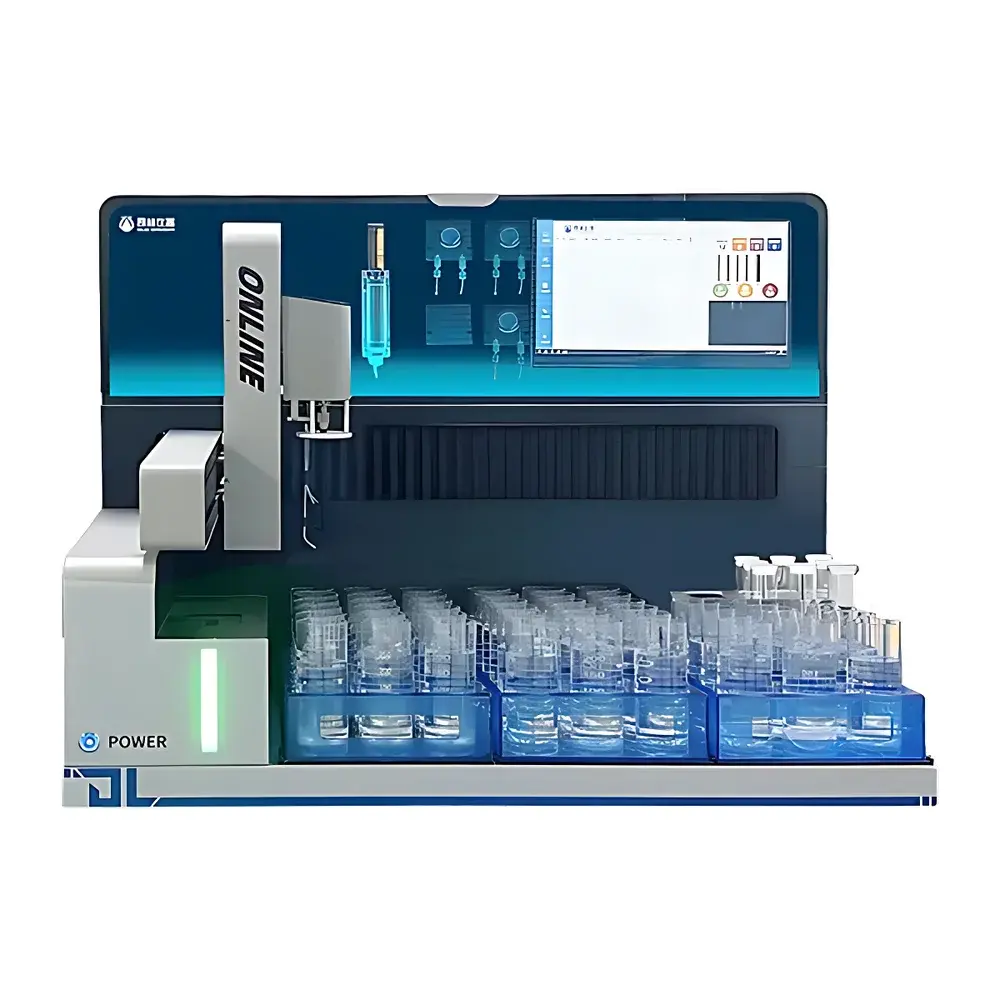
Online Instrument OL2600N Automated Ammonia Nitrogen Analyzer
| Brand | Online Instrument |
|---|---|
| Origin | Shanghai, China |
| Manufacturer Type | Authorized Distributor |
| Country of Origin | China |
| Model | OL2600N |
| Instrument Type | Laboratory-Based Automated Analyzer |
| Measurement Principle | Colorimetric Method (Nessler Reagent Spectrophotometry per HJ 535–2009 and GB/T 5750.1–2023) |
| Sample Capacity | 45 positions |
| Distillation Stations | 8 |
| Measurement Modes | Direct Method, Coagulation-Precipitation Method, Distillation Method |
| Calibration | Automated Standard Preparation & Multi-Point Calibration Curve Generation |
| Remote Access | Web-based & Mobile-Compatible Monitoring & Data Retrieval |
| System Integration | Compatible with Unmanned Laboratory Platforms (e.g., LIMS, SCADA, IoT Edge Gateways) |
| Compliance | Designed to support GLP-compliant workflows and audit-ready data traceability per ISO/IEC 17025 requirements |
Overview
The Online Instrument OL2600N Automated Ammonia Nitrogen Analyzer is a laboratory-grade, fully automated system engineered for precise, reproducible quantification of ammonia nitrogen (NH₃-N) in aqueous environmental matrices. It implements the standardized Nessler reagent spectrophotometric method—fully aligned with China’s national standard HJ 535–2009 and the updated drinking water testing protocol GB/T 5750.1–2023. The instrument integrates sample introduction, reagent dosing, thermal distillation (where required), coagulation-precipitation, color development, photometric measurement at 420 nm, and post-analysis cleaning into a single unattended workflow. Its modular architecture supports three distinct analytical pathways—direct analysis for low-turbidity samples, coagulation-precipitation for moderately turbid or colored waters, and full steam distillation for complex wastewater or high-salinity groundwater—ensuring methodological flexibility without hardware modification.
Key Features
- Fully automated 45-position sample carousel with barcode scanning capability for sample tracking and audit trail integrity.
- Dedicated 8-channel parallel distillation module with programmable temperature ramping, reflux control, and condensate collection verification.
- Onboard reagent management system with level sensors, temperature-controlled storage (4–25 °C), and leak-detection for Nessler reagent, sodium hydroxide, and tartaric acid solutions.
- Double-beam spectrophotometer with tungsten-halogen light source and thermally stabilized photodiode array detector, optimized for absorbance measurement in the 400–450 nm range.
- Integrated cleaning protocol using sequential rinsing with deionized water, acid wash (0.1 M HCl), and air purge to minimize carryover (<0.3% between high/low concentration samples).
- Embedded real-time diagnostics including fluid path pressure monitoring, valve actuation verification, and photometric baseline stability logging.
Sample Compatibility & Compliance
The OL2600N accepts liquid samples within pH 6.0–9.5 and total suspended solids ≤ 150 mg/L (pre-filtered if necessary). It accommodates standard 16 mm × 100 mm borosilicate glass tubes or 50 mL polypropylene vials. The system meets functional requirements for ISO 14001-certified environmental labs and supports compliance with regulatory reporting frameworks including China’s “Environmental Monitoring Technical Specifications” (HJ/T 91–2019) and discharge permit monitoring mandates. All measurement data—including raw absorbance values, calibration parameters, reagent lot numbers, operator ID, timestamp, and instrument status logs—are stored with immutable timestamps and digital signatures, enabling alignment with GLP documentation standards and facilitating FDA 21 CFR Part 11–compliant electronic record retention when deployed with validated LIMS integration.
Software & Data Management
The OL2600N runs on embedded Linux-based firmware with a web-accessible user interface (HTTPS-enabled, TLS 1.2+). Local operation is supported via touchscreen; remote access is available through secure cloud gateway or on-premise server deployment. Software features include method template library (with editable SOPs per matrix type), automatic QC flagging (e.g., drift > ±2% FS/h, blank absorbance > 0.05 AU), batch report generation (PDF/CSV/XLSX), and configurable alarm thresholds for maintenance alerts (e.g., reagent depletion, waste tank fill level > 90%). Audit trails are retained for ≥18 months and exportable in XML format for third-party validation. API endpoints support RESTful integration with enterprise LIMS, SCADA systems, and centralized environmental data platforms.
Applications
The OL2600N is routinely deployed in municipal water quality control laboratories, industrial effluent monitoring stations (e.g., food processing, pharmaceutical manufacturing, chemical synthesis), and provincial environmental monitoring centers. Typical use cases include routine compliance testing of surface water (rivers, lakes), groundwater wells near agricultural zones, municipal wastewater influent/effluent streams, and pretreatment verification for membrane filtration plants. Its distillation mode enables reliable NH₃-N determination in seawater-influenced estuaries and digestate from anaerobic digestion facilities—matrices where interferences from chloride, organic amines, or volatile fatty acids would otherwise compromise direct-colorimetric accuracy.
FAQ
What regulatory methods does the OL2600N validate against?
It is configured and verified for HJ 535–2009 (Nessler spectrophotometry) and GB/T 5750.1–2023, with optional method adaptation packages available for ISO 7150-1 and ASTM D1426–15 upon request.
Can the instrument operate without continuous network connectivity?
Yes—the core analysis sequence executes autonomously; network connection is required only for remote monitoring, report export, and software updates.
Is method validation documentation provided?
Each unit ships with a Factory Acceptance Test (FAT) report, including linearity (R² ≥ 0.999 over 0.05–10 mg/L N), repeatability (RSD ≤ 2.1% at 2 mg/L N), and spike recovery (92–105% across five matrix types).
How is reagent consumption tracked and managed?
Volumetric dispensing pumps log dispense counts and volumes per cycle; onboard sensors trigger visual and email alerts when reagent levels fall below 15% capacity.
Does the system support multi-user role-based access control?
Yes—administrator, analyst, and viewer roles are enforced via LDAP/Active Directory integration or local credential database with password policy enforcement (minimum 8 characters, 90-day expiry).
Related Products







