
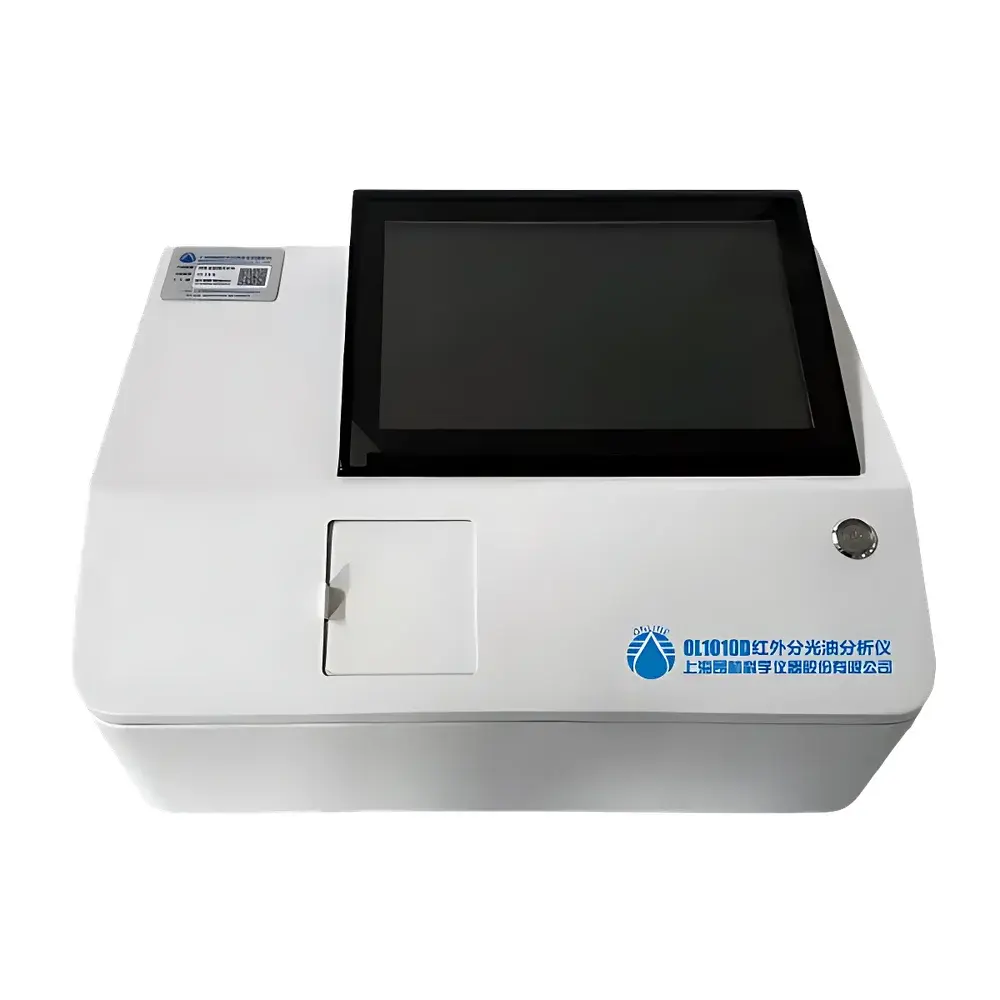
Online Instrument OL1010D Infrared Oil Content Analyzer with Integrated Industrial PC
| Brand | Online Instrument |
|---|---|
| Origin | Shanghai, China |
| Manufacturer Type | Direct Manufacturer |
| Region Category | Domestic (China) |
| Model | OL1010D |
| Instrument Type | Laboratory Benchtop Analyzer |
| Measurement Principle | Infrared Spectrophotometry (C–H Stretch Absorption at 2960, 2930, and 2870 cm⁻¹) |
| Measurement Range | 0–50,000 mg/L |
| Detection Limit | 0.06 mg/L |
| Accuracy | ±2% of reading |
| Resolution | 0.001 mg/L |
| Analysis Time per Sample | <60 s |
Overview
The Online Instrument OL1010D Infrared Oil Content Analyzer is a laboratory-grade benchtop instrument engineered for precise, rapid quantification of total petroleum hydrocarbons (TPH), mineral oil, and animal/vegetable oils in aqueous matrices. It operates on the principle of mid-infrared absorption spectroscopy—specifically measuring the integrated absorbance of C–H stretching vibrations at three characteristic wavenumbers (2960 cm⁻¹, 2930 cm⁻¹, and 2870 cm⁻¹) in solvent-extracted samples. This tri-wavelength algorithm conforms to internationally recognized methodologies including ISO 9377-2:2000 (Water quality — Determination of hydrocarbon oil index — Part 2: Infrared spectrometric method) and EPA Method 1664A (n-Hexane Extractable Material). The system integrates a sealed, detachable optical module with short-path fixed-cell geometry, minimizing stray light and maximizing signal-to-noise ratio. Its solid-state switching power supply drives a thermally stabilized IR source, eliminating mechanical chopper mechanisms and enhancing long-term photometric stability.
Key Features
- Modular optical architecture: Detachable, self-contained optical unit with optimized light path length and high-energy throughput—designed for robustness and field-deployable recalibration.
- Real-time auto-zero correction: Simultaneous acquisition of active-source and dark-current signals enables dynamic baseline compensation, ensuring measurement stability over extended operational cycles.
- Integrated industrial PC: Embedded touch-enabled control interface with local data storage, preloaded analysis software, and USB/Ethernet connectivity—no external computer required for routine operation.
- Electromagnetic compatibility (EMC)-optimized electronics: Redesigned PCB layout and shielding meet IEC 61326-1:2013 requirements for laboratory instrumentation in electrically noisy environments.
- Flexible calibration protocols: Supports single-point verification, multi-point standard curve generation, and three-reference standard calibration (e.g., n-hexadecane, benzene, and tetrachloroethylene) per ASTM D7066-22 guidelines.
- Upgrade-ready platform: Modular hardware design permits seamless integration of automated liquid handling modules (optional), enabling future expansion to fully automated extraction, measurement, waste disposal, and cleaning sequences.
Sample Compatibility & Compliance
The OL1010D is validated for direct analysis of solvent extracts prepared using tetrachloroethylene (PERC) or carbon tetrachloride (CTC), in accordance with US EPA 1664A and ISO 9377-2. It accommodates sample volumes from 10 mL to 100 mL post-extraction, supporting both grab and composite wastewater specimens. The instrument meets GLP-compliant data integrity requirements through built-in audit trail logging (user actions, calibration events, method changes), time-stamped raw spectra storage, and password-protected configuration access. Firmware supports 21 CFR Part 11–compliant electronic signatures when operated with validated third-party LIMS interfaces. All optical components are certified to RoHS 2011/65/EU and CE EN 61010-1:2010 safety standards.
Software & Data Management
The embedded analysis software provides full spectral visualization (absorbance vs. wavenumber), peak integration, baseline correction tools, and customizable report templates (PDF/CSV export). Raw interferograms and processed spectra are stored with metadata including operator ID, date/time stamp, calibration status, and solvent lot traceability. Remote monitoring and control are supported via secure HTTPS web interface—enabling real-time instrument status checks, method parameter adjustments, and historical data retrieval from mobile devices or desktop clients. Data export complies with ASTM E1461-21 (Standard Practice for Digital Data Exchange in Analytical Chemistry) and supports direct ingestion into ELN systems.
Applications
The OL1010D serves as a primary analytical tool in environmental compliance laboratories for regulatory reporting under national discharge permits (e.g., China’s GB 8978-1996, EU WFD 2000/60/EC). It is routinely deployed in municipal wastewater treatment plants, petrochemical refineries, offshore platform environmental units, and food processing facilities for monitoring effluent oil content. Beyond regulatory oil-in-water testing, its full-spectrum IR capability supports qualitative structural analysis of organic contaminants, polymer identification, and QC screening of solvents and surfactants. Educational institutions utilize it for teaching quantitative spectroscopic analysis principles aligned with ISO/IEC 17025 competency frameworks.
FAQ
What extraction solvents are compatible with the OL1010D?
Tetrachloroethylene (PERC) and carbon tetrachloride (CTC) are validated per EPA 1664A; alternative solvents require method revalidation.
Does the instrument support automatic background subtraction during analysis?
Yes—real-time dual-signal acquisition (light-on/light-off) enables continuous zero-point correction without manual intervention.
Can raw spectral data be exported for third-party chemometric analysis?
Yes—interferogram and absorbance spectra are exportable in JCAMP-DX v5.0 format with full metadata embedding.
Is remote firmware update capability available?
Firmware updates are performed via secure USB drive import; over-the-air (OTA) updates are not supported for security-critical lab environments.
What is the recommended maintenance interval for optical alignment verification?
Optical alignment verification is advised every 6 months or after 500 measurements, using the included NIST-traceable polystyrene film standard.
Related Products







