
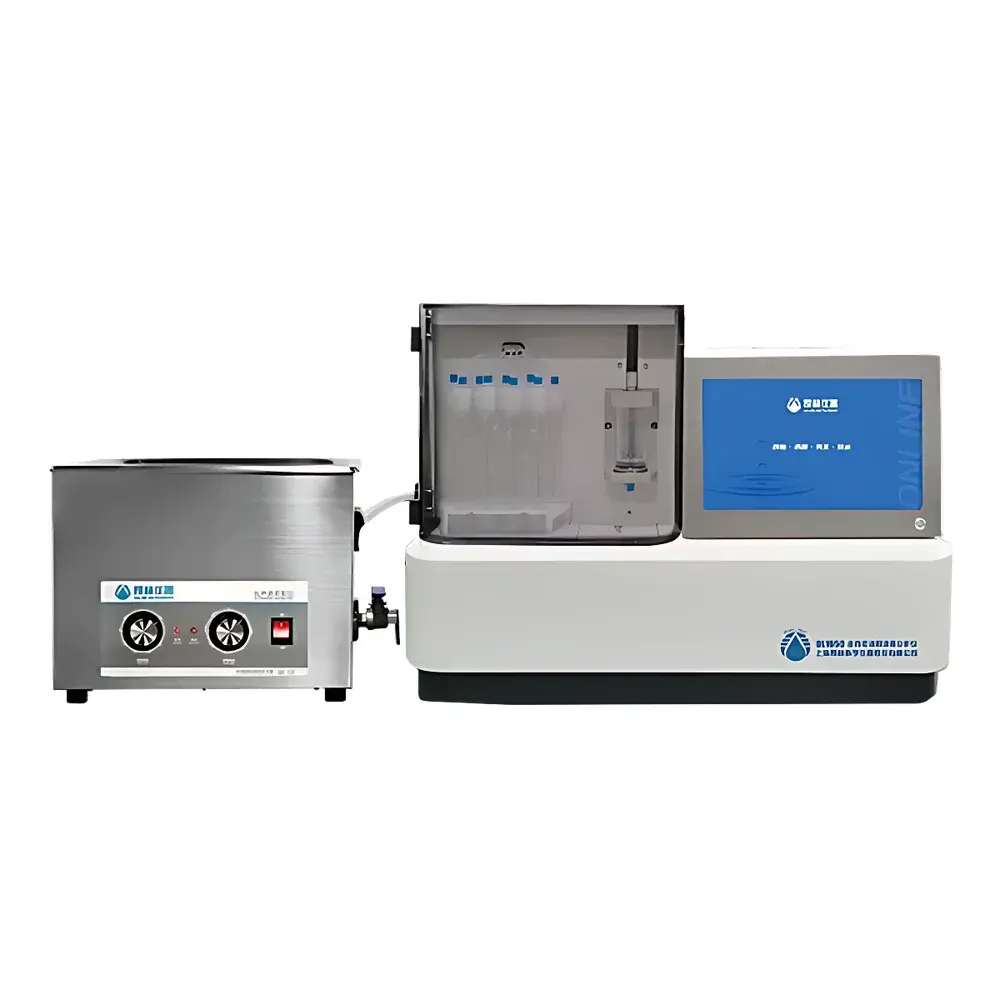
Online Instrument OL1050 Fully Automated Oil Fume and Oil Mist Analyzer
| Brand | Online Instrument |
|---|---|
| Origin | Shanghai, China |
| Manufacturer Type | Direct Manufacturer |
| Country of Origin | China |
| Model | OL1050 |
| Detection Principle | Infrared Absorption (FTIR-compatible broadband IR photometry) |
| Instrument Class | Laboratory-Based Fixed-Position Analyzer |
| Primary Application Sector | Petrochemical Industry |
| Compliance Basis | Designed to support EPA Method 27 / ISO 12103-1 alignment for airborne oil aerosol quantification |
| Measurement Range | Configurable via auto-dilution (standard range: 0.1–100 mg/m³, extendable to 500 mg/m³ with intelligent over-range dilution) |
| Sample Introduction | Filter Cartridge (glass fiber or quartz) or Sleeve-Type Sampling Probe |
| Extraction Solvent | Tetrachloroethylene (C₂Cl₄) |
| Extraction Method | High-Efficiency Ultrasonic Assisted Extraction |
| Phase Separation | Automatic Density-Based Liquid-Liquid Separation (C₂Cl₄/H₂O) |
| Calibration Modes | Certified Reference Material (CRM)-based calibration, Multi-Point Standard Curve, Single-Point Rapid Calibration |
| Reagent Handling | Fully Automated Dispensing, Recovery, and Activated Carbon–Filtered Exhaust Management |
| Data Interface | Embedded Touchscreen PC + Remote Web API & Mobile App (iOS/Android) |
| Software Compliance | Audit-trail enabled, 21 CFR Part 11–ready data logging (user authentication, electronic signature, change history) |
Overview
The Online Instrument OL1050 is a laboratory-grade, fully automated oil fume and oil mist analyzer engineered for regulatory-compliant quantification of airborne hydrocarbon aerosols in industrial exhaust streams and workplace environments. It operates on the principle of infrared absorption photometry—specifically optimized for the C–H stretching vibration band near 2930 cm⁻¹—enabling selective, interference-resistant measurement of total suspended oil particulates and condensable vapors. Unlike portable or filter-weighting methods, the OL1050 integrates sample collection, solvent extraction, phase separation, spectral acquisition, and quantitative analysis into a single unattended workflow. Its design adheres to foundational principles outlined in EPA Method 27 (Determination of Total Hydrocarbons in Stack Gases) and aligns with ISO 12103-1 (Test Dusts for Filter Evaluation), supporting traceable, repeatable results under GLP and pre-GMP laboratory conditions.
Key Features
- Fully automated analytical sequence: integrated control of filter cartridge loading, tetrachloroethylene (C₂Cl₄) reagent dispensing, ultrasonic-assisted extraction (40 kHz, programmable duration), gravity-driven liquid–liquid phase separation, optical cell filling, IR absorbance measurement, and waste segregation.
- Intelligent over-range detection and dynamic dilution: real-time absorbance monitoring triggers automatic serial dilution using certified diluent, extending effective linear dynamic range without manual intervention.
- Hermetic operational architecture: all solvent-handling and extraction steps occur within sealed PTFE-lined pathways; off-gas is routed through replaceable activated carbon cartridges meeting ASTM D6883 requirements for VOC adsorption efficiency.
- No-sample-transfer precision: direct on-instrument extraction eliminates transfer losses, cross-contamination, and operator-induced variability—critical for low-concentration (<1 mg/m³) compliance monitoring.
- Self-calibrating optical system: dual-beam IR photometer with thermoelectrically stabilized detector and NIST-traceable reference filters ensures long-term baseline stability and drift correction.
Sample Compatibility & Compliance
The OL1050 accepts standard 47-mm or 90-mm glass fiber or quartz filter cartridges (e.g., Pallflex Tissuquartz™) as well as sleeve-type probes compatible with ISO 9096 stack sampling configurations. It supports both isokinetic and non-isokinetic sampling protocols when paired with certified flow controllers. The instrument’s extraction and measurement methodology is validated for use with tetrachloroethylene per EPA SW-846 Method 3510C and ASTM D5176–22. All software-generated reports include metadata fields required for ISO/IEC 17025 accreditation: analyst ID, calibration certificate numbers, environmental parameters (T, P, RH), and raw spectral files (CSV and .spc formats). System logs meet FDA 21 CFR Part 11 requirements for electronic records and signatures.
Software & Data Management
The embedded Linux-based control system features a 10.1-inch capacitive touchscreen interface with intuitive workflow navigation and context-sensitive help. Analytical methods—including extraction time, ultrasonic power, dilution factor, and calibration frequency—are stored as editable method templates. Data export supports CSV, PDF, and XML formats with embedded digital signatures. A secure RESTful API enables integration with LIMS platforms (e.g., LabWare, Thermo Fisher SampleManager) and enterprise SCADA systems. Remote access is authenticated via TLS 1.3 encryption; mobile applications (iOS/Android) provide real-time status alerts, historical trend visualization, and audit log review—without exposing internal network infrastructure.
Applications
- Petrochemical refineries: continuous monitoring of catalyst regeneration off-gas, flare stack emissions, and compressor vent streams for hydrocarbon aerosol load.
- Chemical manufacturing: quantification of mineral oil mists from hydraulic systems, gearboxes, and high-pressure reactors per OSHA PEL and ACGIH TLV guidelines.
- Environmental monitoring laboratories: accredited analysis of ambient air samples collected near industrial zones, supporting national air quality reporting frameworks (e.g., China’s HJ 637–2018, EU Directive 2008/50/EC).
- Food processing & catering industry: verification of油烟 (cooking oil fume) abatement system efficiency in commercial kitchen exhaust ducts—aligned with local municipal emission ordinances.
- Research institutions: method development for speciated oil mist characterization (e.g., paraffinic vs. naphthenic fractions) using spectral deconvolution algorithms.
FAQ
What infrared wavelength range does the OL1050 utilize for detection?
The instrument employs a broadband mid-infrared photometric system centered at 2930 cm⁻¹ (3.4 µm), optimized for aliphatic C–H bond absorption—consistent with EPA-recommended spectral windows for total hydrocarbon aerosol analysis.
Is tetrachloroethylene the only approved extraction solvent?
Yes—C₂Cl₄ is specified per HJ 637–2018 and EPA Method 27 due to its high extraction efficiency for non-polar oils and negligible IR interference in the target band. Alternative solvents require full method validation and are not supported out-of-the-box.
Can the OL1050 be integrated into an existing plant DCS or PLC network?
Via optional Modbus TCP or OPC UA gateway module, the OL1050 provides real-time concentration outputs (4–20 mA or digital register mapping) compatible with major industrial control systems.
How frequently must the IR optical path be cleaned or recalibrated?
Under normal operation, the sealed optical cell requires no routine cleaning; factory calibration is valid for 12 months. Annual verification with NIST-traceable oil standards (e.g., SRM 2781) is recommended for ISO/IEC 17025 compliance.
Does the system support multi-point calibration with custom reference materials?
Yes—the software allows import of user-defined calibration curves using CRM-certified oil standards (e.g., mineral oil, synthetic ester, or bio-oil blends), with full uncertainty propagation reporting per GUM (JCGM 100:2008).







