
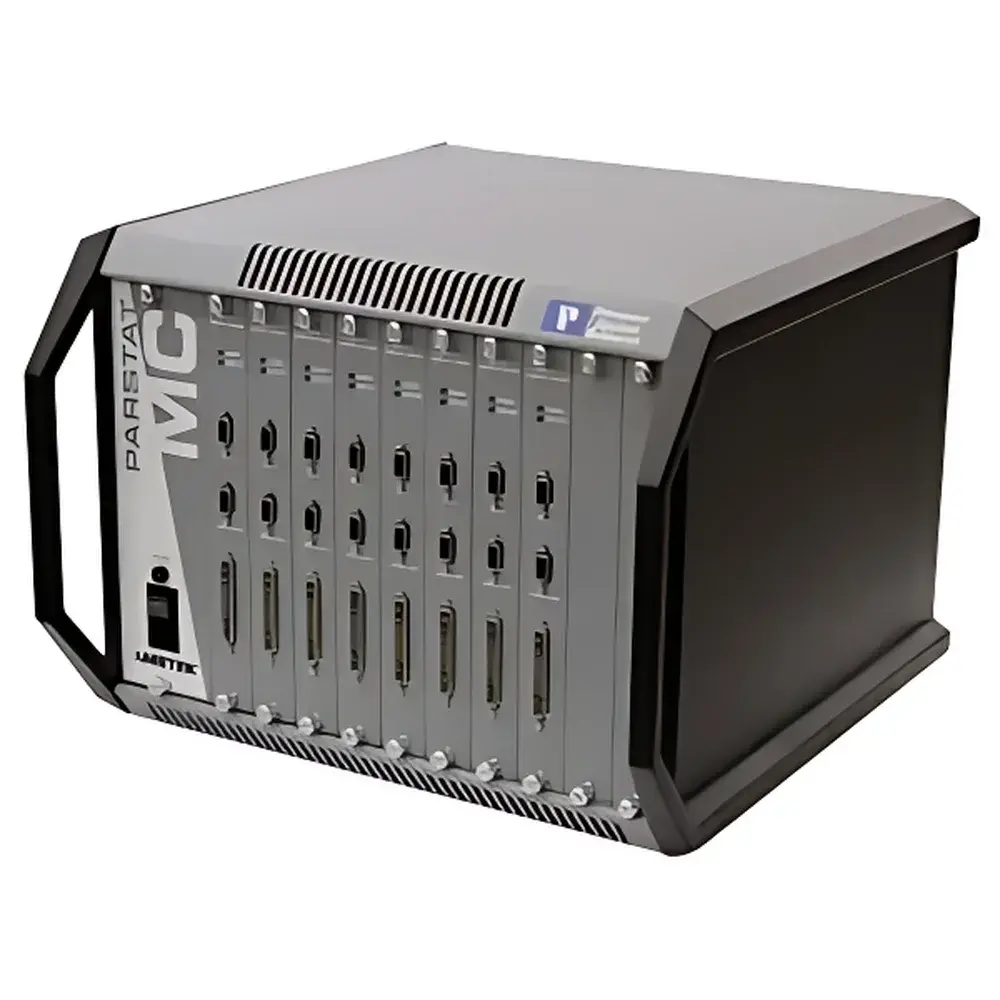
AMETEK Princeton Applied Research ParSTAT MC Multi-Channel Electrochemical Workstation
| Brand | AMETEK–Princeton Applied Research |
|---|---|
| Origin | USA |
| Manufacturer Type | Authorized Distributor |
| Origin Category | Imported |
| Model | ParSTAT MC Multi-Channel Electrochemical Workstation |
| Instrument Type | Electrochemical Workstation |
| Current Range | ±2 A (standard) |
| Current Accuracy | 20 nA–2 A: ±0.2% of reading or ±0.2% of range |
| 4 nA | <0.5% ±20 pA |
| Potential Accuracy | ±2 mV |
| Potentiostatic Range | ±10 V |
| EIS Frequency Range | 10 µHz to 1 MHz |
Overview
The AMETEK Princeton Applied Research ParSTAT MC is a research-grade, modular multi-channel electrochemical workstation engineered for high-fidelity, parallel electrochemical characterization in academic, industrial, and regulatory environments. Built upon over five decades of expertise in potentiostat/galvanostat design, the ParSTAT MC implements a true dual-mode (potentiostatic/galvanostatic) architecture with integrated electrochemical impedance spectroscopy (EIS), enabling precise control and measurement across a broad dynamic range—from ultra-low current (down to 4 nA full-scale, 120 fA resolution) to high-current applications (±2 A). Its core measurement principle relies on high-stability analog feedback loops, 3 × 16-bit synchronized ADCs operating at 500 kS/sec, and a ≥10 MHz differential electrometer bandwidth—ensuring minimal phase lag and exceptional signal fidelity during fast transient or low-noise measurements. The system supports both grounded and floating cell configurations, permitting simultaneous multi-electrode experiments within a single electrolytic cell—a critical capability for battery electrode screening, corrosion coupon arrays, and sensor array validation.
Key Features
- Modular chassis supporting up to eight independently configurable channels per unit—each channel fully functional as a standalone research-grade potentiostat/galvanostat/EIS analyzer.
- True hot-swap capability: individual channel modules may be installed, removed, or replaced without interrupting ongoing experiments on other active channels.
- High-speed data acquisition: 500 kS/sec synchronized sampling of potential, current, and auxiliary signals with 2 µs time resolution.
- Ultra-low noise performance: ≤5 pA input bias current, ≥1012 Ω input impedance (parallel ≤5 pF), and 60 dB CMRR at 100 kHz ensure reliable microampere- and picoampere-level measurements.
- Flexible control architecture: independent potentiostatic/galvanostatic modes with programmable stability settings (high-speed vs. high-stability), dynamic iR compensation, and positive feedback iR correction.
- Integrated EIS module (PMC-1000): frequency sweep from 10 µHz to 1 MHz, minimum AC amplitude of 0.1 mVRMS, logarithmic or linear scanning, and real-time Kramers–Kronig validation.
- Standard ±12 V output compliance voltage and >8 V/µs slew rate support demanding kinetic studies and fast-switching applications such as pulse voltammetry and rotating disk electrode (RDE) control.
Sample Compatibility & Compliance
The ParSTAT MC accommodates diverse electrochemical cell configurations—including standard three-electrode cells, bipolar electrode arrays, thin-film microelectrodes, and multi-compartment flow cells—via its isolated analog front-end and software-selectable floating/grounded mode. It complies with CE marking requirements and meets electromagnetic compatibility (EMC) standards per EN 61326-1. For regulated laboratories, the system supports audit-trail-enabled operation when used with VersaStudio software under 21 CFR Part 11-compliant configurations (e.g., electronic signatures, user access controls, and immutable data logging). While not pre-certified to ISO/IEC 17025 or ASTM G5/G102, its metrological traceability, documented uncertainty budgets (per manufacturer specifications), and reproducible calibration protocols align with GLP and GMP best practices for method validation in battery R&D, corrosion testing (ASTM G59, G102), and pharmaceutical electroanalysis.
Software & Data Management
VersaStudio is the native, Windows-based application platform for instrument control, experiment scripting, real-time visualization, and post-acquisition analysis. It provides intuitive wizards for common techniques (CV, LSV, CA, CP, EIS, Mott–Schottky) and advanced scripting via Python-compatible macros. All raw data are stored in vendor-neutral binary format (.par) with embedded metadata (timestamp, parameter set, hardware ID, calibration history). The software enforces structured project hierarchies, version-controlled method templates, and batch-processing workflows for high-throughput screening. When deployed across multiple ParSTAT MC units (up to four instruments per PC, 32 total channels), VersaStudio maintains synchronized clocking and centralized data aggregation—enabling statistically robust replicate studies across independent electrochemical systems. Export options include CSV, MATLAB (.mat), and Excel-compatible formats for third-party statistical modeling or machine learning pipelines.
Applications
The ParSTAT MC serves as a foundational platform for quantitative electrochemical investigation across multiple domains: battery material development (cathode/anode cycling, SEI formation kinetics, impedance aging studies); corrosion science (electrochemical noise monitoring, localized pitting detection, coating degradation assessment); electrocatalysis (HER/OER/ORR activity mapping, Tafel analysis, turnover frequency derivation); biosensor development (amperometric enzyme electrodes, DNA hybridization detection); and fundamental interfacial charge-transfer studies (Marcus theory validation, double-layer capacitance quantification). Its multi-channel architecture significantly accelerates comparative studies—such as evaluating ten candidate catalysts under identical conditions—or enables spatially resolved measurements across segmented electrodes in solid-state battery half-cells.
FAQ
Can the ParSTAT MC operate in floating (isolated) mode for multi-electrode cells?
Yes—the system includes software-selectable floating-ground configuration, allowing simultaneous measurement of multiple working electrodes in a shared electrolyte without electrical crosstalk.
Is hardware calibration traceable to NIST standards?
All factory calibrations are performed using metrologically traceable references; certificate of conformance includes uncertainty statements aligned with ISO/IEC 17025 guidance.
What is the maximum number of channels controllable from one computer?
A single VersaStudio instance can manage up to four ParSTAT MC units, supporting a total of 32 independent channels with synchronized timing.
Does the system support custom waveform generation beyond built-in techniques?
Yes—VersaStudio’s “Arbitrary Waveform” function allows user-defined voltage/current profiles with sub-millisecond resolution and real-time digital filtering.
Are firmware updates provided free of charge during the warranty period?
Yes—AMETEK Princeton Applied Research offers complimentary firmware and software updates for the duration of the standard 2-year warranty, including security patches and feature enhancements.





