
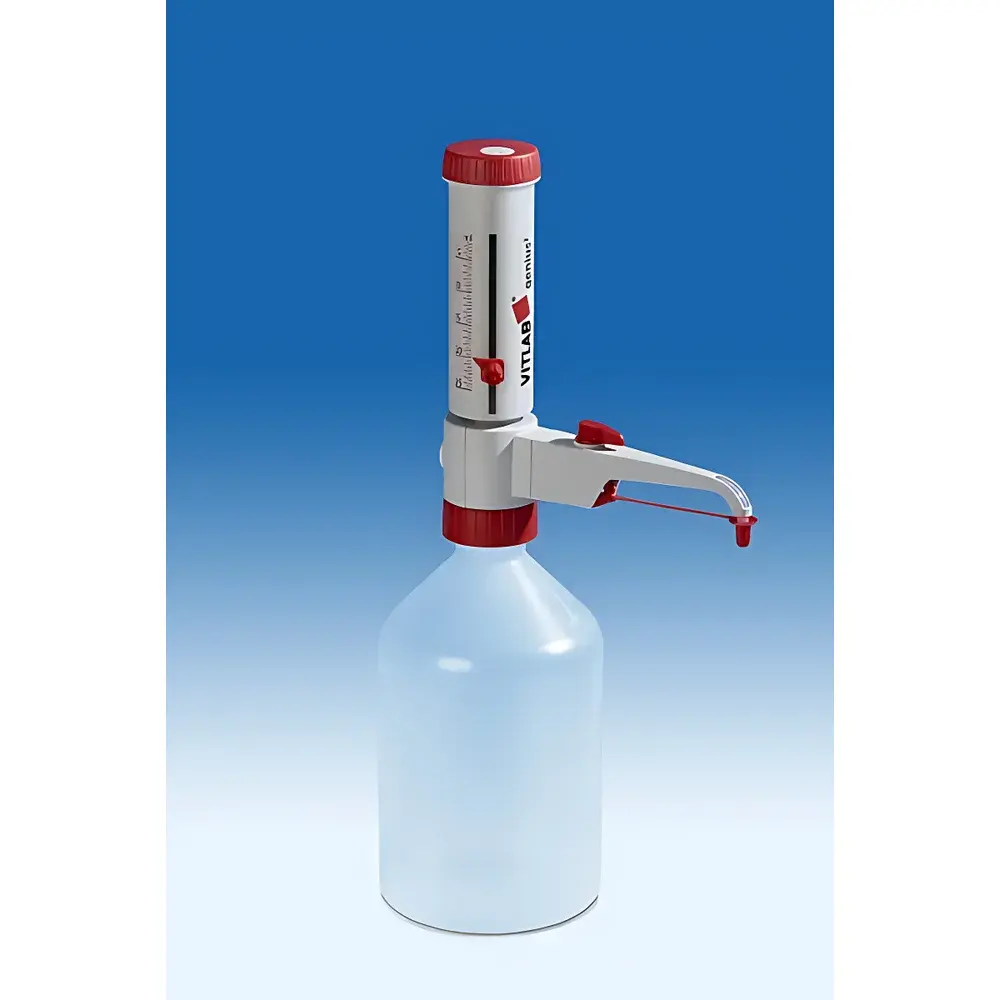
VITLAB Genius Bottle Top Dispenser
| Brand | VITLAB |
|---|---|
| Origin | Germany |
| Model | Genius |
| Type | Electronic Bottle Top Dispenser |
| Volume Range | 0.2–100 mL |
| Minimum Increment | 0.05–2.00 mL (model-dependent) |
| Accuracy | ±0.5% |
| Precision (Repeatability) | ±0.1% |
| Sterilization | Autoclavable at 121 °C (after thorough cleaning) |
| Compliance | DIN EN ISO 8655-6, GLP-ready |
Overview
The VITLAB Genius Bottle Top Dispenser is an electronically controlled, precision liquid handling instrument engineered for repeatable, traceable, and contamination-free dispensing of reagents directly from standard laboratory bottles. Operating on a positive displacement principle with integrated piston-driven mechanics, the Genius ensures volumetric accuracy across its full 0.2–100 mL range without reliance on gravity or ambient pressure fluctuations. Its design adheres to the metrological framework defined in DIN EN ISO 8655-6 for piston-operated dispensers, supporting regulatory requirements for calibration traceability, documentation integrity, and procedural consistency in quality-controlled environments including pharmaceutical QC labs, contract research organizations (CROs), and academic core facilities.
Key Features
- Integrated safety reflux valve prevents unintended discharge during bottle mounting or system depressurization—eliminating pre-dispense waste and safeguarding operator safety when handling hazardous or costly reagents.
- Tool-free, in-lab calibration compliant with DIN EN ISO 8655-6 and Good Laboratory Practice (GLP) guidelines; no external service technician or recalibration certificate required for routine verification.
- Full autoclave compatibility at 121 °C for 20 minutes—validated after complete disassembly and cleaning—ensuring sterility for aseptic applications in cell culture, molecular biology, and diagnostic reagent preparation.
- Chemically inert fluid path constructed entirely from high-purity fluoropolymers: PTFE (piston seal & body lining), ETFE (housing), PFA (discharge tube), and FEP (valve components), delivering resistance to concentrated acids (e.g., HNO₃, H₂SO₄), alkalis (e.g., NaOH up to 50 %), oxidizers, and organic solvents.
- 360° rotatable discharge nozzle maintains label visibility of the source bottle during operation—critical for rapid identification in high-throughput workflows and multi-reagent setups.
- Ergonomic, low-force dispensing mechanism with tactile feedback and digital volume display reduces operator fatigue and minimizes variability introduced by manual technique.
Sample Compatibility & Compliance
The Genius accommodates all common laboratory bottle neck sizes via three included polypropylene adapters (for 28 mm, 33 mm, and 45 mm GL-threaded bottles) and a telescoping suction tube (200–350 mm). Its modular design supports direct integration with HDPE, PET, glass, and borosilicate containers without modification. Regulatory alignment includes conformity with ISO 8655-6 for volumetric performance verification, GLP documentation standards for calibration records and usage logs, and mechanical robustness validated per IEC 61010-1 for laboratory electrical equipment safety. While not intrinsically rated for Class I Division 1 environments, its non-sparking fluoropolymer construction makes it suitable for use in fume hoods and solvent-handling areas.
Software & Data Management
As a standalone mechanical-electronic dispenser, the Genius does not require proprietary software or computer connectivity. However, its GLP-compliant calibration procedure mandates documented evidence—including date, operator ID, reference standard used (e.g., certified Class A volumetric flask or gravimetric balance), and deviation results—for audit readiness. The included calibration certificate provides initial metrological validation against national standards (traceable to PTB, Germany). Users may integrate dispensing events into LIMS or ELN systems via manual entry or barcode-scanned batch records linked to instrument ID and calibration status.
Applications
- Standardized preparation of calibration standards and QC samples in environmental testing (e.g., EPA Method 200.7, 300.0) and clinical chemistry.
- Accurate dispensing of corrosive titrants (e.g., HCl, NaOH, KMnO₄) in volumetric analysis where glass burette drift or meniscus error is unacceptable.
- Reproducible formulation of cell culture media, buffers, and enzymatic reaction mixes under sterile conditions post-autoclaving.
- High-integrity transfer of HF-containing etchants (Genius HF variant, order no. 1606515) in semiconductor wafer processing labs.
- Multi-step dilution series generation in ELISA, PCR setup, and high-content screening where inter-operator variability must be minimized.
FAQ
Can the Genius be calibrated in-house without specialized tools?
Yes. Calibration follows DIN EN ISO 8655-6 Annex C and requires only a certified balance, Class A volumetric flask or cylinder, distilled water, and temperature-controlled environment. No disassembly or torque tools are needed.
Is the entire unit autoclavable?
Yes—provided all components are fully disassembled, rinsed free of residue, and reassembled according to the manufacturer’s sequence. The PTFE piston seal and fluoropolymer valves retain dimensional stability and chemical integrity after repeated 121 °C cycles.
What bottle thread sizes are supported out-of-the-box?
The standard kit includes PP adapters for 28 mm (GL28), 33 mm (GL33), and 45 mm (GL45) bottles. Custom adapters for DIN 12918 or USP-compatible threads are available upon request.
How is accuracy verified across the full volume range?
Verification requires testing at minimum, mid-, and maximum setpoints per ISO 8655-6 §6.3. For example, model 1605506 (2.5–25 mL) must be tested at 2.5 mL, 12.5 mL, and 25 mL using gravimetric or volumetric methods.
Does the Genius comply with FDA 21 CFR Part 11 requirements?
While the device itself has no electronic audit trail, its calibration and usage records—when maintained in a validated ELN or LIMS with electronic signatures, version control, and change history—fully support Part 11 compliance for regulated submissions.



