
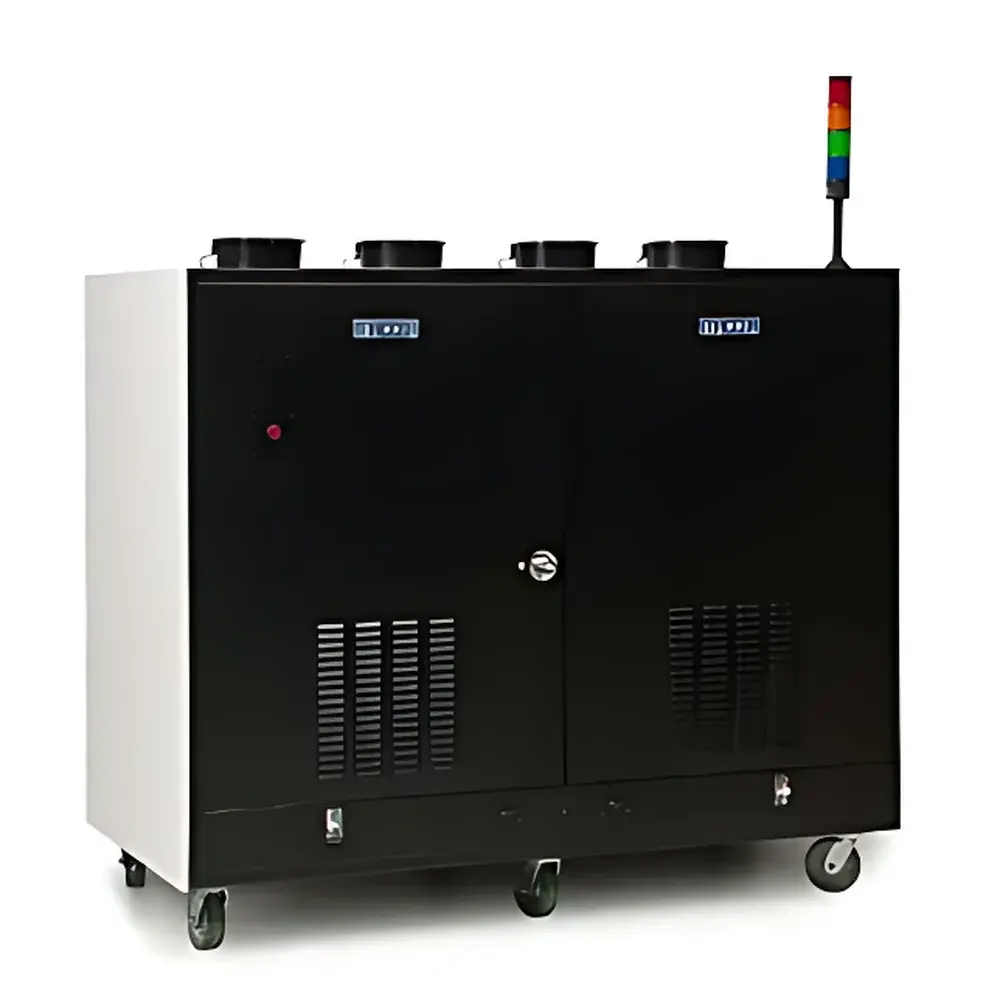
MACCOR Model 8500 High-Power Battery Test System for EV, HEV & PHEV Applications
| Origin | USA |
|---|---|
| Manufacturer Type | Authorized Distributor |
| Origin Category | Imported |
| Model | 8500 Series |
| Quotation | Upon Request |
| Voltage Range | Up to 1000 V |
| Current Range | Up to 1000 A |
| Minimum Step Time & Data Acquisition Interval | 50 ms (standard), optional sub-50 ms capability |
| Operating Modes | Galvanostatic (CC), Potentiostatic (CV), Power Control (CP), Resistance Control (CR), and hybrid step sequencing |
| Regenerative Energy Recovery | Grid-to-Battery (G2B) and Battery-to-Grid (B2G) bidirectional architecture |
| Software Platform | MACCOR Test Executive v7.x or later |
Overview
The MACCOR Model 8500 High-Power Battery Test System is an industrial-grade, programmable electrochemical test platform engineered for rigorous performance evaluation of traction batteries and large-format energy storage systems used in electric vehicles (EVs), hybrid electric vehicles (HEVs), plug-in hybrid electric vehicles (PHEVs), and stationary grid-scale applications. Based on four-quadrant regenerative power electronics architecture, the system operates under true bidirectional energy flow—capable of both sourcing power to the device under test (DUT) during charge cycles and sinking power from the DUT during discharge cycles with >92% energy recovery efficiency into the AC grid. Its core measurement principle relies on high-fidelity, low-latency digital current and voltage sensing synchronized with real-time closed-loop control algorithms, enabling precise enforcement of dynamic load profiles—including transient pulses, variable-rate cycling, and complex waveform-based drive cycles—under continuous thermal and electrical stress conditions.
Key Features
- High-power scalability: Modular channel design supports single-channel or multi-channel configurations, each rated up to 1000 V DC and ±1000 A, with parallel operation enabling aggregate system capacities exceeding 1 MW.
- Sub-50 ms temporal resolution: Standard 50 ms minimum step time and data acquisition interval ensures accurate capture of fast electrochemical transients; optional firmware-enabled enhancements support down to 10 ms for advanced impedance tracking and pulse response analysis.
- Multi-mode operational flexibility: Independent test steps can be configured in galvanostatic (CC), potentiostatic (CV), constant power (CP), constant resistance (CR), or user-defined mathematical functions—including ramp, sine, and staircase profiles—with seamless mode transitions within a single test sequence.
- Bidirectional energy management: Proprietary G2B (Grid-to-Battery) and B2G (Battery-to-Grid) topology minimizes net utility consumption, reduces facility cooling loads, and lowers total cost of ownership over extended test campaigns.
- Rugged industrial design: Convection-cooled power modules with IP2X-rated enclosures, integrated safety interlocks, emergency stop circuitry compliant with IEC 61800-5-1, and redundant overvoltage/overcurrent/fault detection per channel.
Sample Compatibility & Compliance
The Model 8500 accommodates prismatic, pouch, and cylindrical cell formats (including 21700, 4680, and custom large-format modules), battery packs up to 1000 V nominal, and full traction battery systems with integrated BMS communication via CAN 2.0A/B or ISO 11898-2 interfaces. The system meets electromagnetic compatibility requirements per EN 61326-1 (industrial environment), safety standards per UL 61010-1 and IEC 61010-1, and supports audit-ready operation under GLP and GMP frameworks through configurable electronic signatures, 21 CFR Part 11–compliant audit trails, and role-based access control in Test Executive software.
Software & Data Management
Controlled exclusively via MACCOR Test Executive—a Windows-based, scriptable test development and execution environment—the Model 8500 supports standardized drive cycle import (FUDS, US06, HWFET, DST, SFUDS, WLTC, and custom CSV-defined profiles), real-time parameter monitoring with customizable dashboards, automated pass/fail logic, and hierarchical data export in IEEE 1118-compliant .mat, .csv, and proprietary .mcc binary formats. All raw voltage, current, temperature, and auxiliary sensor data are timestamped with microsecond precision using internal GPS-synchronized clocks, ensuring traceability across distributed test labs and third-party validation studies.
Applications
- Development and validation of Li-ion, LFP, NMC, solid-state, and emerging chemistries under realistic automotive duty cycles.
- End-of-line (EOL) functional testing and capacity grading of production battery modules and packs.
- Calendar and cycle life assessment under variable temperature, SOC, and C-rate conditions per ISO 12405-2 and SAE J2929 protocols.
- Regenerative braking simulation and motor-inverter interface characterization in HIL (Hardware-in-the-Loop) environments.
- Large-scale PV + storage system integration testing, including grid-support functions such as frequency regulation and peak shaving verification.
- Fuel cell stack polarization curve mapping and dynamic load response analysis under combined thermal-electrochemical stress.
FAQ
What safety certifications does the MACCOR 8500 hold for laboratory and production floor deployment?
The system complies with UL 61010-1 (3rd Edition), IEC 61010-1, and EN 61326-1 for EMC immunity and emissions. Optional factory-installed arc-flash mitigation kits and remote emergency power-off (ePO) interfaces are available for Class I, Division 2 hazardous locations.
Can the 8500 series integrate with third-party battery management systems (BMS) or PLC-based supervisory controls?
Yes—native CAN 2.0A/B, Modbus TCP, and Ethernet/IP interfaces enable real-time telemetry exchange and coordinated state-of-charge (SOC), state-of-health (SOH), and fault status synchronization with external controllers.
Is data export compatible with MATLAB, Python, or commercial battery modeling platforms like AVL CRUISE M or GT-SUITE?
All test data exports natively support IEEE 1118 (.mat), CSV with header metadata, and HDF5 formats—fully ingestible by MATLAB, Pandas, and major co-simulation environments without post-processing.
Does the system support automated calibration verification and metrological traceability?
Each channel includes onboard shunt-based current calibration and precision voltage reference circuits traceable to NIST standards; annual calibration certificates with uncertainty budgets are provided per ISO/IEC 17025-accredited procedures.



