
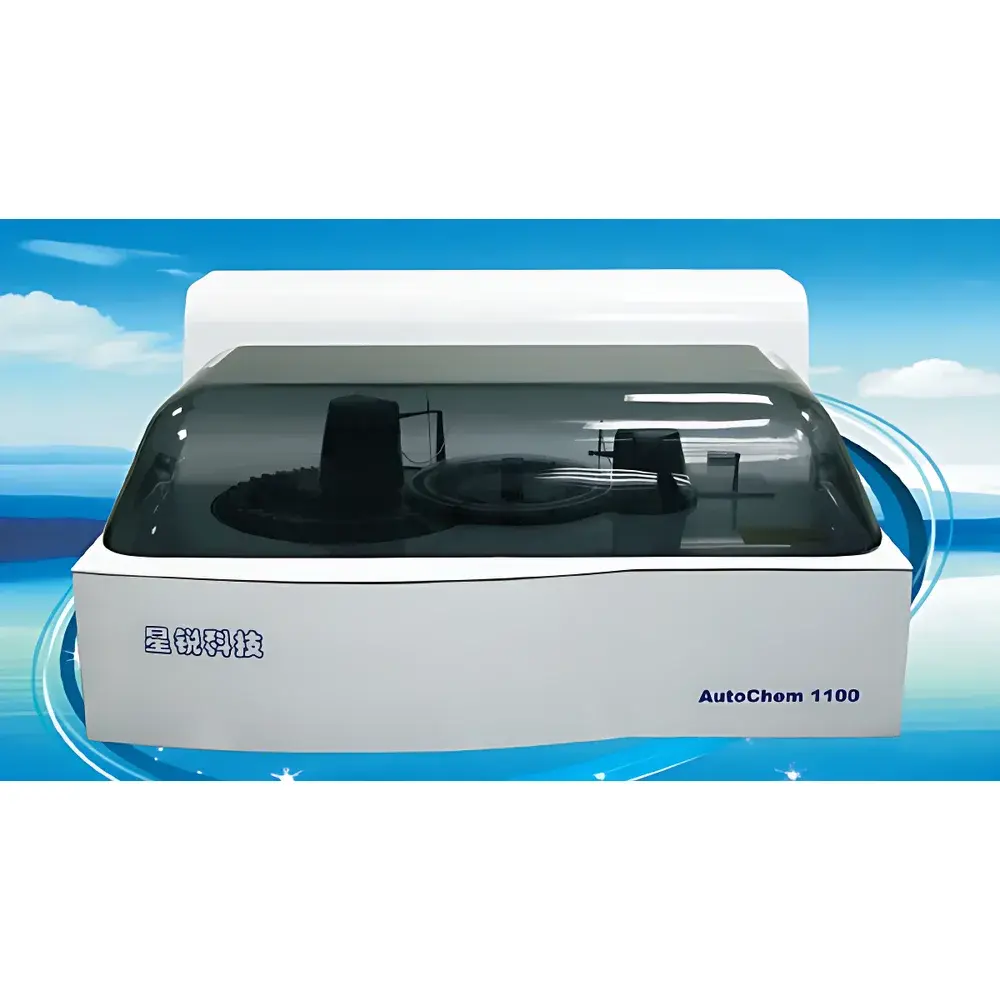
AutoChem 1100 Automated Discrete Analyzer
| Origin | Beijing, China |
|---|---|
| Manufacturer Type | Distributor |
| Origin Category | Domestic |
| Model | AutoChem 1100 |
| Price Range | USD 28,000–70,000 |
| Product Type | Continuous Flow Analyzer |
| Wavelength Range | 340–900 nm |
| Sample Capacity | 60 or 96 positions |
| Reagent Positions | 27 (Peltier-cooled) |
| Cuvette Path Length | 10 mm |
| Light Source | 12 V / 20 W Halogen Lamp with UV-Visible Output |
| Detection Speed | Up to 200 determinations per hour |
| Injector Precision | ±0.5% (5–1000 µL), Resolution: 0.1 µL |
| Reaction Disc Temperature Control | ±0.1 °C |
| Cuvette Temperature Control | ±0.1 °C |
| Photometric Accuracy | ±1% OD (0–2.5 OD) |
| Linearity | <0.5% deviation |
| Noise | <±0.002 Abs (at 340 nm, 2.5 OD) |
| Detection Modes | Endpoint, Differential, Timed, and Kinetic |
| Data Interface | RS-232 / USB |
| Operating Environment | 15–35 °C, 20–80% RH |
| Power Supply | 220 V AC |
Overview
The AutoChem 1100 Automated Discrete Analyzer is a high-precision, benchtop analytical platform engineered for routine and research-grade wet-chemistry analysis in environmental, clinical, agricultural, and industrial laboratories. Unlike classical continuous flow analyzers (CFA) or segmented-flow systems, the AutoChem 1100 implements a true discrete analysis architecture—where individual sample and reagent aliquots are precisely metered into thermally controlled micro-reaction vessels (96-position disc), enabling endpoint, kinetic, differential, and timed detection protocols without cross-contamination or carryover. Its optical engine integrates a custom-designed grating-based monochromator (developed in collaboration with the Changchun Institute of Optics, Fine Mechanics and Physics), delivering stable spectral resolution across 340–900 nm—covering critical absorption bands for nitrate, phosphate, ammonia, silica, cyanide, phenol, and numerous enzymatic or colorimetric assays defined in ISO, ASTM, and EPA methods.
Key Features
- Thermally regulated reaction disc and cuvette holder (±0.1 °C stability), eliminating temperature-induced photometric drift and ensuring reproducible kinetics.
- High-accuracy syringe-driven fluid handling: 1000 µL injector with 0.1 µL resolution and ±0.5% volumetric accuracy across 5–1000 µL range—enabling precise standard dilution, sample auto-dilution, and low-volume reagent dispensing.
- Peltier-cooled 27-position reagent carousel maintains reagent integrity during extended runs; compatible with light-sensitive or temperature-labile reagents.
- Integrated halogen light source (12 V / 20 W) with broad UV-Vis output supports both conventional visible assays and select near-UV applications without lamp replacement or alignment.
- Zero-point auto-calibration at all wavelengths (340–900 nm); photometric linearity better than 0.5% (0–2.5 OD), noise <±0.002 Abs at 340 nm—meeting performance criteria for ISO 6507-1 and USP spectrophotometric validation.
- Full system automation: cold-start operation (no hydraulic equilibration required), automated post-run cleaning with real-time cleanliness verification, and one-click method execution.
Sample Compatibility & Compliance
The AutoChem 1100 accommodates standard 12.5 mm × 75 mm test tubes (60-position tray) or microplate-compatible formats (96-position reaction disc), supporting liquid samples including wastewater, serum, soil extracts, fertilizer solutions, and food digests. All wetted components are chemically inert (e.g., PTFE, borosilicate glass, fused silica optics), minimizing adsorption and memory effects. The instrument complies with IEC 61326-1 (EMC for laboratory equipment) and meets mechanical safety requirements per ISO 13857. While not pre-certified for GMP or FDA 21 CFR Part 11, its audit-trail-capable software architecture—including user-level access control, electronic signatures, method versioning, and raw data immutability—supports validation under GLP, ISO/IEC 17025, and internal QA/QC frameworks.
Software & Data Management
The native AutoChem Control Suite is built on a modular Windows-based platform designed specifically for analytical chemists—not IT specialists. It provides intuitive method creation via drag-and-drop protocol builder, real-time monitoring of fluidic status and temperature logs, and embedded calibration curve management (linear, quadratic, cubic regression). All measurement data—including raw absorbance traces, peak integration parameters, and diagnostic flags—are stored in vendor-neutral CSV and XML formats. Audit trails record operator ID, timestamp, method version, parameter changes, and result modifications—fully traceable for regulatory review. Optional export modules support direct integration with LIMS via HL7 or ODBC, and raw spectral data can be exported for third-party chemometric analysis.
Applications
The AutoChem 1100 delivers validated performance for over 120 standardized methods, including but not limited to: EPA Method 365.4 (phosphate), ISO 11905-1 (ammonia), ASTM D5179 (nitrate/nitrite), ISO 15681-2 (phosphorus), EN ISO 11905-2 (cyanide), and AOAC 973.42 (total phosphorus in soils). Its flexibility extends to custom assay development—such as enzyme-linked immunoassays (ELISA-like kinetics), redox titrations, and multi-step derivatization protocols—enabled by programmable reagent addition sequences, variable incubation times, and multi-wavelength ratio metrics. Laboratories routinely deploy it for compliance monitoring in municipal water treatment, nutrient profiling in agronomy labs, quality control in beverage production, and speciation analysis in geochemical studies.
FAQ
What distinguishes discrete analysis from continuous flow analysis?
Discrete analysis isolates each sample-reagent reaction in a dedicated vessel, eliminating stream segmentation, diffusion-based mixing limitations, and inter-sample contamination inherent in traditional CFA. This enables higher precision for low-concentration analytes, complex multi-reagent protocols, and kinetic measurements.
Can the AutoChem 1100 perform kinetic assays?
Yes—it supports time-resolved absorbance acquisition at user-defined intervals (down to 0.1 s resolution) across up to 10 sequential wavelengths, allowing full progress curve capture for enzyme activity, oxidation rates, or ligand-binding studies.
Is method validation documentation provided?
Comprehensive IQ/OQ documentation templates—including performance qualification tests for photometric accuracy, temperature uniformity, volumetric precision, and carryover assessment—are supplied with the system. Users may adapt them to meet ISO/IEC 17025 or internal SOP requirements.
What maintenance is required beyond routine cleaning?
No consumable optical components (e.g., gratings, detectors) require periodic replacement. Annual verification of syringe calibration, temperature sensor accuracy, and lamp intensity output is recommended—typically performed onsite by certified service engineers.
Does the system support remote monitoring or unattended operation?
Yes—via integrated Ethernet or USB-to-serial bridge, the instrument accepts scheduled run commands and transmits completion alerts via SMTP email or Syslog. Unattended overnight batches (up to 96 samples + standards + blanks) are routinely executed with automatic shutdown and cleaning.




