
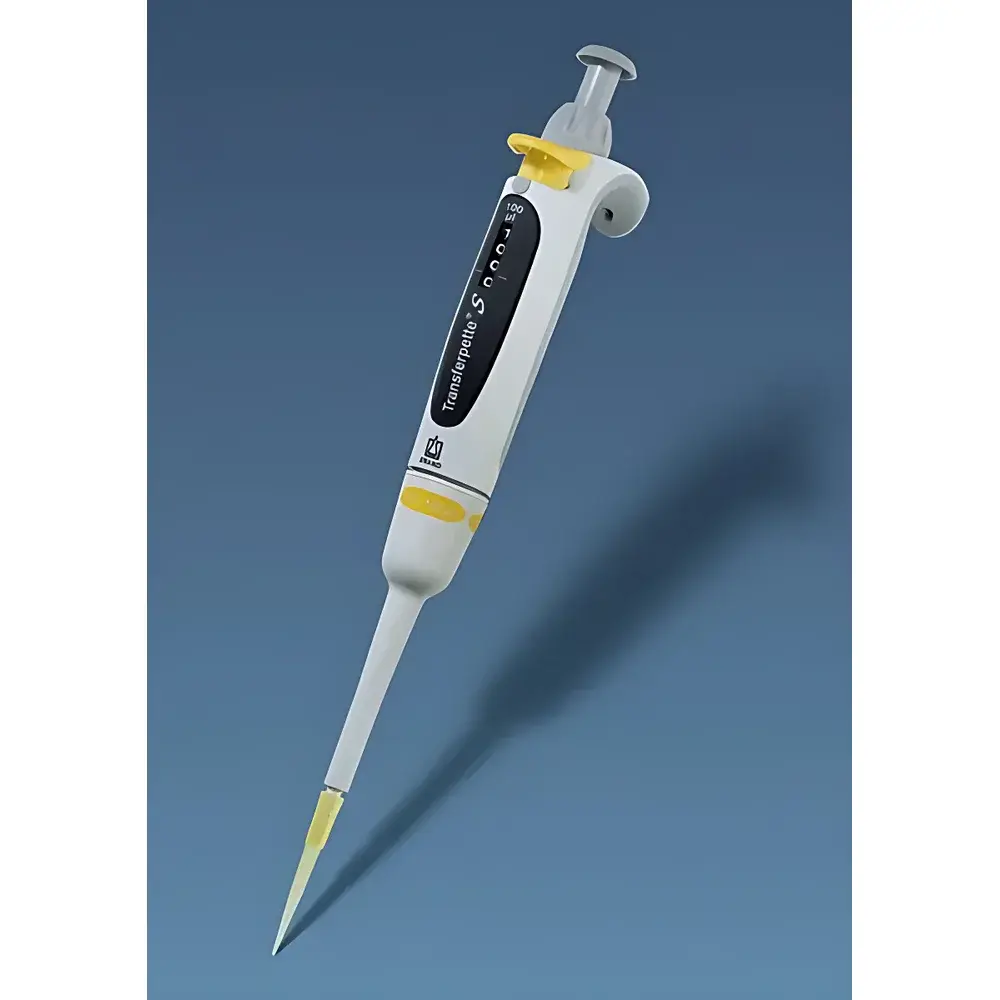
Brand Transferpette® S Adjustable-Volume Single-Channel Pipette, 0.1–1 µL
| Brand | BRAND |
|---|---|
| Origin | Germany |
| Model | 704768 |
| Type | Manual Single-Channel Pipette |
| Volume Range | 0.1–1 µL |
| Maximum Capacity | 1 µL |
| Accuracy | ±0.02 µL |
| Sterilization | Autoclavable at 121 °C / 2 bar |
| Display | 4-digit digital |
| Calibration | Easy Calibration™ (tool-free) |
| Ergonomics | Dual-hand volume adjustment, integrated tip ejection, ergonomic finger rests |
| Compliance | CE-marked per IVD Directive 98/79/EC |
Overview
The Brand Transferpette® S Adjustable-Volume Single-Channel Pipette (Model 704768) is a precision-engineered air-displacement pipette designed for ultra-low-volume liquid handling in demanding life science applications. Operating on the well-established air piston principle, it delivers consistent volumetric delivery across its calibrated range of 0.1–1 µL—critical for molecular biology workflows including qPCR setup, CRISPR reagent dispensing, microarray spotting, and single-cell lysate transfer. Its all-metal upper body, chemically resistant piston assembly, and sealed internal mechanism ensure long-term dimensional stability and resistance to organic solvents and vapors. Unlike displacement pipettes or positive-displacement systems, the Transferpette® S maintains high reproducibility through rigorous factory calibration against gravimetric standards traceable to national metrology institutes, with performance validated per ISO 8655-2:2022 for pipette accuracy and ISO 8655-5:2022 for durability testing.
Key Features
- Ultra-fine resolution: 0.1 µL minimum adjustable increment with 4-digit digital display for unambiguous reading under laboratory lighting conditions.
- True one-handed operation: Volume adjustment is fully functional for both right- and left-handed users via a centrally located, low-torque dial; tip ejection is mechanically decoupled and actuated independently.
- Autoclavable integrity: Entire pipette—including shaft, piston, spring, and tip cone—can be sterilized at 121 °C / 2 bar for 20 minutes without seal degradation or calibration drift.
- Easy Calibration™ system: Field recalibration requires no disassembly or specialized tools; adjustment screw position is externally visible and documented, supporting GLP-compliant maintenance logs.
- Ergonomic risk mitigation: Short 12.5 mm plunger stroke reduces repetitive strain injury (RSI) potential during high-throughput operations; contoured finger rests provide stable grip orientation independent of hand size.
- Chemical resilience: Piston surface and tip ejector components are coated with PTFE-modified stainless steel to resist corrosion from ethanol, DMSO, and common buffer constituents.
Sample Compatibility & Compliance
The Transferpette® S is compatible with universal conical polypropylene tips meeting ISO 8655-3:2022 dimensional tolerances. It handles aqueous solutions, viscous glycerol-based reagents (up to 50% v/v), and low-volatility solvents without measurable carryover or hysteresis. All units bear the CE marking under Directive 98/79/EC for in vitro diagnostic medical devices, confirming conformity with essential safety and performance requirements. The device supports audit readiness for ISO/IEC 17025-accredited laboratories and aligns with FDA 21 CFR Part 11 data integrity expectations when paired with calibrated electronic logbooks for calibration events.
Software & Data Management
As a manually operated instrument, the Transferpette® S does not incorporate embedded electronics or connectivity features. However, its Easy Calibration™ design enables seamless integration into laboratory quality management systems: each recalibration event is physically recorded via engraved reference marks on the calibration screw housing, allowing direct correlation with paper-based or LIMS-tracked maintenance records. Users may document calibration dates, operator ID, and pre/post-adjustment verification results using standardized forms compliant with ISO/IEC 17025 clause 6.4.3 (Equipment Records).
Applications
- Quantitative nucleic acid dilution series for digital PCR and NGS library normalization
- Precision dispensing of restriction enzyme cocktails into 384-well plates
- Transfer of picoliter-scale cell culture supernatants for cytokine profiling
- Preparation of calibration standards for LC-MS/MS bioanalysis
- High-sensitivity ELISA plate coating with biotinylated antibodies
- Microfluidic device priming and channel filling under laminar flow control
FAQ
Is this pipette suitable for handling corrosive acids such as concentrated HCl?
No. While the piston and tip ejector exhibit resistance to alcohols and mild buffers, exposure to strong mineral acids or halogenated solvents exceeds material compatibility limits and may compromise seal integrity.
Can the pipette be calibrated in-house without external certification?
Yes—Easy Calibration™ permits user-performed adjustments using only a standard analytical balance and certified water, provided the procedure follows Brand’s published SOP TR-S-002 Rev. 4 and is documented per institutional QA requirements.
Does the 0.1–1 µL range include linearity verification at the lower limit?
Yes. Each unit undergoes full-range gravimetric verification at 0.1 µL, 0.5 µL, and 1.0 µL during final QC, with results traceable to PTB (Physikalisch-Technische Bundesanstalt) reference standards.
What tip types are recommended for optimal accuracy at 0.1 µL?
Use low-retention, filtered tips rated for sub-microliter volumes (e.g., BRAND PhysioTip® or Eppendorf LoBind®), pre-rinsed with target solution to minimize surface adsorption effects.
How often should recalibration be performed under routine use?
Brand recommends verification every 3 months for daily use; frequency increases to monthly under continuous high-throughput conditions or after autoclaving >50 cycles.



