
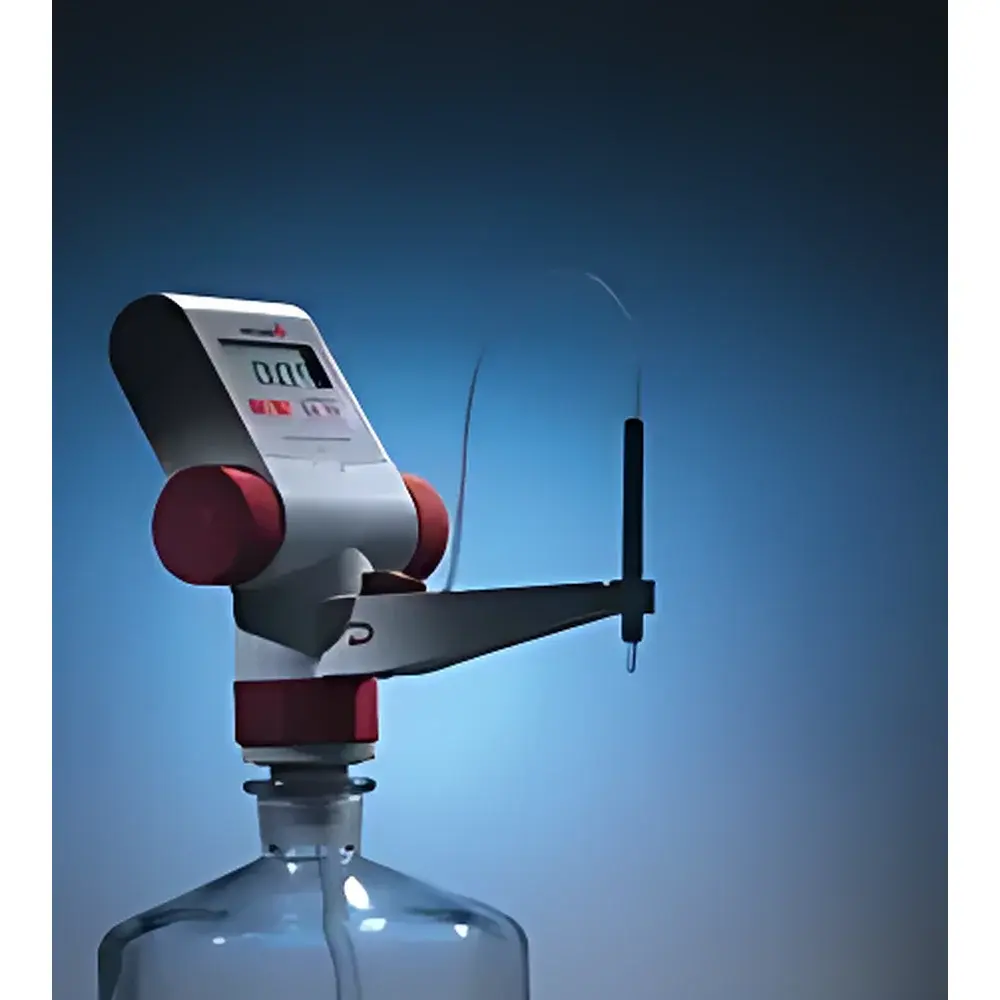
VITLAB Continuous E / RS Digital Burette
| Brand | VITLAB |
|---|---|
| Origin | Germany |
| Model | Continuous E / RS |
| Minimum Display | 0.01 mL |
| Accuracy | ≤ ±0.2% (at 25 mL for 1620506 |
| Coefficient of Variation | ≤ 0.1% |
| Dispense per Full Revolution | 2.5 mL (1620506) / 5.0 mL (1620507) |
| Sterilizable | Yes (autoclavable after complete cleaning) |
| Material Contact Surface | Borosilicate glass, PTFE, ETFE, PFA, FEP, Pt–Ir alloy |
| Compliance | DIN EN ISO 8655-6, GLP-ready |
Overview
The VITLAB Continuous E and Continuous RS digital burettes are precision-engineered manual liquid dispensing instruments designed for high-accuracy titration and volumetric delivery in analytical, quality control, and research laboratories. Unlike traditional glass burettes requiring visual meniscus reading and manual calculation, or fully automated titration systems demanding infrastructure integration and software validation, the Continuous E/RS series bridges the gap with a compact, battery-powered, stand-alone solution grounded in proven piston-driven fluidics. Its core operating principle relies on a dual-piston, pulse-free metering mechanism—patented globally—that enables simultaneous filling and dispensing without pre-filling steps. This architecture eliminates dead volume, minimizes operator-induced variability, and ensures consistent volumetric performance across repeated deliveries. Engineered for traceability and regulatory alignment, the device supports GLP-compliant workflows through tool-free calibration per DIN EN ISO 8655-6, and its materials of construction meet stringent chemical resistance requirements for handling aggressive acids, bases, and organic solvents.
Key Features
- Dual-piston, pulse-free dispensing system: Enables continuous flow without interruption or pressure spikes—critical for stable endpoint detection in redox or precipitation titrations.
- Autoclavable design: All wetted components—including borosilicate glass barrel, PTFE/ETFE/PFA seals, and Pt–Ir alloy plunger tips—are compatible with steam sterilization (121 °C, 20 min) following full disassembly and cleaning per manufacturer instructions.
- 360° rotatable, tilt-adjustable display panel: Features large, high-contrast LCD showing real-time dispensed volume (0.01 mL resolution), cumulative total up to 999.9 mL, and direction indicator (fill/dispense).
- Multi-interface compatibility: Includes GL45/S40, GL45/38, and GL38/32 threaded adapters plus polypropylene universal connectors—ensuring secure, leak-free attachment to standard reagent bottles (e.g., 100 mL–2 L GL45 containers).
- Tool-free GLP calibration: Per DIN EN ISO 8655-6, users perform gravimetric calibration using certified weights and distilled water—no specialized tools or external software required.
- Ergonomic, cordless operation: Powered by two 1.5 V AA batteries (included); typical battery life exceeds 12 months under average lab usage (≈500 dispenses/day).
- Universal discharge tube orientation: The flexible 220–350 mm PTFE-coated delivery tube maintains label visibility regardless of bottle placement or workspace constraints.
Sample Compatibility & Compliance
The Continuous E/RS is validated for use with aqueous solutions, strong mineral acids (e.g., HCl, HNO₃, H₂SO₄ up to 70 wt%), alkalis (e.g., NaOH, KOH up to 50 wt%), and common organic solvents (e.g., acetone, methanol, acetonitrile). All fluid-contact surfaces comply with USP Class VI and FDA 21 CFR 177.1550 for repeated-use laboratory devices. The instrument’s metrological performance adheres to DIN EN ISO 8655-6 (burettes) and supports audit-ready documentation when used within GLP or GMP environments—particularly where electronic records must reflect calibration history, user ID, date/time stamps, and deviation logs (achieved via optional RS232 data export on the Continuous RS variant).
Software & Data Management
While the Continuous E operates as a standalone instrument, the Continuous RS model integrates an RS232 serial interface for direct connection to laboratory information management systems (LIMS) or PC-based data acquisition software. Raw volume data—including individual dispense events, cumulative totals, timestamps, and operator codes—can be exported in ASCII format for traceability and statistical process control (SPC) analysis. Both models store no internal firmware logs; however, their mechanical calibration stability and repeatable accuracy (<0.1% CV) ensure long-term data integrity without dependency on software validation—making them suitable for ISO/IEC 17025-accredited testing labs where hardware-based measurement assurance is prioritized.
Applications
- Standardization of titrants (e.g., NaOH, HCl, EDTA, KMnO₄) in QC/QA laboratories per ASTM E200 and ISO 6497.
- Pharmaceutical assay validation requiring precise acid–base or redox titrations under USP and EP 2.2.40.
- Environmental water analysis (e.g., COD, alkalinity, chloride) per APHA Standard Methods 2320B and EPA 150.1.
- Food & beverage testing (e.g., acidity, SO₂ content) compliant with AOAC 947.05 and ISO 750.
- Field-deployable titration in mobile labs or production line settings where AC power and network infrastructure are unavailable.
FAQ
Can the Continuous E/RS be calibrated in-house without external service?
Yes—calibration follows DIN EN ISO 8655-6 and requires only a certified analytical balance, distilled water, and ambient temperature control. No proprietary tools or software are needed.
Is the device suitable for viscous or particulate-containing solutions?
It is optimized for low-to-medium viscosity liquids (<500 mPa·s) free of suspended solids. Particulates may compromise seal integrity and require frequent maintenance.
What is the maximum recommended operating temperature for the wetted parts?
Borosilicate glass and fluoropolymer components are rated for continuous use up to 80 °C; autoclaving is limited to 121 °C for defined cycles only.
Does the Continuous RS support FDA 21 CFR Part 11 compliance?
The RS232 output enables integration into validated systems, but Part 11 compliance depends on the connected LIMS or data acquisition platform—not the burette itself.
How often should recalibration be performed?
Per GLP guidance, recalibrate before each analytical batch or daily if used continuously; additionally, after any physical impact, sterilization cycle, or change in ambient humidity >20% RH.



